
Tom Brady’s the latest superstar to end a career in the wrong uniform
Sometimes, these end-of-career dalliances work out, but usually not.
When Tom Brady announced on Tuesday morning that his “football journey will take place elsewhere,” the reaction was swift. It was the rare shocking story that was also easy to see coming, and that was reflected in the response, be it from fans, pundits, peers, or now-former New England Patriots teammates.
Much like with Mookie Betts’s departure for Los Angeles, even those who agree with the decision will likely find it tough to see the 42-year-old in other colors — reportedly those of the Tampa Bay Buccaneers, though exactly what that entails is up in the air given Tampa’s scheduled to unveil new uniforms next month.
Whatever Brady wears, it will immediately go alongside Johnny Unitas with the L.A. Chargers, Joe Namath with the L.A. Rams, Joe Montana with the Chiefs, Peyton Manning with the Broncos, Bobby Orr with the Blackhawks, Dwight Evans with the Orioles … history’s rife with players who built legendary careers one place and inexplicably finished somewhere else, but what the GOAT is about to do is rarer than you might think.
Brady was just the fifth player in NFL history to play the first 20 seasons of his career for one team, and he’ll be the first not to simply retire there. Across the four major North American sports, it’s only happened 12 times, with the only non-Hall of Famer in the bunch still active. With a hat tip to Twitter user @JTthePodGuy, a look back at that dozen as we try to make sense of something that won’t feel real for a while yet.
Ty Cobb
Career:
22 years with MLB’s Detroit Tigers (1905-26), two with Philadelphia A’s (1927-28)
When he switched: 1927, at age 41
How it ended: Fine. Cobb batted .343, though that was well off his career average.

Ty Cobb, during his time in Philadelphia.
An immortal among the immortals, Cobb won 12 batting titles in a 24-year career, his hit total — 4,189, though MLB credits him with 4,191 — remained a record until Pete Rose broke it in 1985, and his .366 career average will never be touched. (Tony Gwynn, the gold standard of modern hitters, finished at .338.)
A ruthless competitor driven by the loss of his father, Cobb’s 22-year run with the Tigers included being their player/manager for the final six. That ended suddenly on Nov. 3, 1926, when Cobb resigned his post and retired as a player, declaring “I wanted to quit while I was still up among the best.”
It wasn’t the whole story. Cobb was about to implicated in a gambling scandal eventually known as the Leonard Affair, in which both he and Tris Speaker — a Red Sox for the first nine years of his Hall of Fame career — were accused of fixing and betting on a game between Cobb’s Tigers and Speaker’s Cleveland Indians at the end of the 1919 season, when both teams had little to play for.
Ultimately, both were exonerated, and the 41-year-old Cobb immediately announced he was returning to the game. Two weeks later, he signed with the Philadelphia A’s for $60,000 — the largest salary ever paid a baseball player, blared headlines across the country. He collected his 4,000th hit in his first of two years there, Connie Mack’s team twice finishing second.
Warren Spahn
Career:
20 years with MLB’s Boston (1942-52) and Milwaukee (1953-64) Braves, one with N.Y. Mets and San Francisco (1965)
When he switched: 1964, at age 43
How it ended: Badly. Spahn went 7-16 with a 4.01 ERA, released midway through his final season.

Both Warren Spahn and Willie Mays, shown in 1965, would end their careers in unexpected uniforms.
Spahn is the first of several Braves on this list, as well as one of many to remain with a franchise through a move. He established himself as a star in Boston, winning at least 21 games four times during the largely also-ran franchise’s final six years at what’s today BU’s Nickerson Field, then a career-best 23 in their Milwaukee debut in 1953. He retired with 363 victories, fifth all-time and tops among lefties, and a 3.09 ERA, though that latter number would’ve been below 3.00 had he quit after a 23-7 campaign at age 42 in 1963.
Alas, he didn’t. He flopped to a 5.29 ERA and was pulled from the Braves starting rotation in 1964, after which the Mets — losers of 120 and 111 games in each of their first two seasons — bought his contract to be both a pitcher and a coach. They released him in July, after Spahn lost eight straight games to fall to 4-12, and he pitched the final 16 games of his career for second-place San Francisco.
“I didn’t retire from baseball,” he said. “Baseball retired me.”
Willie Mays
Career:
21 years with MLB’s New York (1951-57) and San Francisco (1958-72) Giants, one-and-a-half with N.Y. Mets (1972-73)
When he switched: 1972, at age 41
How it ended: Badly. Mays hit just .238 in 135 games with the Mets, plus three singles in 10 postseason at-bats in 1973.
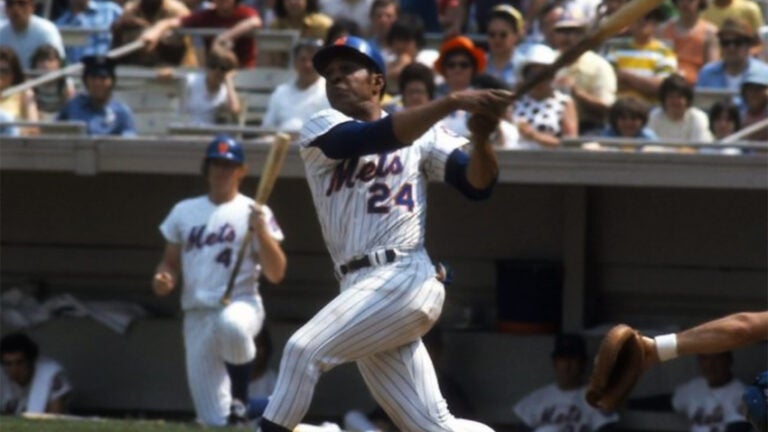
One of the all-time greats, Mays won his second MVP in 1965, capping a four-year home run binge with 52 as a 34-year-old, but was still a force as a 40-year-old in 1971, posting a .425 on-base with 112 walks. The Giants were desperate for pitching in 1972, however — see their acquisition of Spahn — and sent Mays home on May 11, capping years of New York efforts to trade for him.

The Mets traded for Willie Mays on May 11, 1972, the same day the Bruins finished off the Rangers in the Stanley Cup at Madison Square Garden.
Mays was batting .184 for the season at the time of the trade, and though he was better back on the East Coast, cracking the game-winning homer to beat the Giants in his debut, he hit just .250 with 8 home runs — his worst since a 34-game stint as a 21-year-old in 1952.
Believing he had one last season left was a mistake almost from the jump; a crippled Mays was hitting below .100 into mid-June. He privately told the team he would retire at season’s end, which the Mets announced in September as they roared to a shock division title. Though he finished his career in a seven-game World Series loss to Oakland, winning Game 2 with a 12th-inning single, the images of him misplaying fly balls and stumbling on the bases are usually Exhibit A when a superstar sticks around too long.
Gordie Howe
Career:
25 years with NHL’s Detroit Red Wings (1946-71), four with WHA’s (1973-1977) Houston Aeros, three with WHA’s (1977-79) and NHL’s (1979-80) Whalers
When he switched: 1973, at age 45
How it ended: Exemplary. Howe scored 30 goals in four of his six WHA seasons, then played 80 games as a 51-year-old back in the NHL.
Howe’s career already defied succinct description in 1973, when he had four Stanley Cups, six scoring titles, and 21 All-Star appearances from a quarter century with the Red Wings. So it can be easy to forget his signing with the Houston franchise of the upstart WHA in June 1973 reeked of a publicity stunt. Howe was an executive and already in the Hockey Hall of Fame then, retiring with a wrist injury after he mustered only 52 points in 63 games during the 1970-71 season, but he was being given seven figures a year and — importantly — the opportunity to play alongside his sons, 19-year-old Marty and 18-year-old Mark, whom Houston signed weeks before.
That was gone by the end of the 1973-74 season, in which Gordie had 31 goals and 100 points, leading Houston to the league title as WHA MVP. (Mark won Rookie of the Year.) Howe played out his four-year contract, winning another title in 1974-75, signed another (alongside his sons) with the New England/Hartford Whalers in May 1977, and stuck around long enough to play in Hartford’s debut NHL season in 1979-80.
Hank Aaron
Career:
21 years with the MLB’s Milwaukee (1954-65) and Atlanta (1966-74) Braves, two with the Milwaukee Brewers (1975-76)
When he switched: 1974, at age 40
How it ended: Uninspiring. Aaron’s final two seasons boosted his record numbers, but he was essentially a replacement-level player.

With the Milwaukee Braves for 12 seasons, seeing Hank Aaron with the Milwaukee Brewers wasn’t all that odd.
Aaron broke Babe Ruth’s home run record with his 715th on April 8, 1974, Atlanta’s fourth game of the season. By year’s end, he sat at 733, with a slew of other all-time marks in his pocket as well — more than 3,000 games, 6,601 total bases, 1,429 extra-base hits, 15 100-run seasons, 15 30-homer seasons, and 19 straight 20-homer seasons, just to name a few. It was the sort of career that earns a certain respect, and Aaron made no secret how he wanted to play his credit.
“If they said to me, ‘Hank, you can make your own deal,'” Aaron said after the season, referring to the Braves franchise that had held his rights since signing him out of the Negro Leagues in 1952, “then I would try to work something out with the Brewers. … I don’t want to go any other place but Milwaukee.”
Aaron played his first 12 seasons in Milwaukee, striking up a close friendship with future Brewers owner (and MLB commissioner) Bud Selig. On Nov. 2, the Braves obliged Aaron, trading him to Selig’s Brewers for one-time All-Star Dave May. Used almost exclusively at designated hitter, he was an American League All-Star in 1975, but that was largely a career-achievement award. Aaron hit just .232 in 222 games with the Brewers, cracking the last 22 home runs of his 23-year career.
Harmon Killebrew
Career:
21 years with MLB’s Washington Senators (1954-60) and Minnesota Twins (1961-74), one with Kansas City (1975)
When he switched: 1975, at age 39
How it ended: Very forgettably.

Killebrew went out with a whimper.
Aaron, Mays, and Frank Robinson all finished their careers with more home runs, but none could hold a candle to “The Killer” in the 1960s, when he cracked 393, topping 40 homers six times and living up to the quip of former Orioles manager Paul Richards that, “Killebrew can knock the ball out of any park, including Yellowstone.” (His 522-foot blast in June 1967 remains legendary in Minnesota, much like Ted Williams’s “red seat” blast at Fenway.)
Killebrew was the 1969 American League MVP, collecting 49 homers and 140 RBIs as the Twins made the inaugural AL Championship Series, but faded to 28 homers in 1971, then just 13 while hitting .222 as a 38-year-old in 1974. Reportedly offered a 50 percent pay cut for 1975 and little more than the chance to pinch hit, Killebrew balked, and the Twins allowed him to sign with the Kansas City Royals.
The highlight of his year was Minnesota retiring his No. 3 before the teams played on May 4; Killebrew homered that day, his fifth in his first 20 Royals games. Things spiraled down quickly, Killebrew finishing with 14 and a .199/.317/.375 batting line.
Phil Niekro
Career:
20 years with MLB’s Milwaukee (1964-65) and Atlanta (1966-1983) Braves, four with four teams (1984-87)
When he switched: 1984, at age 44
How it ended: Celebrated. Niekro was a league-average pitcher his final four years, but threw 2 shutouts, 19 complete games, and made 122 starts.
The greatest knuckleballer of all time, 121 of Niekro’s 318 career wins came after he turned 40, a record. Unlike many pitchers who come to the knuckler as a late-career savior, Niekro learned from his father as a kid and utilized it throughout. (Some trivia: Niekro grew up near the Ohio/West Virginia border across the street from John Havlicek; the two Hall of Famers were lifelong friends, and Niekro eulogized Havlicek at his funeral last summer.)
As a 43-year-old in 1982, Niekro went 17-4 with a 3.61 ERA, Atlanta making its lone playoff appearance for a stretch of more than two decades. Fading to .500 a year later, however, the Braves released him. There was a bidding war for the majors’ oldest player, who chose the Yankees in January 1984. Niekro made 64 starts in two seasons, throwing 12 complete games, before jumping to Cleveland in 1986, then splitting the 1987 season between the Indians, Toronto (who acquired him while in first place in August), and Atlanta (with whom he made a farewell three-inning appearance on Sept. 27 at age 48).
Ray Bourque
Career:
21 years with NHL’s Boston Bruins (1979-2000), one and a half with Colorado (2000-01)
When he switched: 2000, at age 39
How it ended: Exactly as everyone hoped, with Bourque winning the Stanley Cup, then retiring.

Ray Bourque’s 22nd and final NHL season ended with a celebration.
We needn’t go real deep into this story given this audience, but in brief: The best player on a bad Bruins team, rumors began to circulate in early 2000 — during Bourque’s 21st season, and the 18th in a row he was an All-Star — that he sought to go elsewhere in a late-career effort to win the Stanley Cup that had eluded him. Unlike prior years, this roar had teeth, and on March 6, the Bruins sent Bourque and forward Dave Andreychuk to the Colorado Avalanche for Brian Rolston, Martin Grenier, Sami Pahlsson, and a future No. 1 draft pick.
Colorado lost Game 7 of the Western Conference final that year to Dallas, Bourque ringing the post with a potential game-tying goal in the final seconds, but he signed a free-agent deal with the Avs for one more run in 2000-01. That one paid off: He nearly won a sixth Norris Trophy as the league’s top defenseman, scored the game-winning goal in Game 3 of the Stanley Cup Finals, and skated the Cup at the behest of team captain Joe Sakic after Colorado rolled in Game 7.
John Smoltz
Career:
20 years with MLB’s Atlanta Braves (1988-2008), one with Red Sox and St. Louis (2009)
When he switched: 2009, at age 41
How it ended: Oof. Smoltz had a 6.35 ERA in 15 starts across two teams, Boston dumping him in August.

Smoltz’s 2009 Red Sox won in his former home of Atlanta, but they rarely did when he pitched.
Smoltz gets a bit of an asterisk, a Detroit draftee who spent a season and a half in their system before going to Atlanta for Doyle Alexander in one of the howler trades of all time. He was part of one of the great starting trios ever with Tom Glavine and Greg Maddux, won a Cy Young as a starter in 1996, became a shutdown closer in the 2000s after Tommy John surgery, and rolled into the Hall of Fame on his first ballot in 2015.
His 2009 is not mentioned therein.
Smoltz had season-ending shoulder surgery in June 2008, declaring “I’ve pulled off a lot of miracles” and committing to try one last comeback the following season. Atlanta wasn’t much interested, and the 41-year-old ended up with the Red Sox, who signed him with hopes he could, in Theo Epstein’s words, “dominate at the most important times of the year.” To that end, Boston made no secret Smoltz wouldn’t pitch until midseason, content to let him fully recover.
He made his initial start June 25 in Washington, and it was the first of six in which he’d allowed at least five runs. The night after his last, with a 2-5 record and 8.33 ERA on Aug. 7, the Sox designated him for assignment. Unable to find a trade partner, they released him; he was better in a final seven starts for St. Louis, pitching relief in their Division Series loss to the Dodgers before beginning his broadcasting career in 2010.
Mike Modano (2010)
Career:
20 years with NHL’s Minnesota North Stars (1989-1993) and Dallas Stars (1993-2010), one with Detroit (2010-11)
When he switched: 2010, at age 40
How it ended: Badly. Missed three months due to injury, was a healthy scratch most of the playoffs, and posted the worst numbers of his career.
Congrats, Mike Modano! #NHL100 #LGRW pic.twitter.com/bqvfDVPSdl
— Detroit Red Wings (@DetroitRedWings) January 28, 2017
The top-scoring American player in NHL history, Modano is a hockey icon in two states: Minnesota, where he became the face of the North Stars franchise in its final years before its shocking move south, and Texas, where his 16 seasons of exemplary play — he scored 50 goals in Dallas’s debut season in 1993-94, and was the top scorer on their Stanley Cup winner in 1998-99 — helped establish the sport in the market.
Alas, by 2009-10, he was a faded star, with just 14 goals and 30 points in 59 games for a fifth-place team. After the season, Dallas GM Joe Nieuwendyk — the Conn Smythe winner as playoff MVP on those 1998-99 Cup champions — didn’t offer Modano a contract, seeking to make his team younger. Modano, openly expressing his disappointment, sought to play on, and found a home back in his home state of Michigan with the Red Wings.
He played just 40 games thanks largely to severing a tendon in his wrist and had a mere 15 points, averaging less than 13 minutes per game. Despite a reported offer to come back with Vancouver, Modano — sitting on 1,499 regular-season games played after Wings coach Mike Babcock made him a healthy scratch to begin the final week of 2010-11 — retired.
His foundation’s web site doesn’t even list his Detroit season on his career stats page.
Martin Brodeur
Career:
21 years with NHL’s New Jersey Devils (1991-2014), one with St. Louis (2014-15)
When he switched: 2014, at age 42
How it ended: A short-term fill-in, Brodeur had an .899 save percentage and went 3-3. His final season was just a month.

Martin Brodeur eked out seven games for St. Louis in the 2014-15 season.
Brodeur’s long career has him in possession of most of the notable NHL goaltending records — he’s tops in wins (691), losses (397), and games (1,266) — in addition to three Stanley Cups, four Vezina Trophies as the league’s top netminder, and a pair of gold medals with Canada. He is likely still the most recognizable New Jersey Devils player, given car rental company Enterprise still has him in commercials like he’s an active player.
In fact, he hasn’t played a game in more than five years. And the last seven he played weren’t for the Devils.
In November 2014, St. Louis lost goalie Brian Elliott to a knee injury, and invited the free-agent Brodeur for a tryout. He signed a one-year contract on Dec. 2, and while he did register a 16-save shutout on Dec. 29 against Colorado, he retired at the end of January, spending the next three years in the Blues front office before jumping to a business development job with the Devils in 2018.
Patrick Marleau
Career:
19 seasons with NHL’s San Jose Sharks (1997-2017), two with Toronto (2017-19), 2019-20 with San Jose and Pittsburgh
When he switched: 2017, at age 37
The only active player on this list, Marleau spent 20 years with San Jose counting the 2004-05 NHL season lost to the lockout. The No. 2 overall pick in 1997 holds San Jose’s records for career goals, points, and games, and has two gold medals for Team Canada despite being best known as the player with the most games played — 1,914, including playoffs — without winning the Stanley Cup. (His longtime teammate Joe Thornton, drafted No. 1 by the Bruins in that same 1997 draft, is at 1,815 games.)
Marleau’s now departed San Jose twice. First, he signed a three-year free-agent deal with Toronto in the summer of 2017, eager the join the young core of Auston Matthews, Mitch Marner, and William Nylander. After 43 goals in two seasons, Toronto dealt him to Carolina for salary-cap space; the Hurricanes bought him out, and he returned to the Sharks only to be traded to Pittsburgh last month with San Jose’s season going nowhere.



To comment, please create a screen name in your profile
To comment, please verify your email address
Conversation
This discussion has ended. Please join elsewhere on Boston.com