There was no such thing as a game too big for Ty Law
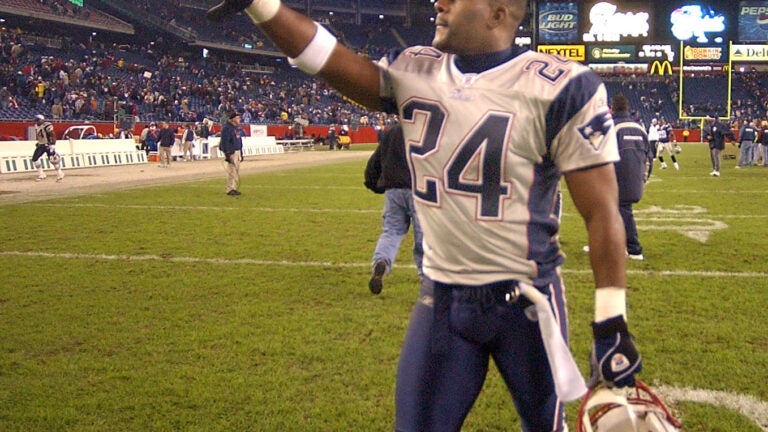
As tempting as it may be to hyperbolize one of my favorite Patriots on the day of his Pro Football Hall of Fame induction, I can’t go so far as to say Ty Law is the best cornerback in NFL history.
I mean, I’ll listen with attentive ear drums if you want to make that case. But the best corner in NFL history — and in Patriots history, now that you mention it — remains Mike Haynes, who was Deion Sanders with a willingness to tackle and without a taxi squad of publicists.
Haynes preceded Law as a Patriot by 19 years (he was drafted in 1976) and preceded him into Canton by 22 (he was a 1997 recipient of the mustard-colored jacket and bronze bust of vague likeness).
There is a superlative that belongs solely to Law, however, and it may be one that carries even more prestige than being the best player ever at the position:
There is no other cornerback in NFL history that came through more often in the biggest moments against the biggest names, no other cornerback who could lock down and rough up the hot-shot finesse receiver and bait and torment the golden boy quarterback while embracing the pressure of playing a position in which one mistake can lead to a highlight never to be lived down.
Ty Law is the greatest big-game cornerback in NFL history, and that is a remarkable thing to be.
His greatest highlights have been shown all week on the NFL Network and our local Patriots programming in anticipation of Saturday’s induction ceremony. As enjoyable as it is to see them again, it’s not as if the reminder is required. His three-interception masterpiece against Peyton Manning and the Colts in the 2003 AFC Championship Game — one that led Manning to later quip that he should be the one to introduce Law during his Hall of Fame induction — is never that far from mind.
But his greatest play came in Super Bowl XXXVI against the Rams — the first one when the team was still in St. Louis — when he picked off a deflected Kurt Warner pass and took it 47 yards for a touchdown. That was the sign, the confirming moment, when it became clear that the underdog Patriots truly had a shot against the Greatest Show on Turf Rams. Law jumped the route, and in a sense jump-started what would become the NFL’s most unexpected and enduring dynasty.
Of course, Law’s tone-setting pick wasn’t his lone contribution that day. Along with fellow defensive backs Lawyer Milloy, Otis Smith, and Tebucky Jones, Law pummeled the soft-shell Rams receivers whenever the opportunity presented itself, and not always within the boundaries of the football field or the rules. It was a brilliant game plan executed by a special and determined group of players. Law was the greatest among them, but they should all be remembered well for what they did that day.
Law played 15 season in the NFL, the first 10 with the Patriots after being drafted No. 23 overall in the 1995 NFL Draft. The Globe story the day after his selection is informative — and amusing — for a couple of reasons. The big knock on Law by scouts was that they weren’t sure he could play man-to-man coverage because Michigan favored a zone.
“It did kind of get to me for a minute what some of the scouts said,’’ said Law, who of course ended up being a superb man-to-man cover corner, his physicality having a direct effect on a rule change regarding what pass defenders can get away with. “But I was the best cover man in college.’’
So, yeah, he showed up in New England with that confidence intact. Also of note in the post-draft story is coach Bill Parcells’s candor that the Patriots would have had a decision to make had Michigan running back Tyrone Wheatley made it past the Giants at No. 17. “At that point [once Wheatley was gone], there wasn’t really anyone else we considered,’’ said Parcells, who clearly had the final say on the grocery list then.
He said they had a chance to move up to No. 19 – presumably for running back James Stewart, who went to the Jaguars – but never seriously considered it. “It would have cost us a three and I decided not to do it,’’ said Parcells. Good thing. That third-round pick was spent on Curtis Martin.
Law thrived under Parcells and had one phenomenal year under his successor, Pete Carroll, finishing tied for third behind Reggie White in the 1998 Defensive Player of the Year voting after intercepting nine passes. But Law, like other Patriots who starred for Parcells and Bill Belichick but took advantage of Carroll’s lack of discipline to their detriment, became a magnet for yellow flags in those regressive Carroll seasons.
His competitiveness, versatility, smarts, and confidence made him a perfect fit under Belichick, but they weren’t always copacetic, especially at the end of his run as a Patriot in 2004.
Law was a company man, but that company was Tajuan E. Law Inc. It was his right, of course, especially in a short-shelf-life sport that threatens a brutal toll on all that play it. That bet-on-myself brashness, which manifested itself in those spectacular big-game performances, was part of his charm.
Law wasn’t so much about the Patriot Way — which, let’s admit it, asks the players to sacrifice individuality and often money for the greater good, something management does not have to do — as he was about what we could call Ty’s Law, which would go something like this: ‘I’m great, I know I’m great, and if you’re not going to pay me, I’ll go be great for a lot of money elsewhere.’
He joined the Jets in ’05 and intercepted 10 passes, including one he took 74 yards for a touchdown against the Patriots and Brady that December. (I suspect the greatest NFL Films audio of all time would be if Law and Brady were miked up during their most competitive practices during the first phase of the dynasty.) He moved on to play for the Chiefs, Broncos, and Jets again, but never did return to the Patriots.
I wish he’d played his whole career here. But in retrospect, that was never going to happen, with his rightful desire to maximize his earnings and Belichick’s unsentimental roster-building practicality.
But that’s OK. He’s remembered foremost as a Patriot today, as he takes his place among the game’s legends. And he’ll be remembered as a Patriot always, because in big game after big game at the advent of a dynasty, Ty Law’s own legend was built.