5 things we learned from Robert Kraft’s talk at Goldman Sachs
Picking his favorite Super Bowl is, unsurprisingly, a difficult exercise.
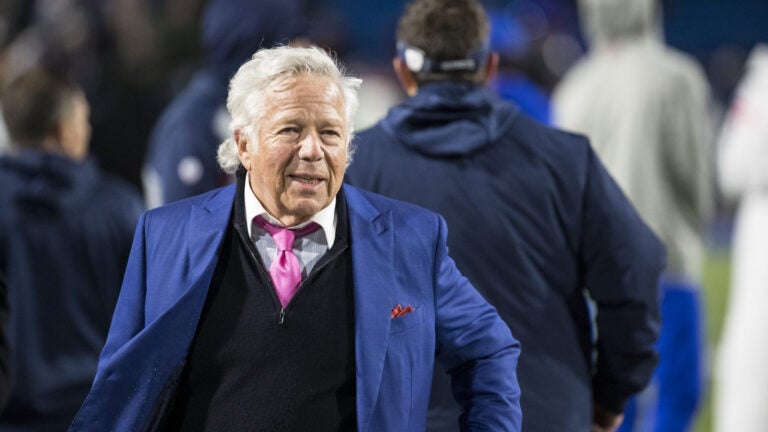
Patriots owner Robert Kraft recently paid a visit to Goldman Sachs’ Manhattan headquarters as a guest speaker for the company’s “Talks at GS” series. The 77-year-old spoke with chairman of public sector and infrastructure Greg Carey for 25 minutes or so, touching on several topics relating to his career as a businessman.
“I’m not used to hearing applause when I come to New York and we’re playing the Jets or the Giants,” Kraft said upon walking onto the stage. “So thank you.”
Here’s what we learned from the talk:
Listening to his parents argue about money inspired his entrepreneurial spirit.
Growing up in Brookline, Kraft said his family had “modest financial means.” He attended both college and graduate school with the help of scholarships and didn’t have a car until he was 25 years old. Still, Kraft said he benefitted from having “a great foundation” — largely in part due to his mother and father.
“I had two great parents, which is like winning the lottery,” Kraft said. “We had great love in our family. It was rich in spirituality and love.”
The only arguments Kraft said he overheard pertained to money.
“At a young age, that sort of said to me, if I could find a way to be financially independent, it really planted seeds with me to want to do that,” he said. “They had such a great relationship, but it always seemed like money was an issue.”
His best decisions were based on instinct.
When he bought the Patriots in 1994, Kraft said he tried to learn the ins and outs of the sport, which he referred to as “nuclear science.” When the team drafted quarterback Tom Brady 199th overall in the 2000 NFL Draft, however, Kraft said he recognized not everything can be explained by “the gurus.”
“The best decisions I’ve made in my life are from instinct,” he said. “They don’t teach it in Harvard Business School. When something feels right to you, even if other people can’t understand it, if it feels right for you, you go with it and lead with it and stay with it. Don’t be afraid to take big risks as long as your instinct is there. And then if you do, and it doesn’t work out, keep coming back like the tide.”
Other factors Kraft noted that have contributed to the New England’s success are its continuity — Brady and coach Bill Belichick have been in town for nearly two decades — connecting with people beyond transactional exchanges, and maintaining those relationships. Kraft acknowledged there are challenges that come with extended continuity, as he has in the past, but said he is resistant to changing things unless he has “something better” ready as a replacement.
“I have friends who don’t operate that way,” he said. “Especially in public companies where they have the 90-day report card.”
Picking his favorite Super Bowl is, unsurprisingly, a difficult exercise.
While reflecting on the Patriots’ five Super Bowl titles, Kraft was sure to mention something special about each championship. Super Bowl XXXVI holds a particular soft spot in Kraft’s heart because not only was it the franchise’s first, but it also happened following a national tragedy.
“We weren’t the best team in terms of the players we had, but we were the best team in terms of the connection,” Kraft said. “[Winning] after what happened with 9/11 — we’re called the Patriots, [and] we wear red, white, and blue — I think our team represented the resilience and mental toughness of people in the country.”
While Kraft sort of glazed over Super Bowls XXXVIII and XXXIX — calling them notable because they were back-to-back and both decided by three points — he expounded on Super Bowl XLIX. After a decade-long drought where Kraft thought a title “might never happen again,” former Patriots cornerback Malcolm Butler intercepted Seattle Seahawks quarterback Russell Wilson with under 30 seconds remaining to preserve New England’s 28-24 win.
“We have a guy who’s working at Popeye’s making $8 an hour and he leaves the job and comes and joins us, and he makes a play at the end of the game,” Kraft said. “Seattle’s right on the goal line, they throw a pass, he intercepts it. That was unbelievable.”
Of course, the incredible comeback Super Bowl LI was not left out.
“Each one is like children,” Kraft said. “Keep having them.”
He has high hopes for soccer.
Kraft, who also owns the New England Revolution and is the honorary chairman of the 2026 World Cup committee, said he expects big things from soccer in the future.
“I really believe in 10 years that that will become the No. 2 sport in America,” he said.
The Revolution recently broke ground on a $35 million training facility in Foxborough, and Kraft, who has been working with Goldman Sachs to privately finance a soccer stadium in “the heart of Boston,” expressed optimism the larger project as well.
The best advice he ever received came from his father.
The historical figure Kraft would like to have met is Mahatma Gandhi.
“In today’s world especially, all of us need to build bridges and bring people together,” he said. “I think [Gandhi] was a genuine, respectful man of peace.”
The greatest man of his lifetime, however, is none other than his father, Harry Kraft, whom he credits for giving him the best advice he’s ever received.
“When you go to bed at night, make sure the people you touch that day are riching for having known you,” Kraft relayed.
https://www.youtube.com/watch?v=CkTPCU8OIG0&app=desktop