Did the Patriots avert disaster by not trading up?
Trading up to get the second overall pick has a mixed history.
Of all the trades Bill Belichick orchestrated during the 2018 NFL draft, the most intriguing may have been the one he didn’t end up making.
In a post-draft interview on Andrew Brandt’s podcast, player agent Jack Mills claimed the Patriots were the “surprise” team trying to trade up to land the Giants’ pick (second overall) in order to draft his client, Baker Mayfield.
“We had another team, which is going to surprise you,” Mills said on “The Business of Sports With Andrew Brandt.” “Another team had said, ‘You may get a big surprise on draft day, at No. 2, if he’s available.’ And it was the Patriots. They had (pick No.) 23 and they had (No.) 31 and they had two seconds. We thought, ‘That’s gonna be a heck of a move, to get up that high from where they are.’ And, of course, he wasn’t available, so we never knew if that was a reality or not.”
Mayfield was selected first overall by the Cleveland Browns, so it ended up being one of the great “what ifs?” of the draft. Mills’s story, regardless of its veracity, at least begs the question: Would it have been worth it for the Patriots to trade up to get the second pick?
Setting aside the particular example of Mayfield, the historical results of trading for the second pick have been debatable.
Since the NFL merger in 1970, the second pick has been traded 16 times.
The Cowboys harnessed this as a strategy during the heyday of Tom Landry’s tenure in the 1970s as a means to cherry pick the best talent. Hall of Famers Randy White and Tony Dorsett were both taken second by Dallas (1975 and 1977) after being acquired via trade.
In the last 20 years, there are five examples.
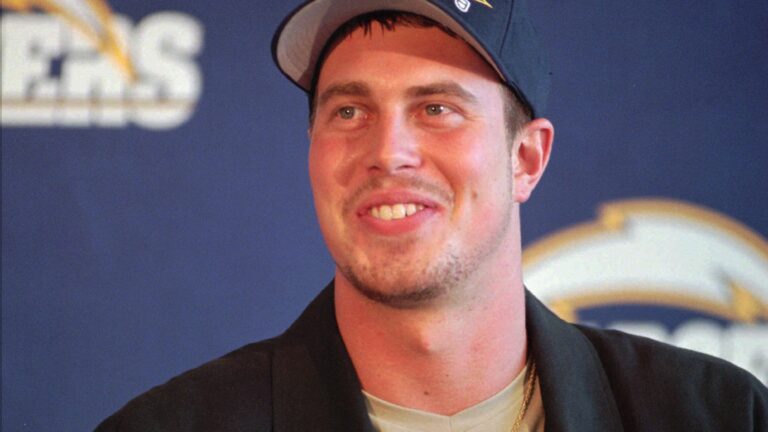
Ryan Leaf, 1998
A fascinating historical footnote: From 1994-2000, the Chargers made only one first-round draft selection. It was none other than Ryan Leaf.
Holding the third pick in the talent-laden 1998 draft, San Diego desired the ability to land either Peyton Manning or Leaf. That meant moving up one pick, but the Cardinals – who held the second pick – drove a hard bargain.
The two teams swapped picks, with the Cardinals also getting the Chargers’ second-round pick, a first-rounder in 1999, Pro Bowl kick returner Eric Metcalf and linebacker Patrick Sapp.
“I think the consensus of opinion is that two guys like (Manning and Leaf) don’t come along very often,” Charger General Manager Bobby Beathard told the Associated Press. “If we’re going to be successful in getting that type of quarterback, we’re going to have to give up something, and we really did.”
Unfortunately for the Chargers, the heavy gamble to move up one pick failed to a historic degree. Leaf proved woefully incapable of carrying the franchise quarterback mantle, especially in comparison to Manning.
The Cardinals, to be fair, didn’t exactly thrive with their picks either. Third overall pick Andre Wadsworth lasted only three seasons in the NFL due to injuries, and wide receiver David Boston – while posting impressive years in 2000 and 2001 – played only six seasons after being taken eighth overall in 1999.
LaVar Arrington, 2000
On the first day of the 1999 draft, Saints head coach Mike Ditka made one of the boldest trades in NFL history.
Deciding that his team needed only one player in the entire draft, Ditka traded all of his picks in the 1999, plus a first-and-third rounder in 2000 to Washington in exchange to move up from 12th to fifth pick. The Saints took Heisman Trophy-winning running back Ricky Williams.
“It was meant to be, it was ordained,” Ditka declared afterward, possibly forgetting the eight draft picks he had given up to ensure such a fate.
Washington used its slew of newly acquired picks to help move back up from 12th to seventh, taking 12-time Pro Bowler Champ Bailey. And the next season, the 3-13 Saints gifted Washington the second pick in the 2000 draft.
Highly touted Penn State linebacker LaVar Arrington was taken second overall. Playing six seasons in Washington, Arrington made three Pro Bowls.
The trade proved disastrous for Ditka and the Saints, as New Orleans unsurprisingly needed far more than one player. After the 3-13 season in 1999 – in which Williams rushed for fewer than 1,000 yards and just 3.5 yards per carry – Ditka was fired.
Robert Griffin III, 2012 (Greg Robinson, 2014)
The only trade in the last two decades to involve multiple second overall picks, the pre-draft move made by Washington in 2012 had far reaching consequences.
To move from sixth to second, Washington gave up three first-round picks (2012-2014) and a 2012 second-rounder. It was four impact picks in exchange for one, all orchestrated to select Heisman Trophy winning quarterback Robert Griffin III.
There were those who applauded Washington’s aggressiveness.
“You’re not giving [those picks] away. You’re getting a quarterback who has star power,” said ESPN draft analyst Mel Kiper. “I don’t care about the spots you move up. It’s a quarterback-driven league. Griffin is red-hot right now.”
In his first season, Griffin vindicated Washington’s approach. He was the Offensive Rookie of the Year in 2012, leading the team from a 3-6 start to a seven-game winning streak and a playoff berth.
Yet injuries slowed Griffin’s progression, and by March, 2016, he was released. He recently signed a contract with the Ravens.
The Rams used their plethora of picks eventually wind up with Michael Brockers, Janoris Jenkins, Alec Ogletree, and 2014 second overall pick Greg Robinson. Robinson, taken by the Rams before they selected Aaron Donald in the same draft, has yet to fulfill his potential as an offensive tackle, and was traded to the Lions in 2017.
Carson Wentz, 2016
Only a few years after benefiting from Washington’s bold gambit of trading three first-round picks to move up, the newly rechristened Los Angeles Rams made blockbuster trade of their own to move from the 15th pick to the first pick (selecting quarterback Jared Goff).
Yet they weren’t the only bold upward trade in the 2016 draft. The Eagles, also needing a quarterback, traded with the Browns to move from eighth to second.
Surrendering first, third and fourth-round picks in 2016 as well as a 2017 first-rounder and a 2018 second-rounder, Philadelphia moved up to select Carson Wentz.
It was a gamble at the time, especially because Wentz was drafted from an FCS college program, North Dakota State. Yet through two years, Wentz has gone a long way to justifying the price tag. Before an ACL tear ended his 2017 season, he was a leading MVP candidate.
Interestingly, the eventual draft fate of Deshaun Watson was tied to this trade. The 2017 first-rounder the Eagles traded to the Browns in the Wentz deal ended up being the 12th overall pick. Cleveland traded the pick to Houston (who took Watson) for the 25th pick in 2017 (Jabrill Peppers) and a 2018 first-rounder (safety Denzel Ward).
Mitch Trubisky, 2017
The most recent example of the second overall pick being traded was born from yet another team’s desire get a quarterback.
The 49ers, apparently not valuing any of the quarterbacks projected to go in the first round, opted to trade back one pick with the Bears. In return, Chicago got the second pick, taking North Carolina quarterback Mitch Trubisky.
The Bears gave up their first-round pick (third overall), third and fourth round picks in 2017, and a third-rounder in 2018.
While the jury is still out on Trubisky and everyone else from the 2017 draft, the trade is already (indirectly) linked to two other notable players.
San Francisco traded the third-rounder acquired in 2017 to the Saints, who promptly selected Offensive Rookie of the Year, Alvin Kamara. And, still in need of a quarterback, the 49ers waited until the NFL trade deadline last October, where they parted with a 2018 second-round pick in exchange for Patriots backup Jimmy Garropolo.