Unpredictability makes the NFL Draft endlessly entertaining TV
Pete Rozelle wasn’t wrong about much during his visionary 30-year tenure as NFL commissioner, particularly when it came to shepherding what would become a mutually beneficial and staggeringly lucrative marriage between the league and television.
So it’s amusing now, with the NFL Draft such desirable programming that it now airs on three broadcast networks over three days, to remember his skepticism when ESPN president Chet Simmons requested to televise the draft beginning in 1980.
Rozelle, Chris Berman recalled to The Atlantic a few years ago, was skeptical about who would watch such a thing, which he likened to reading the phone book. ESPN and the league did strike a deal in ’80, but it wasn’t exactly for prime time. Coverage began bright and early at 8 a.m. on a Tuesday. Bob Ley and George Grande hosted, while Berman rumbled, bumbled, and stumbled out of bed to serve as the reporter.
I’m not sure I can pinpoint the specific year the NFL Draft became an Event, something far closer to a national holiday than what Rozelle, for once the visionary who was unable to see through the clouds, perceived as a procedural process of player procurement.
Maybe there was not a specific moment at all, but instead steady, unyielding growth through the years in which there is apparently no saturation point in sight. I’ll bet you a mint-condition Horace Ivory rookie card that it airs on four networks next year, at a minimum.
The appeal of the draft is apparent. It’s an uncommonly fun viewing experience, especially now that there are just 10 minutes between picks. It’s kind of amazing that Rozelle didn’t see the potential for genuine drama, whether it’s watching a young athlete’s dream come true in real time, or that in-the-moment agony of watching a projected high pick fall, as if in a human game of Plinko.
It’s irresistible, too, for all of the La-Z-Boy general managers who know what’s best for their team based on watching that can’t-miss quarterback play three or four times in college.
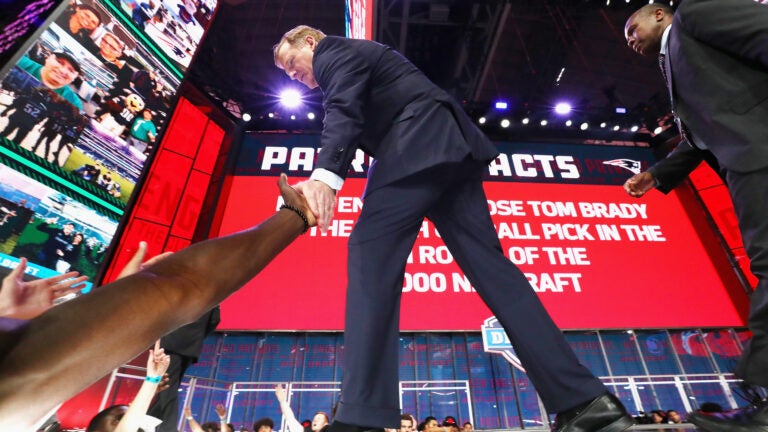
And nowadays, we have the additional bonus of trying to imagine commissioner Roger Goodell’s internal monologue as he wears a look of how-can-they-not-love-me? bewilderment while being lustily booed when he takes the stage to announce the first pick. Heck, I’d pay a decent pay-per-view rate for that.
What I don’t like about the draft is the insta-analysis of how a team fared with this pick or that. That applies not only to the draftniks on the various network sets, but to the fans and media who race to share their immediate conclusions on social media. Because no one — you, me, Mel Kiper Jr., Mel Kiper Sr., and anyone other stray Mel Kipers out there — has a single, solitary clue about how any of these players will perform in the NFL.
The draft is an entertainingly goofy, semi-educated exercise in guesswork. It is now, and it always has been. Three players chosen in the first round in the 2013 draft just five years ago are already out of the league, including No. 9 pick Dee Milliner. Two other top-10 picks — guard Jonathan Cooper and linebacker Barkevious Mingo — are already journeyman, both stopping in New England briefly.
Four quarterbacks went in the top 10 picks Thursday night. Three (Josh Allen, Sam Darnold, and Baker Mayfield) were mentioned as the probable selection by the Browns with the No. 1 overall pick in recent days. The fourth, Josh Rosen, might be the best of the bunch.

UCLA’s Josh Rosen, right, gestures next to Commissioner Roger Goodell after being selected by the Arizona Cardinals during the first round Thursday.
Six quarterbacks were drafted in the first round 35 years ago. The sixth one selected, at No. 27, was Dan Marino, who turned out OK. No one knew then who would be the best. Thirty-five years later, are you willing to bet Mayfield will be better than the 32d pick in the first round, Lamar Jackson? There are too many variables — the players’ work ethic, the quality of his teammates, the competence of his coaches — to say so definitively.
Patriots fans, more than any other fan base in the NFL, should know not to gripe about the selections if they go against conventional wisdom. Thursday night, the Patriots spent their pair of first-rounders on Georgia Bulldogs, offensive lineman Isaiah Wynn and running back Sony Michel. Both were accomplished collegiate players, but neither was a name commonly considered a likely Patriots selection.
Sometimes the unexpected leads to disappointment. That’s a misguided response if you consider the Patriots’ draft history under Belichick. Two of their most unexpected first-rounders — Logan Mankins in 2005 and Devin McCourty in 2010— were treated as reaches by the Kiper types. They ended up becoming cornerstone Patriots.
I still have that visceral reaction to whomever the Patriots pick, but through the years I’ve become wise enough to recognize that we’re not going to have a clue for at least a season or two regarding whether it was a good pick. Let me tell you, it took a long time for me to realize my own personal clue shortage.
I was annoyed when the Patriots took Richard Seymour over receiver David Terrell in 2001, annoyed when they took Vince Wilfork over running backs Steven Jackson and Kevin Jones in 2004, and annoyed when they took projected fourth-rounder Mankins in ’05 over linebacker Lofa Tatupu.
The Patriots did get their weapons the next season, when Belichick traded for Randy Moss and Wes Welker.
I have no idea whether Isaiah Wynn and Sony Michel will become stellar Patriots, the next Eugene Chung and Reggie Dupard, or somewhere in between. All I know is that I don’t know, and neither does anyone else.
Come to think of it, maybe that’s part of the appeal of the NFL Draft as a television product, the variable that Rozelle didn’t recognize way back when. The possibilities for even the highest picks are numerous in both directions, allowing draft observers to see whatever they wish before the real answers begin to come on Sundays.