‘The Two Bills’ doesn’t shy away from touchy subjects
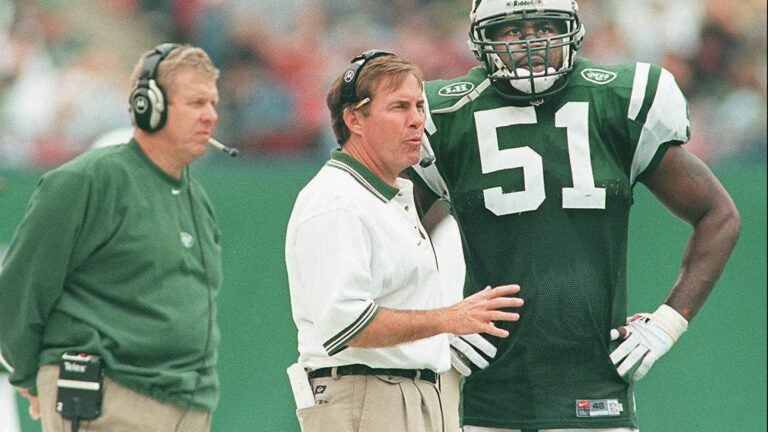
Bill Belichick, forever appreciative of football history even as he’s still making it, has always had a simpatico relationship with NFL Films. Patriots fans who crave every morsel of behind-the-scenes color from the habitually guarded two-decade dynasty have benefited from this.
NFL Films’s features on the Belichick/Tom Brady Patriots — including the two-part “A Football Life’’ documentary on the coach, the “Do Your Job’’ film following Super Bowl XLIX, and various other commemorations and specials through the years — never fail to be informative and entertaining.
The candor, however, sometimes feels controlled. To accuse NFL Films of hagiography would be unfair; it doesn’t shy from controversial topics in its documentaries. But there is an occasional sense that the subject has a say in how much time is dedicated to the unflattering or contentious aspects of a story.
I wondered whether this would be the case with “The Two Bills,’’ the much-anticipated ESPN “30 for 30’’ doc on Belichick and Bill Parcells that was produced by NFL Films. I’m glad to report that the 77-minute film on the coaches’ complicated and mutually beneficial relationship — which debuts next Thursday at 9 p.m., three days before Belichick goes for his sixth Super Bowl title as Patriots coach — is as compelling and complete as we could have hoped for.
“The Two Bills’’ is superb in several ways. Because the film is centered around a conversation between Belichick and Parcells that was filmed last summer in the Giants locker room at MetLife Stadium, the subtleties of their personal dynamic become apparent. The setup allows the viewer to see the other’s reaction to what is being said.
Compliments are frequent, and there is shared laughter, such as when they are shown a clip from an early ’80s Giants game when Parcells, the head coach, gives Belichick, the defensive coordinator, a hard time during an in-game conversation on the headset.
“Don’t you start giving me any [expletive], Belichick,’’ snarls Parcells, “or your [expletive] will be out in the parking lot.’’
“There was no question about it. He was the boss,’’ says Belichick.
“Sensitivity wasn’t in play very much,’’ says Parcells.
Without spoiling too many of the anecdotal gems in the film, let’s just say that Belichick comes across as the more conversational of the two, and perhaps not surprisingly, his memory for minutiae — particularly when it comes to strategic decisions they made in tandem during their Giants days — is remarkable.
The archival footage of Belichick — as a 25-year-old underling with a bowl-cut hairdo on the 1975 Colts staff, or later as a mustachioed special-teams coach with the Giants — is priceless. It’s also fascinating to learn how skeptical some Giants were of him when he joined then-coach Ray Perkins’s staff in 1981.
“I thought, ‘You’ve got to be kidding me,’ ’’ said Lawrence Taylor, one of several ex-Giants and ex-Patriots interviewed for the film, when discussing Belichick’s promotion to defensive assistant from special teams coach. “This guy never played football in his life. He’s probably used to ping-pong or something.’ ’’
Parcells, while easy to smile at such recollections, also has a hint of forlornness about him. He admits to a few regrets, particularly with how frosty his relationship became with Belichick in 2000 after the latter decided not to succeed him as head coach of the Jets and instead took the Patriots job. Parcells, of course, had his own complicated parting with the Patriots in 1997.
Parcells and Belichick reconciled on a Nantucket golf course in 2005 at the urging of then-Patriots personnel director Scott Pioli, who is Parcells’s son-in-law. But Parcells gives off the sense that there is still more to be said. Perhaps at 75 he is concerned with his own legacy.
While Parcells doesn’t have much to say about it, the film does delve relatively deeply into Belichick’s resignation after one day as the Jets head coach and subsequent acceptance of the Patriots job. Belichick explains it this way:
“Essentially, the problem I had with the whole arrangement was when all this transpired, there was no owner. Mr. [Leon] Hess passed away after the [1998] season. There were two potential owners, [Woody] Johnson and [James] Dolan. I hadn’t spoken with either one, but I had issues with both. The whole ownership configuration was a major factor in my decision.’’
The footage of Belichick’s press conference when he resigned from the Jets is especially fascinating. It has been portrayed through the years as a rambling mess, and at the time Jets executive Steve Gutman referred to Belichick as a man in turmoil. But the reality is that Belichick was poised, engaging, and explained in detail why he was making the decision. It reminded me a little bit of his “Mona Lisa Vito’’ press conference during Deflategate.
“I thought it was a great news conference,’’ Patriots owner Robert Kraft says wryly after the footage is shown.
The documentary concludes with a short walk toward more nostalgia. Once the sitdown is concluded, Belichick and Parcells wander over to the Giants Legacy Club, where the franchise’s four Lombardi Trophies are on display.
“These are our two,’’ Belichick says. Then he points at the pair to the right. “These are the two we gave ’em.’’
Says Parcells: “You should’ve never lost that one game. Tyree.’’
A simple observation or a subtle dig? Probably the former. But who knows in a 40-year relationship that left even their former players pondering whether they were true friends or not?
“I definitely see them as best frenemies,’’ says former Patriots and Jets running back Curtis Martin.
But “The Two Bills’’ makes one thing clear. No matter how successful Belichick has been on his own, he is appreciative of — and even a little bit sentimental about — his time working with Parcells.
“I look back on those years with Bill as some of the best years of my life, the best years of my coaching career,’’ says Belichick. “Do we agree on every single thing? No. But that really isn’t the point.’’