5 takeaways from the Patriots’ 35-14 win over the Titans
COMMENTARY
Five takeaways from the Patriots’ 35-14 win over the Titans, a divisional round victory that sends New England to the AFC championship game for a record-setting seventh consecutive season…
PATS BELIEVE IN BRADY
Among the juicier assertions of the provocative Patriots piece ESPN published eight days before the divisional round was the commentary that people within Gillette Stadium had not only begun to see slippage in Tom Brady’s play, but there was a feeling among some that the quarterback had become more fragile, and was starting to play with nervousness.
Well, it’d be hard for the Patriots to refute that claim with stronger evidence than the gameplan for their playoff opener. New England entrusted its 40-year-old quarterback to throw the ball 31 times in the first half alone, and in the process of tying a career high it wasn’t as though those throws were designed to get the ball out quickly and protect the old man. There were some screens mixed in, and a touchdown pass to James White came on a shovel pass, but the Pats weren’t shy about Brady dropping back five to seven steps, surveying the scene, and throwing toward a favorable matchup.
To put his first-half workload in perspective, consider that Brady has seven times thrown fewer than 31 passes in an entire playoff game. He totaled 202 passing yards in the first two quarters Saturday; he also has seven playoff games where he hasn’t thrown for that many in four quarters.
Of course, putting the ball in Brady’s hands with the season on the line is nothing new, as before Saturday he’d attempted at least 50 passes in four of his past eight playoff contests, and by the three-minute mark of the third quarter against Tennessee he’d already made it at least 42 tosses in seven of his last nine postseason tilts. But that’s the point. ESPN’s story built part of its case around the idea that part of the alleged fracture in Foxborough is based on a diminished level of confidence in Brady. That there were doubts creeping in about his ability to carry things forward. A mediocre stretch to close the regular season had some on the outside casting those doubts, too.
But ultimately a stat line showing 53 attempts (including 35 completions for 337 yards and three scores), said more about the Pats current belief in Brady than an anonymous source effectively could.
TEMPO TAKES DOWN THE TITANS
Through halftime, the Patriots had held the ball for 15 minutes and 31 seconds. Tennessee had held it for 14:29, so New England’s advantage in time of possession was minimal. Yet through two quarters the Patriots had run 44 plays as an offense – compared to just 30 for the Titans.
That disparity speaks to the up-tempo approach of New England’s attack, particularly after each of its first two series stalled out after each netted only one new set of downs. Late in the first quarter, Tennessee assembled an impressive march that took them 95 yards to the end zone, though the Patriots answered by going 73 yards in just 2:56. They followed that going 48 yards in 1:56. Both series resulted in touchdowns, meaning the Pats picked up 14 points, 121 yards, and ran 13 plays in just 4:52 of game action.
That efficiency equates to about nine yards of progress for every 22 seconds, even with only one play in that sequence (a 31-yard catch by Dion Lewis) gaining more than 14 by itself. The Pats then followed that up by moving even quicker, averaging about 19 seconds per play while orchestrating a 16-play, 91-yard drive in 5:18, and seizing firm control of the fight while taking a 21-7 advantage to halftime.
“That’s a good way to keep the pressure on a defense,” Brady said. “There’s a lot of ways to do it. I think that’s a great advantage of playing at home. Communication’s really good, and ultimately our guys made a lot of great plays. Executed really well.”
The opportunity to speed things up with the defense on the ropes is a credit to Brady’s mastery, obviously, but it’s also a byproduct of the continuity between the quarterback, his offensive coordinator, and the various weapons at his disposal. Brady and Josh McDaniels understand how to use the talent the Pats have at the skill positions – and the depth and diversity among that talent make it difficult to counteract, as Tennessee and defensive coordinator Dick Lebeau learned. Yet again.
THE USUAL (PLAYOFF) SUSPECTS SHOW UP, AGAIN
Not since the first week of December 2015 has Danny Amendola been targeted at least 10 times in a regular-season game. But Brady’s thrown his way at least 11 times in each of his last two postseason contests, including 13 times Saturday night.
James White hadn’t been the intended recipient of more than six Brady throws since Week 6 of this season, with his role having seemingly been usurped by others in a talented Patriots backfield. But Saturday night, with Rex Burkhead still sidelined by injury, the quarterback went his way seven times, and the Pats called his number twice on runs in the red zone.
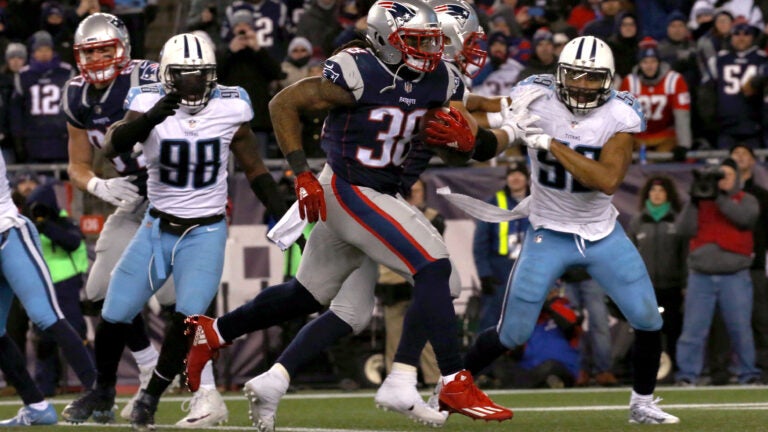
Dion Lewis was a multi-threat monster once more, totaling more than 140 yards from scrimmage. Brandon Bolden made good on his opportunity with a rushing touchdown, while scoring-territory favorites Chris Hogan and Rob Gronkowski made scoring catches. But with the postseason spotlight illuminating their abilities once more, Amendola and White again found a way to elevate their play on the big stage. And again the tandem that combined to score all 22 of the Patriots’ points after closing to within 28-12 in Super Bowl XLI found a way to furnish a spark when the Patriots offense needed it.
For Amendola, that meant six catches that went for third-down conversions, among the 11 overall grabs that accounted for a team-high 112 receiving yards. White, meanwhile, had a five-yard touchdown catch and a six-yard touchdown run that came 3:58 apart early in the second quarter, and turned the tenuousness of a 7-0 deficit into total control.
“He’s just Danny ‘Playoff’ Amendola,” said Gronkowski. “For real. Every time the playoffs come, big games, he’s always there. He’s always stepping up his game.”
It wasn’t quite the comeback we saw last February in Houston. But after that, it shouldn’t be a surprise at this point that Amendola and White were principal pieces of a Patriots rally with the season on the line.
PATS TAKE CHARGE IN THE TRENCHES
In the midst of the Titans’ best drive of the night, Marcus Mariota showed the Patriots where problems could arise if they weren’t careful about containing his legs. On third and seven he briefly looked to throw, but pulled the ball down, took off, and ran for the first time with relative ease. Later in that same series he matched that gain with another 11-yard scamper.
But that was the exception on what was an excellent night for the Patriots’ front seven, which didn’t let Mariota use his speed and elusiveness to make a major difference, and at the same time didn’t sit back in the interest of keeping him confined. New England was in the backfield all night, racking up eight sacks – including two apiece from Deatrich Wise and Geneo Grissom, and singles from four others – and costing the Titans 52 yards of field position. Rookie Adam Butler was impressive, as was Trey Flowers, who hit Mariota three times.
In addition to that, the defensive front strung out and stunted a 4th and 1 run attempt from Derrick Henry, who was limited to 28 yards on 12 carries. A week after pounding the Chiefs for 156 yards, the Alabama product’s longest carry against the Pats went for four yards.
The Patriots controlled the line on the other side of scrimmage, too. Tennessee tied for the sixth-most sacks in the NFL during the regular season, but didn’t drop Brady once. They were also the fourth-toughest team to run against, yet Lewis managed 4.1 yards per carry, White was given a path to the pylon on his scoring run, and the line opened up a canyon for Bolden to run through on his score.
As impressive as 35 points is, and as much as 53 pass attempts might suggest a high-flying finesse approach, the importance of New England’s physicality can’t be understated.
TAKE YOUR BREAKS
The Titans weren’t happy with the officiating early on, particularly a first-half pass interference penalty that negated a third-down catch by Eric Decker, and an encroachment foul that turned a Patriots punt into a first down. Both calls were borderline. But it’s the way each team responded to those calls that illustrates why New England is the one advancing, while Tennessee is left to plot its future.
After the Decker penalty, the Patriots forced an incompletion on the replayed third down, and after the subsequent punt took possession in Titans’ territory. Give New England’s defense and special teams credit for taking advantage.
Likewise, after their drive was extended by Tennessee’s encroachment on what would’ve been a punt, the Patriots punished the Titans by methodically moving the ball down the field. After the penalty, the Pats were still at their own 19 – yet they went the remaining 81 yards without a gain of more than 13 on any singled play, and also without facing a third down needing more than four yards. The chance was still there for the Titans, then trailing by just seven points, to get a stop. Instead, give the Patriots credit for capitalizing on renewed life.
Calls happen. Other things happen in the course of a game. Particularly in the playoffs, survival is dependent upon the response from each side, and which team avoids unfortunate circumstance by limiting mistakes. At one point the Titans had nine first downs and had committed five penalties. In the meantime, the Patriots converted nine of 10 third downs at one point, and went 5-for-5 scoring touchdowns in the red zone.
Maybe as much as any numbers, those tell the story of why it’s on to the title game for the Patriots.