5 takeaways from the Patriots’ 35-17 win over the Dolphins
COMMENTARY
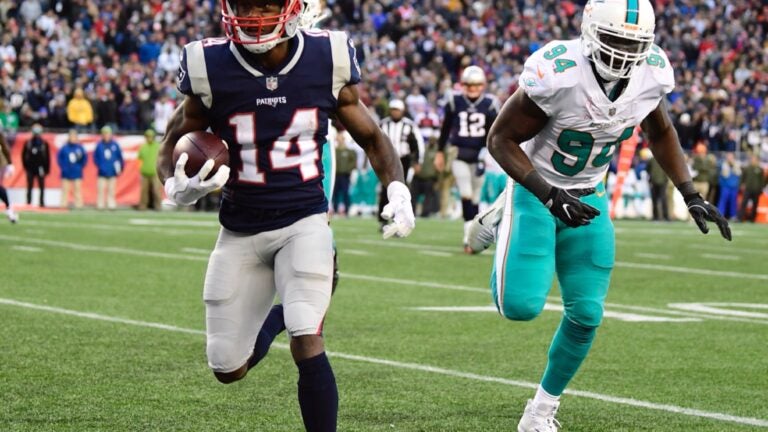
Five takeaways from the Patriots’ 35-17 win over the Dolphins, which moved the team to 9-2, and ensured a 17th consecutive season of at least nine victories:
RED HOT IN THE RED ZONE
Sunday was sloppy at times for the Patriots, the performance stained by two turnovers, a muffed fumble that nearly cost them another possession, seven penalties for 70 yards, and some offensive stagnation over the middle portion of the day.
“We left a lot of plays on the field,” Bill Belichick said. “We had a few lapses in the game” — yet New England eclipsed 33 points for the third straight week since its bye, and overcame its first giveaways since October 15, by turning all five of its red-zone opportunities into touchdowns.
That was an area of concern for New England early in the season, who uncharacteristically entered Sunday ranked 16th league-wide in terms of efficiency, scoring touchdowns on fewer than 54 percent of its opportunities. The Pats had converted 23 of 43, and were particularly poor in the four-game stretch when they failed to score more than 24 points leading up to their bye. In those contests, they moved inside the opponents’ 20-yard line 15 times. Only six of those resulted in touchdowns.
Since the week off, the Patriots have gone 4-for-6 against the Broncos, 2-for-3 against the Raiders, and with a 5-for-5 effort against the Dolphins they’re now 11-for-14 (78.5 percent) over the past three weeks. With that, New England is up to 58.3 percent for the season, and fast approaching last year’s 64 percent clip.
IT’S LEWIS AND BURKHEAD’S BACKFIELD
When the season began, New England’s running backs quartet seemed to be just that – with four players sharing the responsibilities as roles continually evolved. After his Super Bowl heroics and offseason contract extension, James White certainly seemed a big part of that equation. Mike Gillislee, too, especially after scoring three times on opening night.
But after 11 games, the chief roles in the backfield appear at this point to belong to Dion Lewis and Rex Burkhead.
Gillislee has been a healthy scratch each of the past three weeks, and White had three late carries to go with another quiet receiving day that leaves him with one catch for one yard on three targets over the past couple of weeks. Meanwhile, Lewis eclipsed the century mark with 112 rushing yards on 15 carries against the Dolphins, looking strong and elusive and every bit the game-changer he appeared to be before tearing his knee two years ago. And Burkhead added 50 yards on the ground, taking one of his 13 carries for a touchdown, then later adding a second score on a short reception.
In all, Lewis and Burkhead combined for 31 of the running back group’s 35 touches. Some of White’s lack of use could be attributable to the Patriots’ lack of depth at receiver, given that he’s lining up outside with more frequency, and rather than matching up against linebackers or safeties he’s seeing coverage from corners. When Chris Hogan returns, or if Martellus Bennett can get healthy enough to be more of a threat, White’s role may return to something closer to normal. This isn’t to say he’s an afterthought by any stretch. But as of now, the Patriots’ backfield is a two-headed beast. And 196 yards say that arrangement is working rather effectively.
DEFENSE DELIVERS
New England held a seventh straight opponent to 17 points or fewer, and this time the rest of the numbers reflected what the bottom line said about the play of the defense.
The Patriots limited the Dolphins to 221 yards of total offense, which was 118 yards less than they’ve yielded in any game this season – and matched the second-lowest number of passing yards the Pats allowed over their first 10 games. Matt Moore won’t be confused with Dan Marino in Dolphins lore, but Miami’s 154 passing yards were a season-low for the Patriots defense. So was the 67 rushing yards Miami managed. New England’s seven sacks were a season-high.
As the aggregate numbers suggest, the per-play averages were impressive, too, for New England’s defense: 3.7 per play, 3.8 per pass, and 3.5 per rush. The Patriots also held the Dolphins to two conversions on 11 third-down tries, held Miami to one touchdown on three red-zone trips, and forced at least two turnovers for the third consecutive tilt.
One of New England’s three takeaways came on a Stephon Gilmore interception that saved at least three points near the end of the first half and also helped keep Miami without an offensive touchdown until the middle portion of the fourth quarter.
“That’s been the key for us the last couple weeks, defensively: trying to play well situationally, third down, red area, then trying to come up with big plays – some type of turnovers and stops – and that’s helped us out a lot,” said safety Devin McCourty.
OFFENSIVE LINE ISSUES
Going up against the likes of Cameron Wake, Ndamukong Suh, and the Dolphins defensive front is never especially easy for the Patriots – and, in the end, Tom Brady’s final stat line looked plenty good. The quarterback finished with four touchdown tosses, completed 64 percent of his pass attempts, and was sacked only once.
But those numbers don’t tell the full story of the struggles his offensive line had in protecting Brady from trouble. That Brady was only sacked once is a credit solely to his veteran savvy, considering he was hit eight times, and several of them were significant shots that left him laid out on the turf. The quarterback was also hurried on a number of dropbacks, including one where he was made uncomfortable, and stepped up, but didn’t have the space to step into a throw intended for Danny Amendola. That resulted in Brady’s third interception of the season.
On top of that, both starting tackles were flagged for false starts, and the biggest gaffe of the day belonged to center Ted Karras. Playing that position for the second straight week, and second time in his career, he snapped the ball before Brady was expecting it in the shotgun formation. Reshad Jones scooped it as it bounced down the field, and brought it the rest of the way for Miami’s only touchdown of the first three quarters.
Clearly the Patriots managed to overcome Karras’s error, and their issues up front. But with these teams scheduled to meet again in two weeks, under the bright lights of Monday night, and on the road in Miami, the line might need to be better in the rematch.
EBNER LOSS COULD BE COSTLY
Nate Ebner’s sole contribution Sunday was a big one in the moment, his 14-yard run around the right end converting a fake punt attempt and extending an opening drive that New England took all the way to the end zone. But if his knee buckling near the end of that dash was the sight of his season crumbling, it could be a significant loss given how important the Patriots’ special teams have been, and the present status of their personnel.
Special teams captain Matthew Slater missed Sunday’s game with a hamstring injury, and he’s now been inactive for more games (six) than he’s played this season (five). Two other special teams contributors, Trevor Reilly (head) and Marquis Flowers (leg; later returned) both left the win over the Dolphins with injury. And while it’s easy downplay the loss of those players who impact only a limited number of plays over the course of a game, those units have played a significant role in several contests over the course of the Pats’ seven-game winning streak.
They’ve blocked kicks, covered kicks, executed to make possible some crucial kicks, and returned a kick for a score. Eighteen seasons is enough of a sample to surmise that Belichick’s special teams won’t become a liability. But to this point in the season the Patriots’ kicking game has been a weapon – a weapon that could be the difference between winning and losing as the games start to increase in importance.