NFL Films gives you chills by revisiting snowy ‘Tuck Rule’ game
Much of the appeal of NFL Films’ “The Timeline’’ series is that it is an elegantly produced video microcosm of the appeal of sports as a whole. The documentaries carry a fan back to an extraordinary moment, team, or period in NFL history. And they always seem to linger on the angles that make for passionate and ultimately unsolvable barroom debates — the what-ifs, could-have-beens, and never-weres of what might have happened if only one little thing had changed.
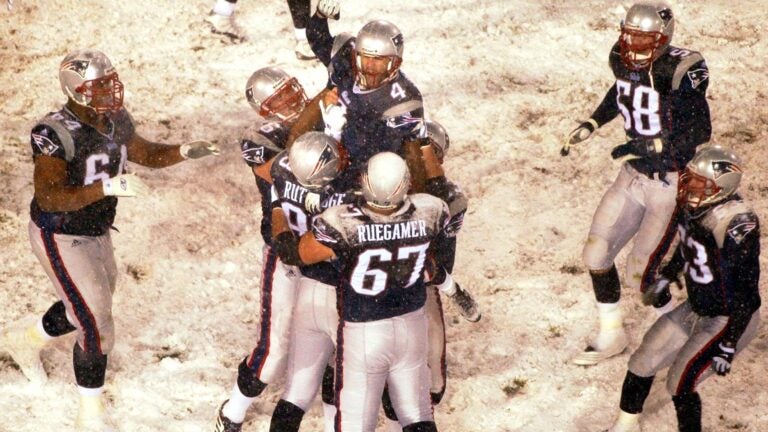
The documentaries are consistently excellent, and Thursday night’s one-hour edition, which was scheduled to air after the Patriots-Buccaneers game on the NFL Network, is practically the series’s quintessential topic: the Tuck Rule, specifically the history-altering way of how it was applied in the 2001 AFC Divisional game between the Patriots and Raiders and the aftereffects that are still felt today by the franchises.
I imagine any New Englander with even a modest interest in football knows about the Tuck Rule. So here’s the condensed version of what happened:
With Tom Brady starting his first playoff game, the Patriots trailed the Raiders, 13-10, with 1 minute and 43 seconds left. Dropping back to pass, Brady was hit by blitzing Raiders cornerback Charles Woodson a split-second after he cocked his arm to pass, then decided not to throw and began pulling the ball back toward his chest. The ball popped loose. The Raiders recovered.
It looked as though defeat in the final game at Foxboro Stadium was inevitable.
But the officials huddled, and one went to watch a replay on the sideline. After a delay of less than two minutes, referee Walt Coleman returned to announce a surprising verdict: “The quarterback’s arm was going forward. It is an incomplete pass.’’
It was the correct interpretation of a ridiculous rule.
The Patriots had life. After two iconic Adam Vinatieri field goals in the snow-globe conditions — one to tie the game, one to win it in overtime — the Patriots prevailed. Two wins later, they were Super Bowl champions, and a dynasty was born.
And the Raiders are still carrying the weight of all those what-ifs.
“One of the parts of the Raiders aspect of this that I find interesting and humorous is they all matter-of-factly mention that they lost a chance at the Super Bowl,’’ said Rob Gill, a Shrewsbury native and senior producer at NFL Films who put together this episode.
“They really think that that was the definite next step for them, even though they would have had to win the AFC Championship game at Pittsburgh.
“You never know what would have happened in that game, and you never know what would have happened if they had played the Greatest Show on Turf [the high-powered St. Louis Rams] in the Super Bowl.
“That’s what they believe, that the Super Bowl was stolen from them.’’
That belief has only been solidified in the years that passed. The Raiders under Al Davis always had an us-against-them mentality, and his former players still carry that attitude. They believe they were robbed because the league didn’t want them to win.
Tim Brown, the Hall of Fame receiver, is the chief conspiracy theorist in the documentary.
“I knew at this particular time they were trying to find a reason to overturn this play. That’s why it was taking so long,’’ said Brown, who erroneously believes that the review is the longest in history.
Woodson is just as blunt: “It’s the worst call in the history of all sports, I believe.’’
And then there’s Jon Gruden, the Raiders coach at the time: “I saw their sideline. Charlie Weis, [Bill] Belichick, Brady. They knew it was a fumble. We all knew it was a fumble. Until . . . wait a minute, there’s a conversation.’’
The sense that the Patriots never would have become the greatest prolonged dynasty in NFL history without the Tuck Rule remains palpable among the Raiders — not to mention envious fans of the 30 other teams.
Brown was among the Raiders who thought that had the Patriots lost, Drew Bledsoe would have been the starting quarterback the following season. Gill, who grew up a Patriots fan, doesn’t buy it.
“Belichick felt like he had found something in Tom Brady,’’ he said. “I think if you were there or have read the stories on that team through the years, it was pretty clear that this was going to be Brady’s team in 2002.’’
He laughs. “The Raiders strongly disagree, of course.’’
I’m going to tuck away some of the more revelatory anecdotes from the documentary rather than spoil them; it will air several times in the coming weeks.
I will say that one of the most appealing elements for Patriots fans, beyond snickering at the Raiders’ bitterness are the archival interviews, especially with Brady, who was less guarded in his younger days.
In the chaotic aftermath of the game, Brady tells the media scrum that he thought ruling it an incomplete pass was the right call, then he smiles and says, “You like that?’’ — an apparent wink-wink confirmation that he knew they caught a break.
“He did seem more willing to say things that wouldn’t be the exact right thing to say in the moment,’’ said Gill, “which is always what he does now.’’
The affably bitter Brown has a suggestion for how Brady should answer questions about the Tuck Rule now:
“Brady should begin every interview he does by saying, ‘I want to thank the Oakland Raiders. Because if not for them, I would not be here. Now what is your question, sir?’ ’’