How important is it for the Patriots to shut down Julio Jones?
Stats suggest too much focus on the dynamic receiver might not be the way to beat the Falcons.
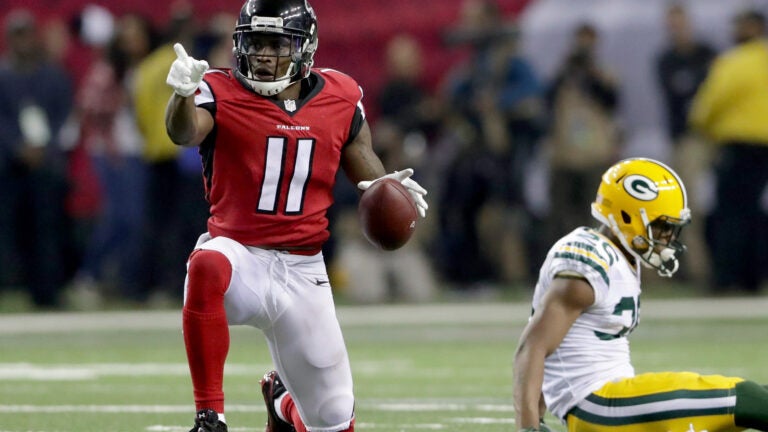
COMMENTARY
Ask a Patriots fan which of Matt Ryan’s weapons is most worrisome in Super Bowl LI, and the answer is almost automatic. It’s Julio Jones, the Falcons’ four-time Pro Bowler who averaged more than 100 receiving yards a game during the 2016 season before racking up 180 more to go with two touchdowns in the NFC Championship game.
The opinion isn’t limited to New England, either. Eight days before kickoff, oddsmakers had installed Jones as the clear favorite among non-quarterbacks to earn the game’s MVP honors.
Based on that, it would seem obvious where the Pats should put their defensive focus if they’re planning on again applying Bill Belichick’s tried and true philosophy of eliminating what the opponent does best. Yet, underneath Jones’ gaudy grand totals are stats suggesting that he may not actually be as much a difference maker against good defenses or in got-to-have-it spots. This evidence suggests that maybe, after all, the Patriot should be able to live with a big night from the Falcons’ primary weapon if it means they’re able to successfully mitigate the Falcons’ other threats.
For example …
When Jones has more than 100 receiving yards … the Falcons are 4-4 this season, and averaging 33.4 points. They’re 7-1 when he’s held to less than 100 yards (averaging 33.8 points), and were 2-0 without him altogether (averaging 41.5 points).
When Ryan targets Jones with at least nine passes … the Falcons are also 4-4. The easy counter is to say Jones’ numbers were suppressed in the latter data sets because his team was playing with a lead, though the games in which he surpassed 100 yards were decided by only a slightly narrower margin (9.4 points on average) than the rest (10.8 points). And Ryan actually averaged more passing yards in wins than in losses, at 313-301.
That means the ball is still going somewhere, and while Atlanta’s other top skill-position players all average more scrimmage yardage in victory than in defeat, Jones averaged 93.5 yards on 5.5 catches in wins, versus 125.4 yards on 7.4 catches in losses. Furthermore, if you remove his monstrous 300-yard performance against Carolina in Week 4, the numbers become even more lopsided, showing that …
Minus that epic afternoon, Jones averaged 4.9 receptions, 7.7 targets, and 72.9 yards in Falcons triumphs.
It’s worth pointing out here that the Panthers’ defense he torched in October allowed more passing yards than any unit in the NFL this season. And the Falcons faced them twice. They also twice faced the Saints, who surrendered the second-most yards. The fourth-worst unit was the Packers — against whom Jones accumulated 180 yards and two touchdowns in the NFC Championship game.
That’s six games opposite three of the four worst pass defenses in football. In total, Atlanta played 11 games against teams that finished the regular season ranked in the 20s or 30s in passing yardage allowed, with Jones appearing in 10 of those plus a tilt against 18th-ranked Kansas City.
In those 11 contests … against teams ranked in the bottom half of pass defense … Jones averaged 6.3 receptions on 9.4 targets, registering an average of 113.7 yards and racked up seven touchdowns.
The Patriots finished the regular season ranked 12th in pass defense, so the Super Bowl will mark just the sixth time Jones has gone up against a unit that wound up among ranked somewhere from No. 1-16.
In five games … against teams ranked in the top half of pass defense … he has averaged 5.8 receptions, 9.2 targets and 81 yards and scored two touchdowns.
Against the Broncos’ No. 1-ranked pass defense, Ryan connected on only two of six throws to Jones, who finished with 29 receiving yards. (It was one of four games this season when the receiver finished with 35 yards or less.) Jones insisted afterward that he’d been double-teamed all day, but cornerback Aqib Talib told the Denver Post the plan was “sometimes single team, sometimes double team,” and “we did a great job of switching up.”
The Falcons won that game 23-16 in no small part because running backs Devonta Freeman and Tevin Coleman combined for 286 yards from scrimmage. Regardless of their intended plan, a case could be made that the Broncos left themselves vulnerable by committing so heavily to stopping Jones. Therefore, if the Patriots can entrust Malcolm Butler to cover Jones without requiring much help, it could be a game-defining decision.
And if Belichick and Matt Patricia do want to pick and choose their spots to give additional assistance to thwarting Jones, whether the plan is primarily Butler or Logan Ryan, it might make sense for them to do it on early downs because …
In the regular season, 72 of his 149 targets, 50 of his 88 catches, and 915 of his 1,409 yards came on first down. More than 72 percent of the passes thrown to Jones came on downs with the Falcons needing at least 10 yards.
Conversely…
Ryan threw 80 passes during the regular season with Atlanta facing third and seven or more, only 15 of which (18.8 percent) were targeted for Jones.
Jones was more heavily involved on third down against the Packers in the NFC title game than was typical throughout the year. Atlanta threw on 12 of 13 third-down tries, and five of those were to Jones. He caught four of them, including a 5-yard touchdown that came courtesy of a nifty play call where he caught a quick sling pass as he gained steam and blocks were being set up ahead of him.
At 6-foot-4 and 220 pounds, Jones has a size and strength advantage on any defensive back the Patriots — and a vast majority of the league — can throw at him. Yet those physical tools don’t necessarily translate as might be expected in the red zone. Over his six-year career, the majority of Jones’ scores have come on plays of 21 yards or longer.
And though he has two touchdowns from inside the 20 this postseason, that’s as many as he had during the entire regular season. It’s not only reflected in a lack of scores, either, considering …
Jones had seven catches in the red zone during the regular season. That tied for 58th league-wide — with Cardinals-castoff-turned-Patriots-addition Michael Floyd and others.
By comparison, Falcons teammate Mohammed Sanu was tied for ninth in the league with 12 red-zone catches. Those included all four of his touchdowns, which were among the 23 Ryan threw over the course of the campaign.
Again, just two of those red-zone TDs went to Jones. The other 21 were spread among 10 other receivers. The emergence of that depth helps explains why Ryan’s passer rating inside the 20 jumped by more than 25 points from last season to this (83.6 to 108.8), and why the Falcons scored the eighth-most points in NFL history. It also reinforces that while Jones might be the most gifted, most singularly dangerous, and ultimately most productive of the group, the Patriots have more to worry about than simply No. 11.
While it was far less than the 120 he averaged against the worst, Jones delivered 87 yards per game against the NFL’s top half of scoring defenses this season. Projected over 16 games, that’s basically the equivalent of a 1,400-yard season. It’s an All-Pro level. Yet even if he delivers or exceeds that against the league’s No. 1 scoring defense in the Super Bowl, the Patriots can survive it.
In fact, assuming that’s what they give up in order to take away Atlanta’s other threats, the Pats might actually prefer it — as counterintuitive as it might seem to New Englanders after 17 years of watching Belichick teams.