
5 reasons the Patriots beat the Steelers in the AFC title game
COMMENTARY
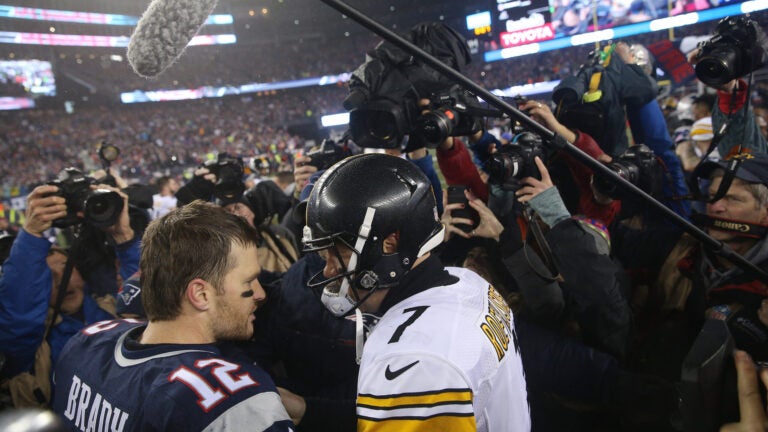
For decades, the Pittsburgh Steelers were considered the preeminent franchise of the American Football Conference. Meanwhile, the maligned Patriots were mostly a laughingstock, even locally. Then Bill Belichick and Tom Brady arrived in Foxborough. And now it’s New England that has won the AFC, or either conference, more than any other operation. For the ninth time overall, seventh time under the leadership of its iconic coach and quarterback, and third time at the expense of the Steelers, the Patriots are headed to the Super Bowl.
Here are five reasons they posted a 36-17 win over Pittsburgh, and will travel to Houston to take on the Atlanta Falcons:
Thomas Edward Patrick Brady
Those who eagerly paired last week’s struggle against Houston with last year’s disappointment at Denver in an effort to rationalize the hot take that a third straight substandard playoff game would signal the beginning of the end for Brady will need to reset their homemade Patriots Armageddon Clock. Not only did the quarterback respond with a good — nay, great — performance, he authored one of the best in the most prolific playoff career of all time.
His 384 passing yards were his most ever in the postseason. His 76.2 percent completion percentage, the result of 32 completions on 42 tries, was the third-highest playoff percentage he’s had. His three touchdowns and no interceptions marked the second time he’s done that since the 2007 season. And his 127.5 passer rating was his fourth-highest in 33 games, and highest in five years.
Has Brady been as statistically good in the postseason as he has been in the regular season? No. But the level of competition is naturally better. That’s an impossible expectation. Yet even with those couple clunkers included, Brady has now posted a passer rating of 93.9 or higher in six of his last eight playoff starts, and has a 19-to-8 touchdown-to-interception ratio in that time. Over that span, Russell Wilson (five) and Aaron Rodgers (four) are the only other QBs with more than two such games.
Brady seemed locked in beginning with his Wednesday press conference, and appeared locked in from the first snap Sunday night — to the degree that it makes one wonder if Bill Belichick bucked standard procedure and took the ball first because of how good he felt about his offense.
The Steelers Didn’t Cover Chris Hogan
After Atlanta’s Julio Jones delivered nine catches for 180 yards and two touchdowns in Championship Sunday’s early game, there probably weren’t a lot of people expecting Chris Hogan to duplicate that production in the nightcap. Perhaps least of all the Pittsburgh Steelers.
Hogan was expected to be an important part of the Patriots’ attack, particularly with Rob Gronkowski’s continued absence and Martellus Bennett playing with what NFL Network says is a cracked bone in his ankle. His size, toughness and ability to get open vertically make him a valuable weapon every week — though his biggest plays Sunday seemed almost to be the result of the Steelers simply losing him in coverage.
Before his first touchdown, he went right up the seam for 26 yards after Brady changed the play at the line. He capped that drive with a 16-yard touchdown on which he was unmarked from the snap all the way until he settled into a wide-open haven within the Steelers’ zone. His second touchdown came when his first defender released him to a safety who’d bit on the Pats’ flea flicker — and there were even a couple more where Hogan was open but he and Brady just didn’t connect. Had he caught those he could’ve eclipsed 200 receiving yards. And, believe it or not, the great Julio Jones.
Limiting The Big Plays
Heading into the AFC Championship game, the Steelers had scored 20 touchdowns this season on plays of 20 yards or more. The Patriots, on the contrary, had surrendered just four scores of that length, notably a 27-yard Tyrod Taylor scramble and two Week 2 passes against the Dolphins. Whichever trend won out figured to have a major say in who won the game — and it did. The Patriots were able to eliminate Pittsburgh’s big plays nearly until the game was out of reach.
The Steelers didn’t have a gain of more than 20 yards until the final 95 seconds of the third quarter, when Roethlisberger advanced the ball to midfield with a 30-yard connection to Sammie Coates. The only other gain of more than 20 yards came on Cobi Hamilton’s 30-yard touchdown catch with 3:42 to play in what until then was a 36-9 game.
Superstar Antonio Brown’s longest catch was an 18-yarder that followed the lengthy hookup with Coates near the end of the third, and it was the only catch of longer than 13 yards for a receiver who averaged 12.1 per catch this season. The Steelers went three-and-out just twice, held the ball for at least eight plays on five possessions, and managed 368 yards while collecting 22 first downs. But without the ability to explode with a quick strike, it penetrated the NFL’s No. 1 scoring defense just once in the first 56 minutes.
The Defensive Line Delivered
For a moment it appeared as though the Steelers would close within three or four points headed into halftime. But officials correctly overturned a Jesse James touchdown catch, giving the Patriots’ defense another chance to keep momentum. And New England’s most underrated unit helped seize that opportunity — as it has all season.
With Pittsburgh enjoying first and goal from inside the 1, the Alan Branch-led interior of the defensive line got a good push, letting Dont’a Hightower penetrate into the backfield and push the Steelers back a yard, dropping DeAngelo Williams at the 2. On second down, Vincent Valentine shot the gap himself, bursting through with speed and power and torpedoing Williams at the 5. On third down, the Steelers opted to throw, but Roethlisberger rushed his sling toward Eli Rogers and Pittsburgh was forced to settle for a field goal that left them down 17-9.
Sunday’s task was certainly made easier when Le’Veon Bell left with a groin injury after just six carries and 20 yards — but the Patriots effectively bottled the dynamic back while he was in there, and at this point there should be no doubt that New England goes to the Super Bowl with its defensive line a significant strength. It may not have the same qualities as some of the more revered and feared groups across football, though it is a quality group in totality when its parts are summed.
Third-Down Success
LeGarrette Blount had a brutish 18-yard run in the third quarter, then tallied 27 yards in the fourth, but a Patriots running attack that burnt the Steelers for 140 yards in the regular season managed only 57 yards on 27 attempts. They had difficulty dealing with Pittsburgh’s scheme up the middle, Belichick said. But the coach also said his team was able to survive because it continuously made plays on third down.
“We (were) good on third down, so we were able to stay on the field with some third-down conversions even though we had some longer-yardage situations,” Belichick said. “That was fortunate. The Steelers made it tough on the running game.”
After the first two series of the night, the Patriots converted 11 of 13 third-down chances before Brady’s final kneeldown left them with an overall success rate of 65 percent — and they weren’t all easy. Six of those conversions required gaining at least six yards, and a couple demanded they get the entirety of the original 10. Pittsburgh had dominated the Chiefs on third down in the Divisional round (Kansas City went 2-for-9), and was among the NFL’s best third-down defenses on the road, but New England consistently had the right play for the spot and executed. The Patriots now get to take on an Atlanta team that, for all of its success, ranked among the NFL’s worst third-down defenses this season (41.8 percent; 26th).



To comment, please create a screen name in your profile
To comment, please verify your email address
Conversation
This discussion has ended. Please join elsewhere on Boston.com