
What if the Patriots never won the Tuck Rule Game?
COMMENTARY
Sometime around 6:15 on Sunday night, as Crazy Train takes over for Carmina Burana and 65,000 Pats fans are ready to smash their heads through a brick wall, Tom Brady will jog out of the Gillette Stadium tunnel for his NFL record 33rd career playoff game.
Now on the surface, that number might not blow your mind. Those “33 games” don’t pop off the page like, say, NBA all-time leader Derek Fisher’s 259 career playoff games or MLB all-time leader Derek Jeter’s 158. But for some perspective, Brady’s 33 playoff starts are six more than Peyton Manning, currently second on the all-time quarterback list, which means Brady’s started 22 percent more playoff games than his closest competition. For more perspective, Brady’s started more playoff games than the combined totals of Ben Roethlisberger (19) and Eli Manning (12), Troy Aikman (15) and Roger Staubach (17), Jim Kelly (17) and Steve Young (14). After Sunday, Brady will have more playoff starts than the combined Hall of Fame foursome of Bob Griese, Fran Tarkenton, Joe Namath and Dan Fouts.
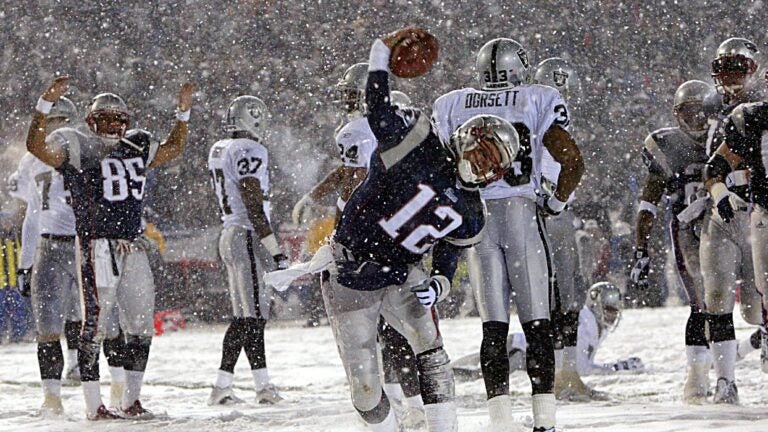
Do modern day quarterbacks benefit from an expanded playoff field? Sure, but don’t forget Brady’s skipped wild card weekend 11 times in 13 years. Don’t forget he’s also the all-time playoff leader in wins, completions, passing yards and touchdowns. Whatever it is, just know Brady’s playoff career is beyond historic. It’s unrivaled. And to think it all started 15 years ago today – January 19, 2002 – with a game so insane it’s not even remembered so much as Brady’s playoff debut as it is for the weather, and the kick, and the little slice of NFL Rule Book that changed everything forever.
So on the 15th anniversary of the Tuck Rule Game, let’s talk about the Tuck Rule Game. Let’s ask and answer the age-old questions: What if things were different? What if they didn’t reverse the call? What if Adam Vinatieri missed the kick? What happens to Brady? What happens to the dynasty? What happens to the Raiders? What happens to Jon Gruden? But first, here are three things uncovered during research for this article that feel worthy of your attention.
I. “Snow Bowl”-gate
First, the Tuck Rule Game is called the “Tuck Rule Game” because as cool, and fitting, and familiar as “The Snow Bowl” sounds, the use of “Snow Bowl” to describe a memorable snowy football game is like slapping –gate on the end of scandal. Everyone does it. The market’s oversaturated.
In November 1950, Michigan and Ohio State played in the Snow Bowl. In December 1985, the Buccaneers and Packers played in the Snow Bowl. The 84th Grey Cup, played in 1996 between the Montreal Argonauts and Edmonton Eskimos, is known as the Snow Bowl. The 2000 Independence Bowl between Mississippi State and Texas A&M (complete with a 35-yard touchdown catch by Bethel Johnson!) is known as the Snow Bowl. In Week 13 of the 2013 NFL season, the Lions and Eagles played a game that all these three years later is still remembered fondly as the Snow Bowl.
There are too many Snow Bowls, and that night at Foxboro Stadium, the last game ever at Foxboro Stadium, deserves better than a Wikipedia disambiguation page. So, at least for the next thousand or so words, it’s known only as the Tuck Rule Game.
II. Where’s Walt?
Referee Walt Coleman, who overturned Brady’s legendary non-fumble, hasn’t worked a Raiders game since.
This wild and sketchy tidbit can be found tucked away in the last line of the Tuck Rule Game’s Wikipedia page, and can be confirmed on Pro Football Reference—where they list every game Coleman’s worked since 1999.
The Tuck Rule Game was his third Raiders game in three years. In the time since, Coleman’s worked 229 regular season games. He’s worked 17 games that involved the Patriots. He’s worked at least nine games for every NFL team—
Except the Raiders.
He’s worked zero Raiders games in 15 years.
That’s crazy, and not an accident, and maybe there’s an explanation but as with most things NFL, we’ll probably never get one.
III. Suddenly Seymour
Finally, the most important play no one remembers about the Tuck Rule Game occurred on the drive before Coleman’s legendary reversal. It’s considered by many players and coaches to be the most critical play of the entire game, and 15 years later there’s significant confusion and bad information surrounding what exactly happened.
To set the stage: It was the fourth quarter. There was 2:24 on the clock. The Raiders were up 13-10, facing a 3rd and 1 on their own 44, and the Pats had only one time out. With one more yard, and a fresh set of downs, Oakland about seals the deal.
Over on the sideline, Jon Gruden dials up “14 Blast”, the Raiders’ best short yardage play, the kind of old school, smash mouth power move that still gets John Madden hot and bothered. It’s a deep handoff to 240-pound running back Zack Crockett, who’s supposed to follow 250-pound fullback Jon Ritchie and barrel for a first down.
“Nothing is absolute,” said CBS’ Greg Gumbel, as the Pats broke the huddle, approached the line, and the gongs from Hell’s Bells boomed through the old Foxboro Stadium speakers, “but you’d have to say Jon Gruden would feel pretty good about his chances with a first down here.”
A few seconds later, Rich Gannon received the snap, turned and placed the ball right into Crockett’s gut—and as for what happened next, let’s check in with Patriots.com, the team’s official website, and this excerpt from an article about the Tuck Rule Game.
“Oakland handed to powerful fullback Zack Crockett, but rookie defensive lineman Richard Seymour got penetration, freeing Tedy Bruschi and Ty Law to stop Crockett short on what was a game-saving play.”
For more, let’s check in with retired Raiders All-Pro guard Steve Wisniewski, whose 2015 memoir goes into great detail about what he called “the play of the game.”
“I saw Patriots linebacker Tedy Bruschi inching forward as Gannon started his cadence,” Wisniewski wrote. “When the center flexed his bicep to snap the ball, Bruschi sprinted to the play side “A” gap over our right guard. He watched film too and was well coached. Before our right guard could take his first step, Bruschi was in his gap, causing penetration and a pileup of bodies.”
Finally, here’s the official box score, available on NFL.com, which clearly credits Bruschi and Law with one of the biggest defensive stops in Patriots history.
For what it’s worth, about every online source credits Bruschi as the lead tackler.
But here’s the thing . . . FAKE NEWS!
Bruschi wasn’t even on the field for 3rd and 1.
Check the video and you’ll see Bruschi at the 1:50:45 mark, on the sideline next to Bill Belichick. At 1:51:30, you’ll see him walk back on the field.
In the intervening 45 seconds, reality unfolds and here’s what happened: Seymour blew up the whole play.
He deserves more credit than anyone for the biggest stop in this history-altering game. He busted through the line and stopped Jon Ritchie in his tracks. Crockett, running full speed behind his fullback, then tripped over the pile, attempted one last desperation lunge, but was caught and slammed into the snow by a pack of Patriots, led by Law and – not Bruschi – but the one and only Bryan Cox.
Bryan Cox!
This isn’t meant to steal any sunshine from Tedy Bruschi. Bruschi is Bruschi and will always be. He could’ve been in a coma that night and it wouldn’t change a thing about his legacy. Instead this is a chance to point out what happened the play before Seymour’s heroics – on 2nd and 3, when a first down would’ve been equally tragic for New England. On that play, the Raiders handed off to Charlie Garner, who hit the hole and looked destined for the game-sealing first down. That is, until Bruschi tore away from a block and threw himself in front of Garner like he was bullet headed for the president. Tedy grabbed Garner, held on for dear life and stood his ground in the slippery snow just long enough for Tebucky Jones to swoop in and drop the running back a yard short. Without that play, Seymour’s play doesn’t happen. Without both those plays, Shane Lechler’s ensuing punt never happens. And here’s something you might forget about that punt—
Troy Brown returned it 27 yards.
For perspective, the 2016 Pats had only one punt return all year longer than 27 yards. (Although Cyrus Jones did have one go 27 yards the wrong way off his foot). Brown fielded Lechler’s punt on a bounce, with a running start, in the middle of snow storm, and broke it all the way to New England’s 46. He put the Pats and Brady in position to put Vinatieri in position. But here’s something else you might forget about that punt return—
Brown fumbled.
Right at the end. This was a legitimate fumble, and it wouldn’t have been overturned, and it bounced around for what felt like eternity until Larry Izzo threw himself across the snow and onto the ball.

Patriots kicker Adam Vinatieri celebrates atop his teammates after kicking the game-winning field goal in overtime to defeat the Oakland Raiders in their AFC divisional playoff game January 19, 2002.
Izzo put Brown in position to put Brady in position to put Vinatieri in position. Brown and Izzo only found themselves in their positions because of what Seymour, Law and Cox did on 3rd and 1, and they couldn’t have done what they did without what Bruschi and Tebucky Jones did on 2nd and 3, and . . . and . . . and you know how this goes. We can play this out forever both ways into the past and future until half the world’s population did something that led to something that resulted in the football world we live in today.
We can get deep, and random, and weird. What if this? What if that? Before you know it we’re back in late-June 1876, in the great plains of Montana, as General George Custer makes the final arrangements before attacking at the Battle of Little Big Horn. Among them, Custer orders his 16-piece cavalry band to turn back and wait out the battle on a steamboat in the nearby Powder River.
Custer then marches straight into an ambush.
He’s killed along with nearly 300 of his 700 men.
But what if he didn’t send the band back? What if he brought them along for Custer’s Last Stand, and the cavalry’s band leader, a talented composer and musician named Felix Vinatieri, was among the hundreds killed in action? What if Felix wasn’t alive to conceive his son Ehrum in 1889? What if Ehrum was never alive to conceive his son Albert, who was never alive to conceive his son Paul, who was never alive to conceive his son Adam Vinatieri?
What if Felix Vinatieri hadn’t settled in South Dakota after his honorable discharge from the army, and his great great grandson hadn’t grown up and trained in a region where the Tuck Rule Game’s horrible conditions are just another day in January?
On a different spectrum, what if sometime around 1976, with a trio of young daughters already at home, Thomas and Galynn Brady decide — “You know, we’d have loved a little boy, but three kids are enough.”
The layers make your head spin. It’s like Sliding Doors meets all three Back to the Futures, meets The Adjustment Bureau, meets Mr. Destiny, meets the lingering memories from that absolutely insane football game 15 years ago today, featuring a franchise that had never done much good, in a stadium that was among the worst you’ve ever been to, and a quarterback and coach who were about to grab hold of fate, or luck, or just plain life and spin it into one of the most dominant stretches in American sports history.
But OK – what if they lost?
What if Lonnie Paxton choked on the game-tying snap or Ken Walter whiffed on the game-tying hold? What if the NFL re-instated replay two years after the Tuck Rule Game instead of two years before? What if today was nothing but the 15th anniversary of a forgettable snowy playoff loss to the Raiders?
One way or another, everything would be different. We know that. As for how different, here’s a quick guess on both sides of the Tuck Rule Game’s line of scrimmage.

Tom Brady has his arm blocked while in motion by the Raiders’ Charles Woodson.
I. Jon Gruden and the Raiders
Not that different.
There are people – mostly Raiders fans – who’ll argue a Raiders win in the Tuck Rule Game would’ve launched an Oakland dynasty. In this scenario, Gruden essentially becomes Belichick. The Raiders become the team of the aughts. The fact that they reached the Super Bowl the following season, even without Gruden, gives this theory a little extra pop but . . .
First of all, that Oakland team wasn’t that good. Relatively speaking, of course. Compared to that Patriots core. The 2001 Raiders finished 10-6. They lost four of their last six regular season games. Their defense had a few big names, and Charles Woodson is an absolute legend, but Oakland was 19th in points allowed and 18th in yards. Even if they squeezed by the Pats, and then Kordell Stewart and the Steelers, they weren’t a good match-up for the Greatest Show on Turf. Oakland actually played the Rams the following regular season. St. Louis was 0-5 at the time, still reeling from the Super Bowl loss, with Marc Bulger in for an injured Kurt Warner and they still beat the Raiders 28-13.
Not to mention, despite his almost-strip sack in the Tuck Rule Game, Woodson played on one good foot that postseason. He hadn’t practiced in weeks thanks to turf toe, and taking it to the actual turf against that historic Rams offense wouldn’t have been good for business. Not to mention, if we’re talking dynasty potential, those Raiders were powered by an offense led by 35-year-old Tim Brown, 36-year-old Rich Gannon and 39-year-old Jerry Rice.
They had giant decisions looming and two incredibly stubborn alphas who believed it their right to make those decisions. In other words, the Jon Gruden/Al Davis relationship was a mess with or without the Tuck Rule Game. That marriage was a ticking time bomb. It was Parcells/Kraft, not Belichick/Kraft. Given what happened with the Raiders, you might say Davis was in the wrong for trading Gruden – but Chucky didn’t exactly set the world on fire in Tampa. He won the Super Bowl in Year 1 with a team mostly groomed by Tony Dungy, then compiled a 43-51 record, with zero playoff wins, before he was fired in 2009.
Of course, nothing about any of this is set in stone. We know this much. But it’s pretty clear the Raiders weren’t headed for a decade of dominance. Like Belichick in Cleveland, Gruden wasn’t ready to be Belichick in Oakland. Al Davis was long past the phase of personal reflection and self-improvement required to co-exist alongside a coach with Gruden’s conviction. And finally, the biggest difference between what the Patriots did in real life and the Raiders wouldn’t have done in this bizarro universe is they didn’t have their quarterback of the future.
What if they drafted Philip Rivers or Ben Roethlisberger over Robert Gallery with the No. 2 pick in 2004? What if they didn’t draft Fabian Washington one pick ahead of Aaron Rodgers in 2005? What if they didn’t pick JaMarcus Russell with the No. 1 pick in 2007, and instead went with the eventual No. 2 pick Calvin Johnson, or built around No. 3 pick Joe Thomas, or No. 7 pick Adrian Peterson? These are good questions for another long article but the bottom line is it took them 13 years to find a quarterback like Derek Carr – and nothing would’ve changed until they did.

Patriots quarterback Tom Brady loses the ball after being hit by the Raiders’ Charles Woodson.
Adam Vinatieri celebrates atop his teammates shoulders after kicking the game winning field goal in overtime to defeat the Oakland Raiders in their AFC divisional playoff game.II. Tom Brady and the Patriots
Not that different.
This is one man’s opinion, but win or lose, Tuck Rule or not, Brady wasn’t going anywhere. He was here to stay in New England. Then again, here’s another man’s opinion, and he has much better insight than the one typing these words.
“I wouldn’t say that,” linebacker, special teamer and three-time Patriots Super Bowl champ Matt Chatham said when presented with the opinion above. “We were struggling some as an offense, so there was some curiosity with Tom, for sure. He was a young guy filling a role on a team that was also loaded on the defensive side of the ball. His was an awesome story, how well he handled a tough situation, but leadership was all over that roster beyond just the typical QB stuff. Unique team and situation.”
OK, so let’s say Belichick pulls a 180 after the Raiders loss and trades Brady to—well, maybe he trades him to Oakland where Brady watches Gannon for a year before taking the reins? Then Brady and Randy Moss have a nice little run with the Silver and Black. Or what about the Cowboys? They were about to kick off Year 2 of the Quincy Carter experiment. Jerry Jones would’ve have loved Brady. He could’ve billed him as the next Troy Aikman. The next Roger Staubach. Then again the Cowboys’ leading receiver was Joey Galloway and we all know how well he and Tom worked out. Buffalo was obviously in the market for a QB, but let’s not wish that hypothetical on Brady. In fact, let’s leave this world all together and consider one last dimension along space-time continuum.
The Pats lose to Oakland and Brady stays in New England.
Where is Tom today?
We know his life wouldn’t be the same, but we don’t know what that means. There’s a decent chance he didn’t wake up next to Gisele this morning. He might not have four rings. Then again, he might have five. Off the field, instead of a trip to Pittsburgh for the AFC Championship, maybe Brady escaped to Hawaii and fell in love with a zenned-out pothead surfer named Haunani. Maybe they have a massive 15th anniversary luau set for this spring. There’s a version where the Pats lose to Oakland and Brady foregoes Hawaii for LA. While there, he gets in an argument with Tara Reid because he didn’t like American Pie 2 and Reid runs over Brady’s foot with her Land Rover.
But more realistically, within the realm of football, the best guess is Brady was here to stay. He would’ve kept his job, because it was his job. He won it. He led the Pats to 11 wins in 14 games, and unlike Drew Bledsoe, Brady hadn’t signed the richest contract in NFL history.
There was a time when it was rumored Belichick secretly preferred Brady to Bledsoe even before Week 2 against the Jets. According to Charlie Weis, in an interview last year, Brady barely beat out Damon Huard for the back-up job. Either way, once Belichick saw he could win with Brady, he clearly believed in Brady. He trusted Brady. He wasn’t about to turn back. In that case, amidst all the uncertainty, here’s another guess—
Brady still would’ve won a Super Bowl in New England.
Maybe not four, but at least one, and this doesn’t have so much to do with him as it does with, like Chatham said, the team around him.
Look at the list of players who won three rings in New England.
Bruschi, Law, McGinest, Seymour, Vrabel, Vinatieri, Ted Johnson, Roman Phifer, Larry Izzo, Matt Light, Troy Brown, Kevin Faulk.
Whether or not Belichick ultimately drafts Deion Branch, and David Givens, and Vince Wilfork, and Asante Samuel – even if the coach never swaps Lawyer Milloy for Rodney Harrison – Brady was surrounded by a championship caliber defense, and a championship caliber blind side, and championship caliber special teams. For the better part of 15 years, along the way to more NFL playoffs starts than anyone who ever lived, he’s been surrounded by teammates who help put him in position to win; teammates who can be counted on when he puts them in position to win; a coach who pulls all the right strings and an owner who’s smart and humble enough to step aside and let the puppet master work.
It all adds up.
It all has.
On Sunday night, Tom Brady will take the field as the most decorated and accomplished quarterback in NFL history. You can call it fate. You can call it luck. You can say everything would be different if not for one crazy play and all the crazy plays before and after. And you’d be right. That’s life. But Brady will be the first to tell you what happened with the Patriots these last 15 years wasn’t necessarily because he was on the team, but because he was part of a team.
A great team.
And today, on the 15th anniversary of Brady’s first ever jog out of a Patriots playoff tunnel, two more wins and so many crazy plays stand between this reality and greatness on a whole new level.





To comment, please create a screen name in your profile
To comment, please verify your email address
Conversation
This discussion has ended. Please join elsewhere on Boston.com