
5 reasons the Patriots beat the Texans
COMMENTARY
If you took the Patriots and the points this week, congratulations, both you and New England’s football team were winners in the AFC’s divisional round – although there were surely stages along the way where neither of those seemed a certainty. Here are five reasons why Tom Brady and the Pats advanced with a 34-16 victory over the Texans that wasn’t as comfortable as its 18-point margin might suggest:
HOUSTON’S FATAL FLAW
On a night when a bunch of other things didn’t always go according to plan, the biggest reason many were giving the Texans no chance to win eventually proved to be the primary reason they didn’t. Houston scored only 23 offensive touchdowns during the regular season, tied for the fewest in football, and even when New England gifted it a series of great opportunities on Saturday, the Texans still managed to reach the end zone only once.
The Patriots committed three turnovers that gave the Texans possession inside the New England 35, and cornerback Eric Rowe committed a personal foul after a third-down stop that was basically the equivalent of a fourth turnover in the way it extended a deadened drive. All of Houston’s points came on those possessions, as did all three of its trips to the red zone, but three field goals to a single six-pointer isn’t enough to beat the Patriots. Even on one of their worst nights, it turns out.
Some of that is a credit to the league’s No. 1 scoring defense, which has been bending without breaking all season. But that’s less of a feat against a Texans team with an obvious – and ultimately fatal – flaw.
BIG-PLAY LUCK
The Texans’ TD came on what appeared to be a breakdown in the Patriots’ defensive secondary, when Duron Harmon bit on a play fake and left C.J. Fiedorowicz all alone in the end zone. The Pats coverage seemed to break down again late in the third quarter, when a receiver beat Malcolm Butler deep, but Will Fuller let a 55-yard touchdown pass slip through his arms.
The Patriots were lucky there – and throughout the night, really, their good fortune showing up on a number of throws that resulted in New England’s significant advantage in big-yardage plays. With Fuller’s drop, the only seven plays to gain at least 20 yards all belonged to the Pats offense. And a few of them were products of un-Brady-like throws where the quarterback threw it up in the air and trusted his receivers to make a play.
Where Brady’s two interceptions both came on deflections, those more risky deep balls landed harmlessly if not in the arms of Chris Hogan or Julian Edelman. Some of it was surely calculated risk against a Texans defense that yielded 10 touchdowns of at least 27 yards this season, and a couple of the shots were taken on third-and-long – but still there was a sense of frustration evident in what looked to be a few desperate heaves against a defense making it difficult for New England to move the ball as efficiently and methodically as usual.
THIRD DOWN DOMINANCE
The Patriots allowed the Texans to move the chains on just three of 16 third-down conversion attempts. Nineteen percent is pretty good for any defense, regardless of the caliber of the offense – and becomes even better when considering that nine of those attempts came with the Texans needing five yards or less.
The tone set by Rob Ninkovich’s third-and-4 sack on the game’s opening series, the Patriots did a good job of tackling and executing defensively when given the chance to get off the field. Accordingly, only four of Houston’s 15 full possessions lasted longer than four plays, and six went three-and-out. Only a couple netted more than 50 yards, and its longest drive of the game came while trailing by 18 before ending with an interception.
The Texans offense ranked 29th league-wide this season by gaining 26.7 yards per drive. The Patriots held them to an average of 19 on Saturday. And that had a lot to do with why even though the game might’ve been more difficult for New England, it never really ever felt in doubt.
LOGAN RYAN
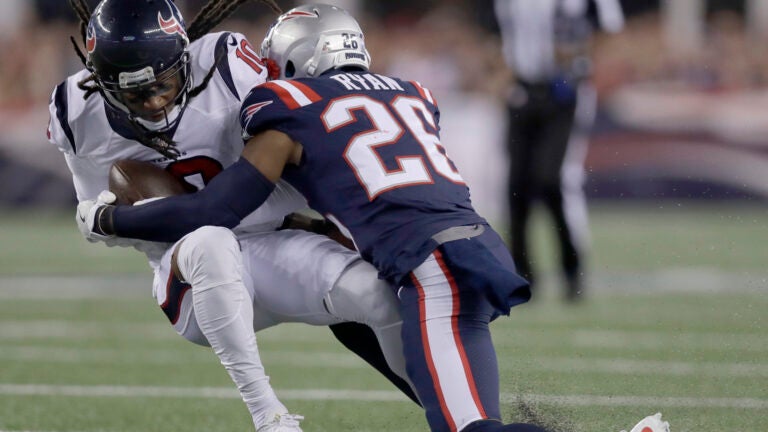
His reward came in the form of a fourth-quarter interception – the first of his career, and one of three on the night for the Rutgers contingent in the Patriots’ secondary – but Logan Ryan was excellent all night. He registered a sack with a well-timed blitz early on, got his hands on a couple other passes in addition to his pick, and finished with seven tackles.
Earlier this season it looked as though the fourth-year cornerback might have regressed after a strong 2015 campaign, but Saturday’s interception was his third in the past four games. Ryan is a free agent at the end of the season, and with that potential payday now just a game or two away, this surge could constitute a late contract push. And Saturday suggests the Patriots stand to benefit from that motivation.
LEWIS’ TALENT TRUMPS HIS FUMBLES
Over his four seasons with the Patriots, Stevan Ridley fumbled the ball 11 times over the 923 times he held it, or roughly once every 84 touches.
Over his two seasons with the Pats, Dion Lewis has now held the ball 186 times, and put it on the ground five times, or roughly once every 37 touches.
Ridley’s ball security issues appeared to cost him the trust of his coaches, and there were occasions where a fumble would quickly result in his benching and suggest a no-tolerance policy for New England running backs.
That same standard and those same stigmas don’t seem to apply to Lewis – despite that he’s fumbling more than twice as often – and Saturday night showed why. While Ridley was a decent workhorse back, a healthy Lewis has explosiveness and elusiveness that gives the Patriots offense a dimension unlike any other on the roster. His receiving touchdown displayed the burst he brings out of the backfield, his kick return score demonstrated his pure speed, and his running score showed that with all of that he’s strong enough to run inside when it’s needed.
If he didn’t have that difference-making skill set, it’d be easier for the Patriots to trust James White (who has one fumble in 189 pro touches) or Blount (whose ball security Josh McDaniels has raved about). Instead, it appears Belichick and his coaches are willing to accept some risk for the potential reward of trusting Lewis – and the possibility that even if he essentially gives up a touchdown, he could make up for it with three of his own.



To comment, please create a screen name in your profile
To comment, please verify your email address
Conversation
This discussion has ended. Please join elsewhere on Boston.com