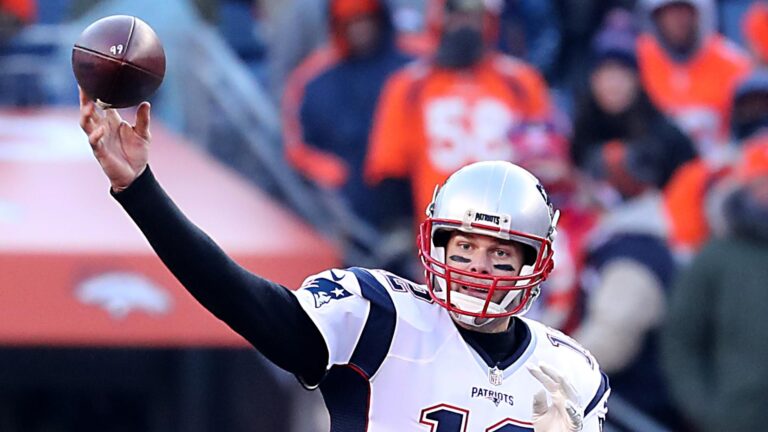
His 68.2 rating was his worst of the season by nearly 25 points, and ranks 206th among his 234 career starts. He made too-quick decisions sometimes, aware and even wary of a Denver pass rush that folded, spindled and nearly mutilated him time and time again during the Patriots’ season-ending loss in the AFC Championship Game a year ago.
Those were, undeniably, mediocre numbers even by a mediocre quarterback’s standards, let alone a passer of Brady’s unfathomable level of ongoing accomplishment. And yet, after the satisfying Sunday was over, and the Patriots had beaten a non-Tebow version of the Broncos in Denver for the first time since their Safety Dance in 2003, my feeling about Brady’s performance strongly ran contrary to what the stat sheet was trying to suggest.
I thought the performance — not the numbers, but the performance — enhanced Brady’s case as the most valuable player in the NFL this season.
Even while acknowledging all of the good things — LeGarrette Blount and Dion Lewis teaming up to add effective versatility to the running game, and the suddenly lively defense swarming to the ball and creating turnovers again, and Ryan Allen’s pinpoint punting, and all of the other elements that went in to pulling off such a fulfilling team win — it still doesn’t happen without Brady helming it all.
He did what the best, and only the best, quarterbacks do on their down statistical days: He recognized the value of playing mistake-free football under extraordinary duress, against that pass rush and those defensive backs, in that torturous venue, with the Broncos’ season practically hanging in the balance. And so he did it. Even on his worst statistical days — and let’s not forget, there were some beautiful, crucial third-down throws, particularly to Julian Edelman, when the Patriots were fending off the Broncos in the second half — Brady does what the Trevor Siemians of the world cannot. He refuses to make the game-turning mistake.
That occasional, necessary conservative efficiency is not the most appealing aspect of his value, of course. If he is to win the NFL MVP award this year despite missing at least 25 percent of the season — and according to ESPN, he has 2-1 odds, second only to Dallas rookie running back and kettle-jumping enthusiast Ezekiel Elliott (15-8) — certain numbers will be a large part of his case. He leads the league in touchdown-to-interception ratio (22-2), but he’s only eighth in completion percentage (66.9), trailing the likes of Sam Bradford, Brian Hoyer, and Ryan Tannehill, and his counting stats (3,064 passing yards, 22nd in the league; 22 touchdown passes, tied for 12th) take a hit because of the time he was forced to miss.
The irony is that to win the award, it would probably behoove him to fatten up his stats against the Jets and Dolphins, the latter of which could be a meaningless game in all other relevant matters.
Maybe he will do that, maybe he won’t, but that won’t change the long-established reality and the reason why Brady remains the most valuable player in the National Football League whether he formally receives the honor or not. The only statistics he cares about are Patriots Football Games Won and Lombardi Trophies Collected.
Sunday, he did not compile his usual statistics. Instead, he pulled a 2015 Peyton Manning: He won in Denver by eliminating mistakes. The victory proved his indispensable value in a more subtle and gritty way than usual.
More important, it looks like a significant step toward achieving what he really covets this season. Yes, MVP trophies are nice, and Brady deserves to win it this year, despite the effect on his statistics of the league-mandated hiatus. But that certain silver trophy that comes accompanied by a confetti shower after the final game of the season? That’s what it’s all about. That’s what Tom Brady is all about. And that’s why no one will ever be valued more.





To comment, please create a screen name in your profile
To comment, please verify your email address
Conversation
This discussion has ended. Please join elsewhere on Boston.com