
What the Tom Brady decision means for Adrian Peterson and the rest of the NFL
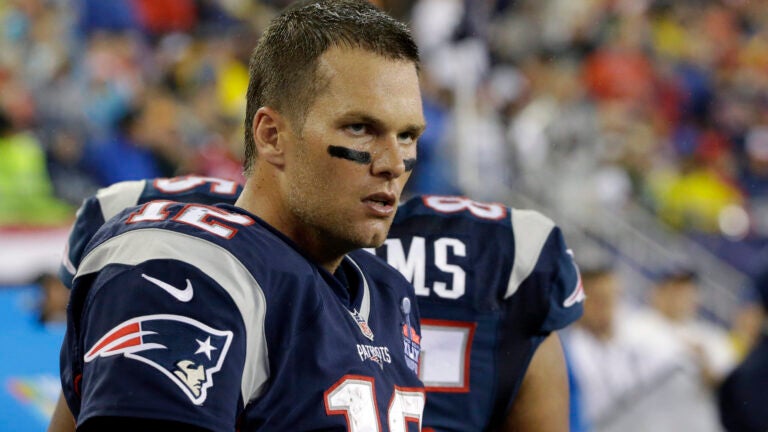
The Tom Brady case is dead. Long live the Tom Brady decision.
The Patriots’ embattled signal-caller is back on the field, and pending the outcome of a far-off appeal that experts say is more or less going to be rubber stamped, his battle against the NFL is over — but its legal implications will be felt for years.
On Friday, Brady attorney Jeff Kessler sent a letter to the Eighth Circuit appellate court in Missouri, where the NFL’s appeal of the Adrian Peterson is being heard. This was done through a federal procedure that lets litigants introduce new legal authority pertinent to an ongoing case.
Like Brady’s case, Peterson’s hinged largely on the lack of “notice’’ he could be punished as harshly as he was for his domestic violence incident last year, and so the decision could be used to inform the judge’s decision there, according to Daniel Wallach, an appellate expert and sports attorney with Florida-based Becker & Poliakoff.
[fragment number=0]
It may fall on deaf ears, though: The Eighth Circuit Court of Appeals, which hears cases from Arkansas, Iowa, Minnesota, Missouri, Nebraska and North Dakota, is a higher authority than the Southern District Court of New York and thus may not to consider the lower court’s opinion in authoring its own.
“It would actually be rare for a circuit court to even rely at all on a district court opinion, let alone a district court opinion in another state,’’ said attorney Alan Milstein, who represented Maurice Clarett in his fight against the NFL a decade ago.
Story continues after gallery
Other punishments issued by Roger Goodell
[bdc-gallery id=”121318″]
Wallach, on the other hand, believes the importance of the “notice’’ argument to both decisions means the Missouri-based appeals court will take U.S. District Court judge Richard M. Berman’s opinion into consideration.
Whether or not the Brady case and decision influence the Peterson case, they have several potential ramifications for the NFL, chief among them their setting the Southern District Court of New York as the likely battleground for future disputes between the NFL and its players.
The NFL filed its motion to confirm Roger Goodell’s arbitration finding in New York minutes after it was issued in a successful attempt to pre-empt the NFLPA’s filing a competing motion to vacate in Minnesota, where Peterson’s suspension was overturned and which has historically been player-friendly. The NFLPA indeed filed in Minnesota the following day. The judge assigned the case opted to defer to the New York court citing the “first-filed’’ rule, also including in his reasoning a footnote saying the case had no geographic ties to Minnesota.
While it’s possible a future case involving a player could be heard in his team’s local court (Peterson’s was heard in Minnesota because he is a Viking) Wallach said “forum-shopping’’ like the NFLPA attempted here is unlikely to work, meaning it’s likely future cases end up in Manhattan, where the NFL is headquartered.
But the NFL shouldn’t expect any sort of home team advantage: Should the Second Circuit Court of Appeals confirm Berman’s ruling, it would set a binding precedent there that weakens Roger Goodell’s ability to punish players for the broad offense of “conduct detrimental to the league’’ per the current league collective bargaining agreement.
“It was a sweeping, scathing decision issued by Judge Berman,’’ Wallach said. “The precedental effect of Judge Berman’s decision, especially if it’s affirmed on appeal, will be that this is the supreme ‘law of the shop’ in future NFL cases.’’
And because this precedent so curtails Goodell’s authority to issue penalties for equipment violations like the one alleged in Deflategate – which the current CBA says brings discipline “including but not limited to’’ a $25,000 fine – Milstein expects the league to issue a clarified punishment schedule like it did after the Ray Rice scandal last year.
So, too, do the experts say the decision will effect how the NFL issues its penalties and how it handles arbitration. Despite Berman’s not ruling on whether Goodell was inherently biased as an arbitrator and thus unable to fairly preside, both Wallach and Milstein agree the NFL would be wise to rethink letting Roger Goodell review the league’s decisions.
And Berman’s ruling the NFL erred in not making league attorney and Wells Report co-author Jeff Pash available for questions as well as denying the Brady camp access to Wells’ investigative notes means the league should be more forthcoming in future arbitration cases.
“The NFL will certainly learn a lesson from the Berman decision about the procedures it needs to follow for the arbitration – making sure the witnesses that need to be called are called and the documents that need to be produced are produced,’’ Milstein said.



To comment, please create a screen name in your profile
To comment, please verify your email address
Conversation
This discussion has ended. Please join elsewhere on Boston.com