
How the NFL Monitors Its Players
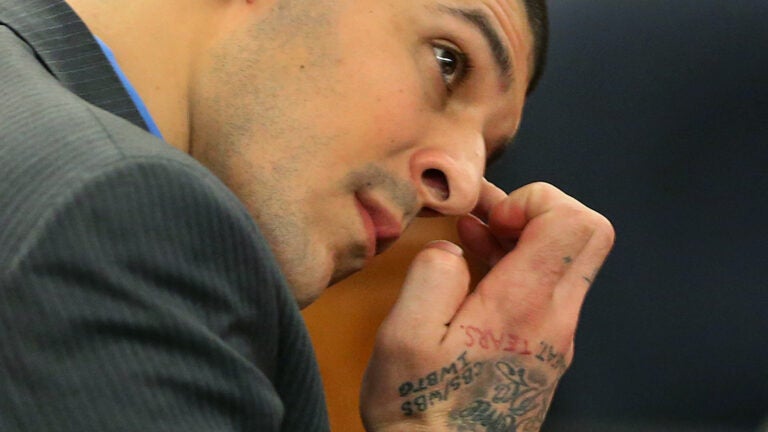
Shortly after signing his five-year, $40-million extension in Aug. 2012, Aaron Hernandez presented Patriots owner Robert Kraft with a $50,000 donation to the Myra Kraft Giving Back Fund, a youth scholarship fund named in honor of the team owner’s late wife.
“I said, ‘Aaron, you don’t have to do this, you’ve already got your contract,’’’ Kraft said at a charitable gala in 2012, according to ESPN. “And he said, ‘No, it makes me feel good and I want to do it.’’’
Hernandez’s NFL draft stock originally dropped in large part due to character concerns, but in this moment, it appeared — at least outside the closely guarded confines of Gillette Stadium — the Patriots’ latest reclamation project was an unqualified success.
But after Hernandez was arrested less than a year later, stories began trickling out that Hernandez’s tenure with the team was more controversial than was let on. Former New England offensive lineman Matt Light told the Dayton Daily News he ‘never believed in anything Aaron Hernandez stood for.’ An NFL source told The Boston Globe’s Shalise Manza Young a rookie Hernandez once threatened Wes Welker.
[fragment number=0]
Just after Hernandez was arrested, police in Massachusetts began investigating a 2007 shooting in Gainesville, Fla. in which Hernandez may have played a role. ESPN was able to obtain a report placing Hernandez at the scene through a standard records request, though the Gainesville Police Department would later say it was “fulfilled in error.’’ And while appearances were good, the trial has shown Hernandez was at least involved with shady characters.
What’s unknown is just how much the Patriots and the league knew about the star tight end, but one thing is for sure: the NFL’s investigative arm – and New England’s local team security – are top notch.
In the NFL, players and personnel are monitored by a nationwide investigative network known as NFL Security. And they’re good.
“Outside of the CIA and the NSA, one of the great investigative arms in all of America is NFL Security,’’ said Don Yaeger, co-author of Pros and Cons: The Criminals who Play in the NFL. “I will tell you… it’s amazing what a good job they have done of generally having their finger on the pulse.’’
NFL Security is comprised of 13 members at league headquarters in New York City, along with a pair of on-the-ground investigators in each of the 31 NFL cities plus Las Vegas, Los Angeles and Hawaii, NFL Spokesman Brian McCarthy said.
It’s headed by Jeff Miller, former commissioner of the Pennsylvania State Police, with most of its approximately 70-strong force made up of former state, local and federal law enforcement. Its tasks include ensuring stadiums are safe and up to league standards, conducting background checks on players entering the league, and monitoring and investigating possible league conduct police violations or “anything that would also interfere with the integrity of the game,’’ McCarthy said.
The seeds of what would become NFL Security were sown in 1947 when a New Jersey gambler was arrested on charges of trying to bribe two players. But it would not exist in the form it does today until 1963, when a gambling scandal drew the ire of as high an institution as the United States Senate, Dan Moldea writes in his 1989 book Interference: How Organized Crime Influences Professional Football. In the wake of that crisis, then-commissioner Pete Rozelle created NFL Security.
While it’s relatively small considering the scope of the league, NFL Security’s reach is long: the league maintains a nationwide web of law enforcement contacts who immediately inform it of any incidents involving NFL players, Yaeger said – even if the player in question is merely involved and not a suspect. If the incident warrants an investigation, they conduct one.
Each NFL franchise maintains its own security operation, though they work closely with the league’s investigators. The New England Patriots’ staff is led by former Wembley Stadium security chief Mark Briggs, but little else is known – a representative for the team said they have a policy of not discussing security operations publicly. According to Yaeger’s sources, the team has a network of “several former law enforcement types from Boston,’’ working for them full-time, so any time a Patriot’s name pops up in an investigation, the team finds out.
While behavior like Hernandez’s may go unnoticed or unchecked in some NFL locker rooms, Yaeger said it’s shocking to think the Patriots were caught unaware given both the quality of their security operation and a culture of players self-policing the locker room.
“The irony of this entire thing is that in many ways other teams look up to them and say ‘wow,’’’ Yaeger said. “They’ve done such a good job of internally policing. The locker room culture is so strong.’’
Yaeger said many in the sports community were hopeful NFL Security’s file on Hernandez – which would have included his pre-draft report and subsequent findings from his time in the league – would be entered into evidence in his trial, but it’s remained under wraps.
“They wanted to know, ‘what did New England know and when did they know it?’’ Yaeger said. “They wanted to know, outside failed drug tests and surly behavior and alcohol, issues involving a couple teammates – outside those things, what did they know about Aaron Hernandez?’’
But without that file becoming public, it’s unlikely those outside the league office will ever know just how much the NFL knew about Hernandez.
The Aaron Hernandez Murder Trial in Pictures
[bdc-gallery id=”316750″]





To comment, please create a screen name in your profile
To comment, please verify your email address
Conversation
This discussion has ended. Please join elsewhere on Boston.com