
Free Passes: How Brady and Manning Helped Ruin Pro Football
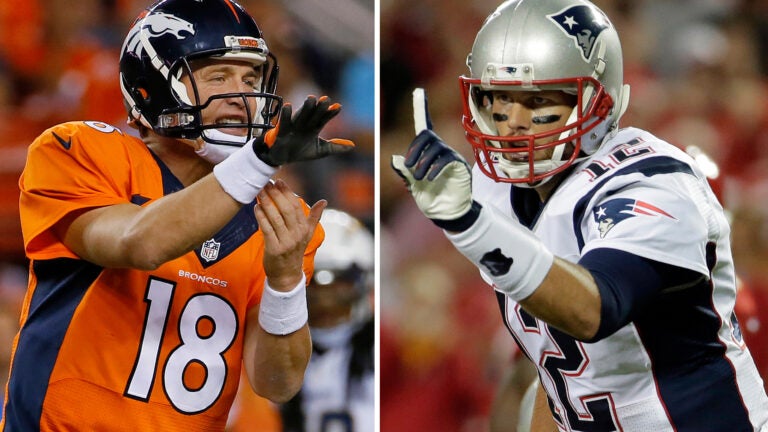
Tom Brady had one of the four or five best games of his Hall of Fame career last Sunday against the Bears, completing 30 of 35 passes for 354 yards and five touchdowns. He wasn’t even named AFC Offensive Player of the Week. Ben Roethisberger of the Steelers passed for 526 yards and six touchdowns.
Peyton Manning was superb in the Broncos’ victory over the Chargers last week, completing 25 of 35 passes for 286 yards and three touchdowns. The only thing anyone remembers about the game is how Manning called out the Denver scoreboard operator after the game in the most Peyton Manningesque moment of all time. Eleven other NFL quarterbacks threw for more yards in Week Eight of the 2014 season.
The cliché goes that the NFL is a “passing league.’’ The truth is it’s become a “passing gets easier all the time league.’’ Two magnificent games by the best quarterbacks of the 21st century were no more than above league average and above average respectively. And so far this year, Hall of Fame caliber work is about the league median for passing statistics.
When Brady and Manning began their careers, a quarterback who completed 60 percent of his passes in a season was a marvel. John Elway did it three times, Dan Marino five times, to name a couple of fair passers. Today, there are exactly four NFL starting quarterback who’ve completed fewer than 60 percent of their passes, and one of them, Geno Smith, no longer starts.
When Manning and Brady were young, a quarterback with an NFL passer rating of 100 or higher was a cinch MVP. At the midway point of this season, seven quarterbacks, including them, are over 100, and five more are between 95 and 100.
Brady led the NFL with touchdown passes in 2002 with 28. He might have more than that by Thanksgiving this year and as far as the Pats go, he’d better. In 2002, he also threw 14 interceptions. A 2-1 ratio of touchdowns to interceptions was considered super back then. Elway only accomplished that feat in three seasons, Marino in two.
Brady has 18 touchdowns and two interceptions in eight games in 2014, Manning has 22 TDs and three picks in seven games. Eight other quarterbacks have a 2-1 or better touchdown to interception ratio, including passers not famed for their accuracy such as Joe Flacco, Colin Kaepernick and Eli Manning. Though it’s an event that is now rare, the interception has become the most important play in pro football. Ask Brady about the Chiefs game if you don’t believe me.
Passing, in short, has become so much less difficult that Brady and Manning have to shatter records just to stay atop the quarterback pile and keep their teams atop the playoff heap. There’s a certain irony in that. Brady and Manning, or more accurately things that happened to Brady and Manning during their careers, are one big reason throwing the ball in an NFL game has become a game of backyard catch.
Everyone not getting paid by the NFL or its broadcasting partners knows WHY passing is so much easier. A series of rules changes and changes in rules interpretation have made playing pass defense damn near impossible. Study those changes, and we see they are closely related to bad stuff in Brady and Manning’s otherwise jolly NFL lives.
In the 2004 season, Manning and the Indianapolis Colts set a passel of individual and team offensive records. They then lost a playoff game to the Pats 20-3 as New England’s defense mercilessly harassed Manning’s receivers. Then Colts GM Bill Polian bitched so loudly about this manhandling that prior to the 2005 season officials were instructed to call downfield contact penalties more strictly.
In the opening game of the 2008 season, Brady suffered a severe knee injury when he was hit by a Chiefs defender as he dropped back to pass. The following winter, a rule was passed forbidding pass rushers from hitting quarterbacks at or below the knee. It was immediately dubbed the Brady Rule.

Last season Manning and the Broncos broke all the passing and scoring records Brady had previously set in 2007. They were then humiliated by the Seahawks in Super Bowl XLVIII as Seattle’s defense employed creative mayhem on Manning’s targets to devastating effect.

At the next league meeting, officials were instructed to make downfield contact between receivers and defenders a “point of emphasis,’’ meaning a zero-tolerance policy. Penalties have increased at roughly the same pace as passing yards.
If you can’t hit the quarterback high or low, he’s going to have more time to throw. If staying close to a receiver is borderline illegal, there will be more easy completions, fewer interceptions, and a sharp increase in QBs with Canton-worthy stat lines.
None of this was Brady or Manning’s fault. They have taken advantage of the changes, but that’s their job. Each man would have been a Hall of Fame player if they had performed in the ultra-violent 1960s and 1970s when defenses held the higher cards.
But when Kyle Orton has a passer rating of over 100, football is out of whack. Speaking as a lifelong fan, I found the second half of the Steelers-Colts game unwatchable as Roethisberger and Andew Luck threw pass after pass. It didn’t end until close to 8 p.m., and I wonder what CBS executives thought about that, not to mention the producers of their Sunday night prime time programs.
NFL owners love the all-score, all-pass league of today. It’s their creation after all. I believe they misunderstand their sport. Football’s appeal is built on violence, not an ever-changing scoreboard. It is a disservice to the skills and wills of Brady and Manning to make what they do easier to emulate. Commonplace excellence is an oxymoron supreme.
There are doubtless many fans who love it, too. I hope they and their fantasy teams are very happy together. I know I loathe it more each record-breaking week. I’m pretty sure that if he were alive, Vince Lombardi would loathe it more than I do.





To comment, please create a screen name in your profile
To comment, please verify your email address
Conversation
This discussion has ended. Please join elsewhere on Boston.com