
The Knuckles: Horrible College Coaches and Perplexing Events in the Pacific Northwest
It’s all football all the time in this week’s edition of The Knuckles. We all know how many knuckleheads roam the crowded landscape of both the NFL and NCAA Division 1, and they sure are easy targets. They didn’t disappoint this past week.
Some of our winners have earned their prestigious honors for more serious reasons than others, but the common thread among them all is that they are all knuckleheads. They come in all shapes, sizes and contexts, and we wouldn’t want it any other way.
College football’s national champions and the defending Super Bowl champs are represented here, just the same as perennial losers like some of the longest suffering denizens of the dregs of pro football. We’re an equal opportunity outfit here at The Knuckles. So without any further ado, let’s have a look at this week’s lucky and deserving winners.
BRONZE – The Cleveland Browns: God save the Cleveland Browns, who used last Sunday to remind us all what a bunch of sad sacks they are. You know, in case anyone forgot.
Sitting pretty at 3-2 and coming off two hugely impressive wins in a row (an historic comeback against Tennessee and a blowout of division rival Pittsburgh), the Brownies invaded Jacksonville and were crushed by the Jaguars, arguably the NFL’s worst team, for their first win of the year.
It was a classic case of a team thinking it’s better than it actually is, playing a doormat and assuming just showing up will guarantee a win.
Instead, it was just the Browns, embarrassing as always. Former Tom Brady-protégé, Brian Hoyer, who’s been pretty good as Cleveland’s starter thus far, played one of the worst games imaginable for a quarterback, completing just 16 of 41 pass attempts for 215 yards, a fumble lost and a pick. That’s 39 percent, and if you guessed that’s a season low for any QB in the entire league, you win. And it was even worse than the numbers portrayed. Some of his incompletions were unimaginably bad, missing open receivers by multiple feet on a number of occasions.
But the Browns were only down 10-6 with a little over six minutes left when they forced a punt. But for some reason, even though he was inside the 5-yard line, return man Jordan Poyer tried to field the kick, it clanked off his shoulder pad and the Jags recovered at the eight. They scored on the next play and on the second play of Cleveland’s ensuing possession, Hoyer tossed his interception. Game over.
I suppose being surprised at the Browns losing a game ever makes me a knucklehead. But the fact that they could take any opponent lightly, even a team as eternally awful as the Jacksonville Jaguars, takes the prize.
[fragment number=0]
SILVER – The Seahawks: Can’t figure this one out at all. On the heels of the Seahawks’ stunning trade of Percy Harvin to the Jets last Friday came the usual hatchet jobs on what a bad seed Harvin is/was and how that’s what led to the defending champs shipping him out not even a year and a half into their massive investment in him.
The most compelling of these postscripts was compiled by Bleacher Report’s Mike Freeman, a national NFL reporter formerly of CBS, who, among other things, writes a column every week titled “10-Point Stance,’’ in which he addresses a variety of timely league topics. The No. 1 item in this week’s post looks at the relationship between Harvin pre-trade and Seahawks’ QB Russell Wilson.
Freeman, using the decade-old conflict between Donovan McNabb and Terrell Owens from TO’s Philly days as a reference point, sheds some light on what he thinks is at the crux of why Harvin was banished. Freeman reports that some Seahawks’ players, with Harvin acting as “an accelerant,’’ had/have issues with Wilson, from his relationship with the team brass, to his failure to take the proper amount of responsibility when mistakes are made, to a racial component, which he says is that “some of the black players don’t think Wilson is black enough.’’ He also notes that this feeling is “backed up by several interviews with Seahawks players.’’
Without delving too deeply into any of Freeman’s specific points, what’s most significant about the trade is that Seattle gave up a first round draft pick, a third round draft pick and a seventh round draft pick just to bring Harvin into the fold in March of 2013, then signed him to a six-year, $67 million contract with $25.5 million guaranteed. And then gave him to the Jets in exchange for anywhere from a second to a fourth rounder. Or, as Freeman called it, “a peanut butter and jelly sandwich.’’
It appears the team found Harvin so toxic that despite being on top of the football world just about nine months ago, it was willing to swallow that much capital just to make him go away. Give credit to the organization for publicly admitting such a massive error. Place the blame for things reaching this kind of boiling point not just at the feet of Harvin but at the feet of those players who supposedly sided against Wilson.
While it’s hardly surprising to be inundated with hit pieces on a departed player/coach/manager on his way out the door, it’s a stretch to believe that Freeman’s sources aren’t at least sort of credible. Clearly, something was seriously wrong in the Seahawks’ locker room, clearly Harvin was right in the middle of it and clearly that’s why the team tossed him overboard to save itself despite the cost. And even if Wilson, whose public persona and the way he comports himself has been compared to none other than Derek Jeter, is a complete fraud. He still led the Seahawks to a title, their first ever, in just his second year. Doesn’t he deserve at least a shred of the benefit of the doubt? Do those players not in his camp have such short memories that they allow such nonsense to supersede how impressively he led them last year?
Harvin may indeed have been the accelerant that made some problems that already existed even worse. And that makes him a knucklehead. But his teammates who stood with him and emboldened him in becoming such a problem are just as guilty.
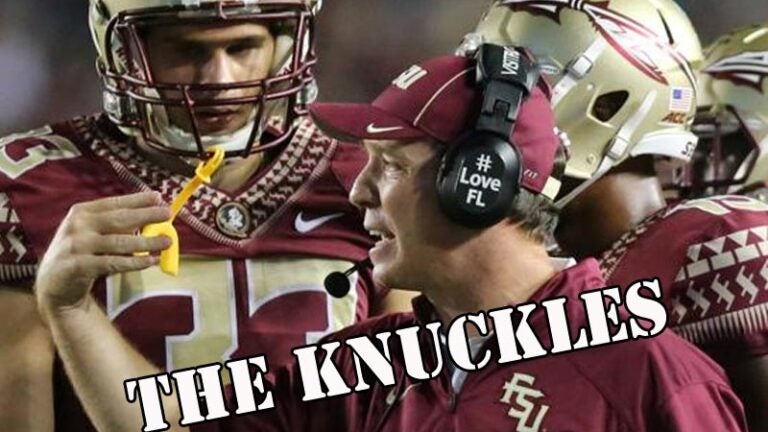
GOLD – Jimbo Fisher: Even if you don’t pay attention to sports at all, you’ve likely heard of Jameis Winston, the Florida State quarterback who threatens to retire the award for biggest knucklehead on earth seemingly every week. But instead of rehashing all of the reasons why, let’s turn our attention to his head coach, a dude who goes by the name of Jimbo.
[fragment number=1]
Yep, that’s his name. Jimbo Fisher has been in charge of the Seminoles’ program since 2010 after serving a three-year apprenticeship under the school’s head coach emeritus, Bobby Bowden. Jimbo has made an art form of enabling Winston, his meal ticket, for a couple of years now. And why wouldn’t he? The ‘Noles won the National Championship last season despite Winston’s alleged involvement in a sexual assault, the investigation of which was botched and bungled, perhaps intentionally, by both the university and the Tallahassee police department.
Now, Winston faces a student code of conduct hearing in regard to the allegations, and he’s already been suspended for one game (as well as a handful of baseball games last spring) for… well, for being a knucklehead in public. And last but not least, he’s facing allegations that he was illegally compensated for signing a few hundred autographs for a known memorabilia website.
What a guy.
But remember, this is all about his chief benefactor, good ol’ Jimbo, who has been publicly quoted discussing how “classy,’’ Winston is and saying that “he’s done nothing wrong.’’ Maybe Jimbo believes these things. Or maybe he just thinks he has to say them as a way to thank Winston for making his career. But there’s a real boundary between standing behind one of your players and openly enabling him and saying that Winston has done nothing wrong, even if he’s never been convicted of or punished for anything, is not only an example of enabling, it’s disingenuous to the point of being insulting. Jimbo crosses that boundary with regularity.
It’s foolish to assume that Jimbo or FSU will ever do anything to truly address all of the issues plaguing Winston. There’s too much money at stake. But why say more than you absolutely have to when asked about him? Why play dumb?
That may be a rhetorical question.
[fragment number=2]




To comment, please create a screen name in your profile
To comment, please verify your email address
Conversation
This discussion has ended. Please join elsewhere on Boston.com