
‘Magic in the Air’ is a slam dunk on a game that was defined by its joyful pursuit of aesthetic brilliance
“Professional basketball has become so analytical, so soulless at times,’’ wrote author Mike Sielski.
There’s a quote early in sportswriter Mike Sielski’s soaring new book on the history of the dunk that stuck with me when I read it.
“Professional basketball has become so analytical, so soulless at times,’’ wrote Sielski, a Philadelphia Inquirer sports columnist, in “Magic In The Air,’’ “that a player whose game and fame are predicated on pulling off spectacular dunks …. stands out like a beam of light.
“Joy used to be the rule, not a secondary consideration,’’ he continued. “Maybe we can get back there again.”
In the aftermath of last weekend’s NBA’s All-Star debacle — which felt not like a celebration of the sport, but more like a corporate retreat hosted by an achingly obnoxious Kevin Hart, with intermittent basketball interludes — Sielski’s lines more than lingered.
It felt like a diagnosis demanding an overdue treatment.
So I asked him: How do we get back there again?
“Adam Silver sure would like to know,’’ said Sielski of the NBA commissioner. “You know what I think it is? I think there’s an aesthetic aspect that basketball is missing.”
Not entirely, and not all the time, he noted. We agreed that Stephen Curry sticking long-distance daggers into Team France, for instance, during the gold medal men’s basketball game in the Paris Olympics is about as aesthetically pleasing as sports can be.
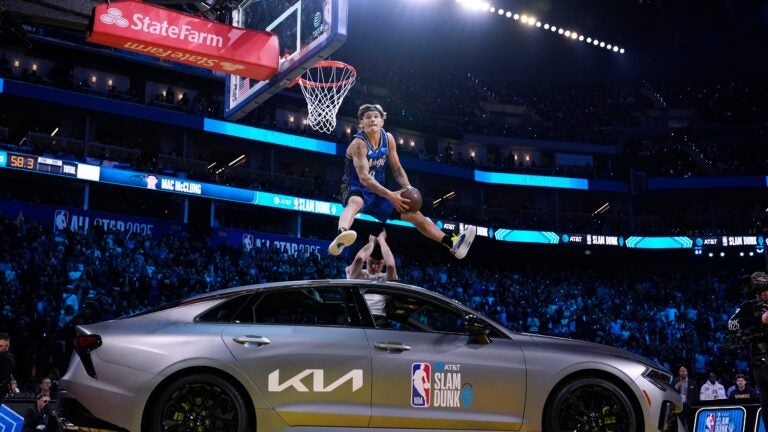
But familiarity and redundancy has sapped a sense of wonder, Sielski said. Mac McClung — the G-Leaguer and gymnast-in-basketball-gear who jumped over a car on his way to winning the dunk contest for the third straight year — is the rare exception. And even McClung comes with a bit of a sideshow aspect considering he has played all of five NBA minutes this season.
“The true joy of basketball derives from watching these athletes do what they do in a breathtaking way,’’ said Sielski. “The reason McClung is brought back for the dunk contest, and the reason why people remain interested in him, is because physically he defies every stereotype. He’s a short white guy, which suggests to the average viewer that there’s a challenge in him dunking the ball. It seems extraordinary when we see him do it and I think that sense of wonder has been lost because we’ve seen so much that it’s impossible to match the feeling of seeing Julius Erving or Michael Jordan dunk for the first time. That feeling is retained a little bit with someone like McClung, sort of like with [5-foot-6-inch dunk champion] Spud Webb in the ‘80s.
“Basketball right now needs more of those feelings, the sense that you’re watching something extraordinary and maybe even unprecedented. The NBA has to find a way back to that somehow.”
Such joy is easily found in Sielski’s book, which is not a chronological narrative history of the dunk, but structured rather as a series of compelling chapter-by-chapter stories that could stand as exceptional long-form features on their own. My favorites were on Joe Fortenberry, a massive Texan who played for the 1936 US Olympic team in Germany and was credited by New York Times sportswriter Arthur Daley with the first dunk, and David Thompson, the sky-walker for North Carolina State at a time when dunking was banned by the NCAA, and later an ABA and NBA superstar who became a what-if with the Denver Nuggets.
“I wanted to write a book that would be in-depth and tell the story of something in full, but also would be something that someone could pick up and read Chapter 8, and then Chapter 4, and each one would just be it’s own self-contained entity,’’ said Sielski, who said he was inspired by his friend Tyler Kepner’s book, “K’’, which told the story of baseball through history of all the different pitches. “I realized that the dunk would allow me to write about all of these gigantic figures in sport — Jordan and Dr. J and Bill Russell and Wilt Chamberlain — and tell some lesser-known stories too, like Joe Fortenberry’s.
“The end result, I think,’’ he said, “is that the book itself is full of joy.”

Basketball docs are must-watch
While the NBA may be searching for certain answers, we might just be in a golden age of documentaries about basketball. Netflix’s “Court of Gold,’’ a behind-the-scenes look at the men’s basketball competition at last summer’s Paris Olympics, will turn you into a Kevin Durant fan if you’re not already. And not just because he wears a Bruins hat through much of the six-part series. HBO Max’s “We Beat The Dream Team” doc — a way overdue telling of the band of US college stars that beat the original (and, really, only) Dream Team in a scrimmage during their tuneup for the ‘92 Olympics — is also excellent. And, around here, the most anticipated basketball doc of all – HBO Max’s epic nine-part “Celtics City” docuseries, executive produced by Bill Simmons – drops March 3.
ESPN, MLB to end partnership
The word Thursday night that ESPN and Major League Baseball will mutually end their 3½ decade rights partnership after this season wasn’t a surprise, though it was not expected to be announced this soon. But for those of us that permanently have the “Baseball Tonight” theme song rattling around in our heads, it is sad news. As Celtics radio voice Sean Grande noted on Thursday night’s broadcast, it’s disconcerting that ESPN is splitting with baseball, and TNT and the NBA are going their separate ways in the same year. Two sports television divorces that we couldn’t have imagined even a few years ago … Ch. 7 is carrying four Red Sox spring training broadcasts, starting with Sunday’s 1 p.m. matchup with the Blue Jays … Joe Buck will call a national MLB game for the first time since leaving Fox in 2021 when he handles play-by-play for the Yankees-Brewers Opening Day matchup on ESPN. I’ve missed Buck on baseball, so count me among those who have longed to hear it.





To comment, please create a screen name in your profile
To comment, please verify your email address
Conversation
This discussion has ended. Please join elsewhere on Boston.com