
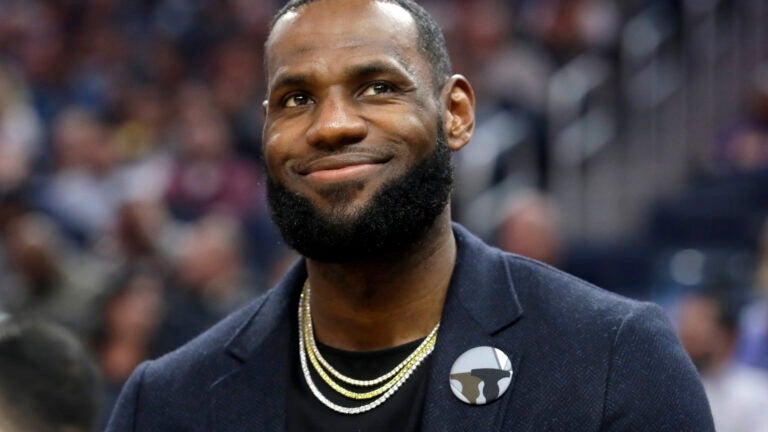
LeBron James and other stars form a voting rights group
“If you actually don’t put in the work or if you don’t have the mindset, there’s never going to be change.”
Related Links
“Because of everything that’s going on, people are finally starting to listen to us; we feel like we’re finally getting a foot in the door,” James said in a phone interview Wednesday. “How long is up to us. We don’t know. But we feel like we’re getting some ears and some attention, and this is the time for us to finally make a difference.”
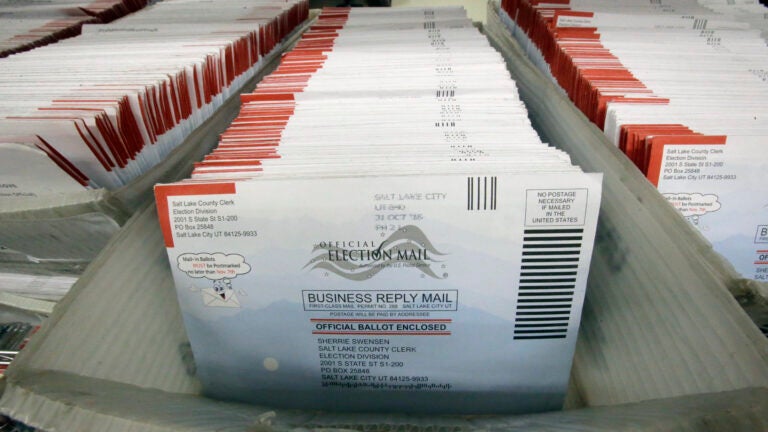
The organization, called More Than a Vote, will partly be aimed at inspiring African Americans to register and to cast a ballot in November. But as the name of the group suggests, James and other current and former basketball stars — including Trae Young, Skylar Diggins-Smith and Jalen Rose — will go well beyond traditional celebrity get-out-the-vote efforts.
James, 35, said he would use his high-profile platform on social media to combat voter suppression and would be vocal about drawing attention to any attempts to restrict the franchise of racial minorities.
“Yes, we want you to go out and vote, but we’re also going to give you the tutorial,” James said. “We’re going to give you the background of how to vote and what they’re trying to do, the other side, to stop you from voting.”
He made no mention of President Donald Trump, whom he has sharply criticized in the past, but he repurposed Trump’s slogan to hail America’s beauty, explaining, “We want to be beautiful once again.”
The new organization represents James’ most significant foray yet into electoral politics.
He has long said that he believes his greatest legacy will come from his off-the-court achievements. He has poured millions into his native Ohio, helping to underwrite college tuition for low-income students to attend the University of Akron and even opening his own school in the city for children in third through eighth grades.
He has also delved into entertainment, starting a media production company with his close friend Maverick Carter that has produced an HBO series, “The Shop,” in which the two men conduct casual interviews in a barber shop. James has also underwritten a series of documentaries.
Until now, though, his political involvement has mostly been limited to speaking out on social media and appearing at a single rally late in Hillary Clinton’s 2016 presidential campaign.
The death last month of George Floyd at the hands of Minneapolis police, however, helped convince James that he needed “to get out and do a little bit more.”
Invoking the names of an earlier generation of athletes who called for social justice, James, a forward for the Los Angeles Lakers, said he wanted to be a model for future generations.
“I’m inspired by the likes of Muhammad Ali, I’m inspired by the Bill Russells and the Kareem Abdul-Jabbars, the Oscar Robertsons — those guys who stood when the times were even way worse than they are today,” James said. “Hopefully, someday down the line, people will recognize me not only for the way I approached the game of basketball but the way I approached life as an African American man.” In some respects, James’ activism reflects a return to an earlier generation of athletes who used their fame to speak out about racial equality and the Vietnam War with little regard to whom it might offend.
And because today’s players have come of age in an era of social media, they want to engage in advocacy in their own voice.
“This group of athletes wants to feel empowered in every single way,” Carter said.
Jocelyn Benson, the Michigan secretary of state, said that “trusted voices” like James’ could help break through the din at a moment of rising skepticism toward the news media and both political parties.
“What we’re seeing in Michigan is, there’s a heightened need to inform citizens how to vote in this coronavirus era,” said Benson, a Democrat who is helping advise the group. “We’ve got to go beyond registering people to vote and talking about the importance of voting to actively combating voter suppression.”
The group, which will be organized as a 501(c)(4) nonprofit organization and therefore not engage in specific advocacy for a candidate, is still coming together, but James said he had found only willing ears in his recruiting conversations.
“I’m sick of seeing unarmed black men killed by the police,” said Diggins-Smith, a guard for the Phoenix Mercury, adding that she wanted “to put some action behind my frustrations, behind my anger, behind the helplessness that I’ve been feeling.”
For James and the other organizers, part of their motivation is to combat apathy among black voters. Older African Americans are historically reliable voters, but in 2016 there was a drop-off with younger black voters, particularly men.
“We’re not letting that happen again,” said Rose, who called Floyd’s death perhaps the most galvanizing killing since the lynching of Emmett Till.
Young, a 21-year-old breakout star with the Atlanta Hawks, said he was hoping to be a “role model for my generation.”
“If people my age see that I’m going out and I’m voting and I’m talking,” he said, “maybe the next 21-year-old will.”
On Monday, James convened a call that included Rose, the Detroit-raised former NBA star; Diggins-Smith; Draymond Green, a forward for the Golden State Warriors and another Michigan native; Udonis Haslem, a longtime Miami Heat forward who is from Florida; and NFL running back Alvin Kamara, who is from Georgia. James has also gotten a commitment from comedian Kevin Hart, a Philadelphia native, and is speaking to a number of musicians. James and Carter are putting up the initial funding.
The organization will team up with voting rights organizations, including When We All Vote and Fair Fight; and is being advised by Adam Mendelsohn, a former political strategist who has worked with James for nearly a decade, and Addisu Demissie, who ran Sen. Cory Booker’s 2020 presidential campaign.
It is James, though, who has the loudest megaphone. His social media following is unequaled among American athletes: He has more than 136 million followers among his Twitter, Facebook and Instagram accounts (a little more than 137 million people voted in the 2016 presidential election).
Now, he said, it’s time for his admirers to do their part.
“There’s a lot of people that want change in the black community,” James said, but he added, “If you actually don’t put in the work or if you don’t have the mindset, there’s never going to be change.”
As for his own plans this fall, he said he had not yet talked to Joe Biden, the presumptive Democratic nominee, but he did not rule out appearing on the campaign trail.
“We’ll see if we can help a candidate here and there,” James said.


To comment, please create a screen name in your profile
To comment, please verify your email address
Conversation
This discussion has ended. Please join elsewhere on Boston.com