Comparing the talent in each NBA conference after LeBron’s move to LA
Not surprisingly, the Celtics are an Eastern Conference aberration.
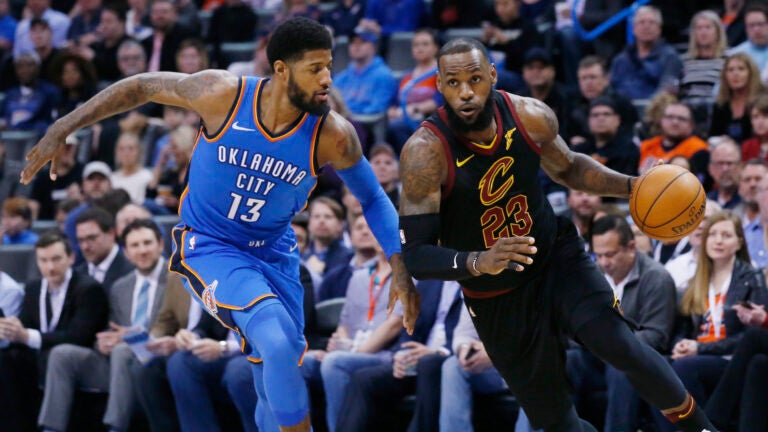
With LeBron James’s decision to sign with the Lakers, an already yawning talent gap became even more pronounced between east and west.
Accounting for just the 2018 NBA free agent signings to this point, it’s been all Western Conference. While James, Chris Paul, Paul George, and DeMarcus Cousins have all made waves out west, the Eastern Conference has had to settle for names like Ed Davis, Doug McDermott, and Joe Harris.
And while each of those latter mentions could excel in their own right, they hardly represent a group of equal gravitas as their Western Conference counterparts.
What exactly is the talent disparity of the NBA’s two conferences? Attempting to quantify exactly how much greater the top talent is in the Western Conference compared with the East is admittedly an inexact science, but – using a few basic markers, here’s a breakdown.
Standard stats
The most basic – and arguably flawed – method in comparing the Eastern and Western Conference talent pools is in standard stats.
In points per game, the narrative is confirmed, as James’s move to L.A. means the Western Conference now holds 12 of the top 20 scorers from a season ago, including seven of the top 10.
The remaining East scorers are:
Giannis Antetokounmpo: 26.9
Kyrie Irving: 24.4
Victor Oladipo: 23.1
DeMar DeRozan: 23.0
Joel Embiid: 22.9
Bradley Beal: 22.6
Kemba Walker: 22.1
Blake Griffin: 21.4
Tallying the top players in both rebounds and steals per game produces the same conclusion, as the west carries 12 of the top 20. Blocks per game is a category in which the East actually holds an 11-9 advantage.
Yet not only are these stats limited by the context of a particular team’s circumstances, they also only account for one particular measurement of the game. To gain a clearer (though still incomplete) view, it’s important to check another kind of NBA stat.
Advanced stats
Ultimately, advanced stats are a tool that measures specific factors, limited in their own right just like standard stats. Still, the recent additions to NBA player evaluating are a more comprehensive attempt to measure overall effectiveness.
With that in mind, most advanced stats continue to confirm the Western Conference’s clear superiority.
With James joining the Lakers, it means that the West now holds 14 of the top 20 players in 2017-2018 win shares per 48 minutes. And of that tally, only one Eastern Conference player ranks in the top 10: Kyrie Irving. The other five players from the East sit no higher than 13th.
Defensive rating is a stat that attempts to quantify an individual’s effectiveness within his team’s structure. As Basketball Reference notes, “Out of necessity (owing to a lack of defensive data in the basic boxscore), individual Defensive Ratings are heavily influenced by the team’s defensive efficiency.”
With that qualifier noted, many of the league’s top 20 players in defensive rating are clumped together on several teams. San Antonio has four players in the group, while Utah, Philadelphia and Boston each have three. In all, the Western Conference still holds a 12-8 advantage.
Value over replacement attempts to explain how much better a particular player is than an average counterpart. Not surprisingly, James ranks first (8.9), and western players hold the top six spots. Milwaukee’s Antetokounmpo (ranked seventh) is the highest positioned eastern player.
While nine of the top 20 players in value over replacement are from the Eastern Conference, the West’s dominance over the top 10 – holding seven spots – makes clear that in both standard and advanced stats, the Western Conference’s supremacy bears out.
All-Star teams
Another means of comparing the conferences is in the annual All-Star Game. Just as individual NBA statistics are flawed in a limited way, All-Star rosters are also imperfect. Yet they too can be informative about the nature of the two conferences.
Player movement, as James’s recent move emphatically underscored, is a major component of the East vs. West question.
Looking at recent All-Star teams, it’s been littered with examples of Eastern Conference talent who either left as free agents or were traded out west. This turned into an avalanche in the 2017 offseason:
Carmelo Anthony: Traded by the Knicks to the Thunder.
Jimmy Butler: Traded by the Bulls to the Timberwolves.
Paul George: Traded by the Pacers to the Thunder.
Paul Millsap: Left the Hawks in free agency for the Nuggets.
Even Isaiah Thomas, technically traded within the Eastern Conference, was eventually shipped out west by the Cavaliers in February (though he’s currently a free agent).
Eastern talent has moved within the conference in that time (Irving, Oladipo, and Al Horford being examples). But there has been exactly one Western Conference All-Star from the last three years to move east:
Gordon Hayward. That’s the list.
All-Star rosters, of course, aren’t representative of all the best players in the league. In this case, however, they help to showcase the almost exclusively westward flow of talent in the NBA over the last several years.
Salaries
One final method of comparing the Eastern and Western conferences is in how NBA teams compensate players. Just like the categories before, salary distribution is a highly imperfect manner of comparison. Nonetheless, it can also provide insight.
An initial observation is in the sheer disparity of East vs. West contracts handed out so far in 2018 free agency.
Between players like James, who have switched teams, to those like Kevin Duran and Chris Paul who have re-signed, Western Conference teams have agreed to hand out over $900 million in contracts already in the offseason.
The East, meanwhile, has reached only a fraction of that. Aaron Gordon’s $84 million deal to stay in Orlando leads the way, though it’s barely half of Paul’s equally long contract (four years).
Combining the projections of the new deals for Durant, James, Paul, and George along with the list of the league’s highest salaries according to Basketball Reference, the NBA’s 2018-2019 salary rankings tilt decidedly westward.
Of the top 20 salaries for next season (barring changes in the continuing offseason), 14 of them will play in the Western Conference. Among the Eastern players, both Hayward ($31,214,295) and Horford ($28,928,710) sit near the top.
The Celtics are a potential exception to the East vs. West debate, given Boston’s array of diversely acquired talent. In comparing Boston’s conference as a whole, however, it’s clear that James’s exit only adds to an existing disparity.