Doping whistleblower sues Russian Olympians and their oligarch backer, the Brooklyn Nets owner
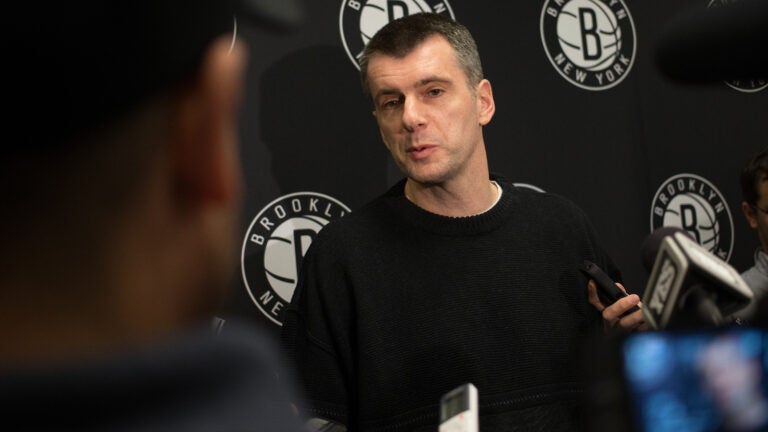
Grigory Rodchenkov, Russia’s former anti-doping lab chief who in 2016 publicly detailed the nation’s Olympic doping schemes and upended Russia’s standing in international sports, responded to a defamation suit Monday, countersuing several Russian Olympians and taking aim at the oligarch who is partly financing their legal fight: Mikhail D. Prokhorov, the controlling owner of the NBA’s Brooklyn Nets.
In New York state Court, Rodchenkov’s lawyers countersued three Russian biathletes who have called it libelous that he linked them to the state-backed doping scheme that corrupted the 2014 Winter Olympics in Sochi, Russia.
In court filings, Rodchenkov’s lawyers called that defamation suit an effort to intimidate and silence him, and also sued the financiers of the athletes’ suit. The countersuit invokes New York state’s anti-SLAPP law, intended to prevent people from using courts to intimidate those who are exercising their First Amendment rights. Rodchenkov is seeking to recover legal fees as well as damages from Prokhorov and an unknown other five financial backers.
Jim Walden, a lawyer for Rodchenkov, said of the biathletes’ suit: “It’s a frivolous suit that I believe is intended to flesh out where exactly he is,” adding that his client continued to fear potential retaliation from Russia.
Scott S. Balber, a New York lawyer representing the Russian athletes, said Monday that his clients had “lots of evidence that supports our claims that, in fact, Rodchenkov fabricated a lot if not all of the storyline” as it related to the three biathletes.
The escalating legal battle comes as Rodchenkov, who has been living in the United States since fleeing Moscow in November 2015, awaits a decision on his application for political asylum. It also comes as global sports officials are seeking to move beyond the yearslong doping scandal, which culminated in a ban of Russia at the 2018 Winter Games, though a significant number of its athletes competed as neutral participants.
Rodchenkov has cooperated with both anti-doping officials and criminal authorities in their investigations of Russia’s systematic doping. U.S., Austrian and French criminal authorities have conducted inquiries into potential crimes relating to the Russian sports fraud, which corrupted results at elite global competitions across multiple years.
Acting on Rodchenkov’s evidence as well as evidence gathered by anti-doping regulators, the International Olympic Committee disciplined nearly four dozen Russian athletes last year for connections to the doping system. Among them are the three biathletes suing Rodchenkov: Olga Zaytseva, Yana Romanova and Olga Vilukhina. (Each woman was stripped of a silver medal and is seeking $10 million in damages.)
But this year, nearly 30 of those penalized Russian athletes successfully appealed their punishments to the Court of Arbitration for Sport, the ultimate authority on global sports disputes. The court ruled that there was insufficient evidence that all athletes had violated doping rules.
Last week, the court published its first full reasoning for one such decision, in which cross-country skier Alexander Legkov had his punishment overturned because, the court said, it could not be certain the athlete himself had been personally involved in the cheating scheme, despite suggestive evidence that his urine sample had been manipulated.
Russian officials have seized on victories like Legkov’s, calling them a vindication of the nation’s athletes and a repudiation of Rodchenkov. In recent days, Russian officials have claimed that Rodchenkov has walked back or retracted his statements about Russia’s cheating.
“We see now as a fact that this person is confused with his testimonies, that he is actually confirming his lies and his slander,” Dmitry Peskov, President Vladimir Putin’s spokesman, told Russian state media last week.
But Rodchenkov’s lawyers — Walden, of Walden Macht & Haran, and Gregory L. Diskant of Patterson Belknap in New York — said their client “had not wavered,” calling him “very clear and very highly corroborated.”
“If the Russians seriously believe there is no state-sponsored doping system, why didn’t they produce the emails, the lab data, the stored samples at the Moscow lab?” Walden said, referencing certain specific evidence that regulators and investigators have long requested of Russia, which remains decertified by the global anti-doping regulator and barred from track and field competitions.
In the filings Monday, Rodchenkov responded to the libel claim with a simple defense: He argued he had told the truth, pointing to scientific and forensic evidence that later confirmed much of what he had told The New York Times in 2016.
Rodchenkov’s countersuit is likely to seek in depositions the names of the others who are financing the lawsuit against him, as well as information on the assets of Prokhorov, who this spring sold 49 percent of his stake in the Nets but remains the team’s controlling owner.
“Prokhorov has assets here,” Walden said. “We need to go about expeditiously securing them, so he doesn’t go about taking them out of the country. You can expect that’s what we’re going to be looking at next.”