
Get the latest Boston sports news
Receive updates on your favorite Boston teams, straight from our newsroom to your inbox.
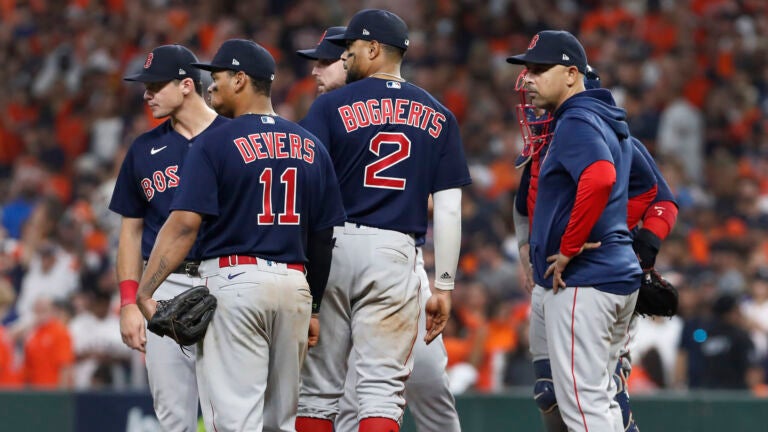
In an ideal world, Red Sox pitchers and catchers would start reporting to camp a couple weeks from now as MLB Spring Training ramped up throughout the league.
Given the current state of things, that almost certainly won’t happen.
Major League Baseball’s lockout continues as the league and players union appear no nearer to finalizing a new collective bargaining agreement to get the 2022 MLB season back on track. As the labor dispute drags on into March, the possibility of a shortened MLB season increases.
That means Opening Day at Fenway Park on March 31 could be in jeopardy just a year after fans finally got to return to the ballpark after the pandemic-altered 2020 season.
Here’s where things stand at the moment between the two sides.
Negotiations have moved onerously since the lockout officially began on December 2 of last year. The first meeting didn’t take place until January 13, about six weeks after the previous CBA expired.
The two sides have only met four times in total with little if any progress on key issues like arbitration eligibility, service time manipulation for players called up from the minors, and minimum salary increases.
During that time, the union has withdrawn its proposal to allow older players to reach free agency before reaching six seasons of service time, and has come down on the amount of pre-arbitration bonuses it requested by $5 million.
But the two sides are more than $100 million off on the minimum salary issue; the union proposed increasing minimum salaries for rookies to $775,000 while MLB wants to start at $614,000 before incrementally raising that number before players are eligible for arbitration.
Team luxury tax thresholds and revenue sharing are also at the heart of the dispute, and virtually no progress has been made on either front.
A reportedly heated meeting between MLB and the players union ended unproductively on Tuesday with the union budging slightly on just the arbitration bonuses and service time but nothing else.
After that, the league changed course, saying it would not counter the union’s proposal after originally stating it would do so and requesting federal mediation to work through the impasse.
The two parties similarly used mediation to help end their labor crisis in the strike-shortened 1994-95 seasons, though it couldn’t avert the cancellation of the 1994 World Series or help the ’95 season start on time. Mediators also cannot force an agreement to take place.
The players union has to approve the introduction of a federal mediator, though. On Friday, the MLBPA released a statement declining to do so, saying they still plan to negotiate.
Revenue isn’t the only thing being risked by potentially pushing the start of Spring Training or the regular season back. Players use that first month of the season to work their way back into game shape, even if they’ve been working out on their own during the winter.
A prolonged lockout could mean that ramp-up time for the regular season is drastically cut down as it was during the pandemic-shortened 2020 campaign. That puts players’ health and job opportunities at risk, says Red Sox pitcher Rich Hill.
“I’m not really looking forward to pushing spring training back,” Hill told ESPN baseball insider Buster Olney last week. “I think that’s ultimately what’s going to happen unless something drastic happens in the next couple of weeks here where we finally come to a decision and both sides have some Kumbaya and we can move forward. I think pushing spring training back, you’re putting guys at risk for injury during the season and the other side of it, too, is the development of guys who are coming up through the minor leagues.”
Hill warned an accelerated Spring Training could hurt both pitchers and hitters going into the season. As things stand, however, that appears to be the reality Hill, the Red Sox, and MLB players may have to accept.
Receive updates on your favorite Boston teams, straight from our newsroom to your inbox.



To comment, please create a screen name in your profile
To comment, please verify your email address
Conversation
This discussion has ended. Please join elsewhere on Boston.com