
New England’s place in an ‘insulting’ history of the Cleveland baseball team’s nickname
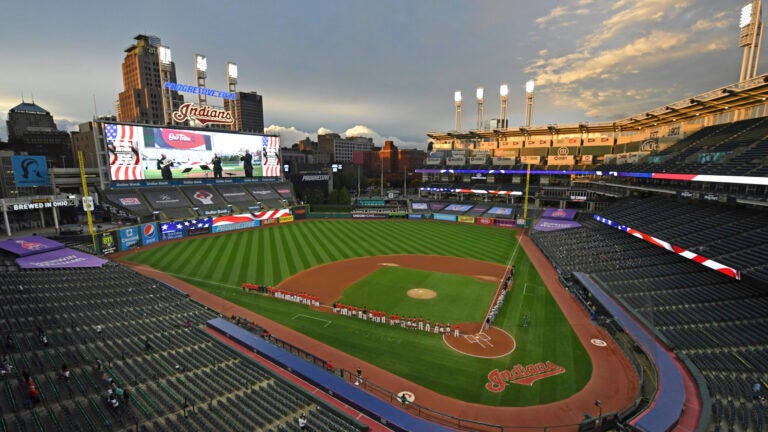
As recently as 2016, the Cleveland baseball team appeared to have no intention of changing either its “Indians” nickname, or its racist logo Chief Wahoo — a grinning, red-faced caricature of a Native American stereotype.
Two years ago, however, Cleveland officially rid itself of Chief Wahoo. On Sunday, the New York Times reported that after a months-long examination, Cleveland plans to drop its nickname as well. The team confirmed the news Monday.
Statement from the organization.https://t.co/IHa68yEQGA pic.twitter.com/gGS6xutSOy
— Cleveland Guardians (@CleGuardians) December 14, 2020
Per the New York Times, the nickname could be phased out completely as soon as 2021. It remains unclear how Cleveland will choose its new moniker.
How the name came to be
When arguing for the historical relevance of “Indians” as a nickname, Cleveland’s baseball team previously pointed to Louis Francis Sockalexis, who played for the team near the turn of the century. Sockalexis, who was a member of the Penobscot Indian Nation in Maine, was a multi-sport athlete who attended Holy Cross in Worcester. At Holy Cross, Sockalexis reportedly pitched three no-hitters and batted .436 and .444 in the 1895 and 1896 seasons respectively. He was later signed by Cleveland and is considered by many to be the first Native American athlete to play in the Major Leagues.
In Cleveland, Sockalexis was subjected to racist taunts from opposing fans, who showered him with slurs and war cries. Alcoholism reportedly claimed his career (and eventually his life), and local sportswriters latched on to “one of the most dominant and enduring Native American stereotypes, that of the drunken, lazy, and suspect Indian,” according to a 1998 examination of Cleveland’s use of Sockalexis’ story by Ellen J. Staurowsky, a professor at Ithaca College.
For years, the Cleveland baseball team said its name was meant to honor Sockalexis, but the Penobscot Indian Nation voiced objections to Chief Wahoo in particular. In 2000, per the Bangor Daily News, the Penobscot Indian Nation called on Cleveland to “recognize, accept and honor” Sockalexis and to “advocate for the elimination of racist images of Indians.”
In 1993, Sockalexis’ oldest surviving relative, Kenneth Paul, said that the team should change its logo.
“Wahoo or Yahoo, it’s more insulting than anything,” Paul said. “I think they should change the whole thing to something else. It won’t break my heart. It won’t break anybody’s.”
Staurowsky went even further, casting doubt on the idea that the name “Indians” was meant to honor anyone at all. Per Staurowsky, local papers never mentioned Sockalexis as the team attempted to select a nickname in 1915, and the Cleveland Plain Dealer reported at the time that the nickname was “but temporarily bestowed” until the team could “earn some other cognomen which may be more appropriate.”
A history of resistance
Still, Cleveland stuck with both the nickname and the Chief Wahoo imagery despite annual protests at Opening Day. When Larry Dolan bought the team in 2000, he said he had “no problem” with Chief Wahoo.
“If I did, I would consider a change,” Dolan said, adding later in the interview that if protestors wanted to have a dialogue about changing the name, “they need to understand where we’re coming from.”
All of this ran counter to demands by Native American groups that the team change the name and especially the mascot. In 2003, Steve Russell — a legal scholar and a citizen of the Cherokee Nation — wrote that “The Cleveland Indians are probably the least offensively named professional team, until you meet Chief Wahoo. It is like naming a team the ‘African-American Freedom Fighters’ and then making Sambo the mascot. It is like naming a team ‘La Raza’ and then resurrecting the Frito Bandito for mascot duty. No one can make the honor claim with a straight face, unless they seriously think Chief Wahoo is a straight face.”
In 2008, the Plain Dealer itself published an article entitled “Chief Wahoo Should Go,” quoting Charlene Teters, a founding board member of the National Coalition on Racism in Sports and Media, as saying, “Don’t insult my intelligence telling me this honors me. … It is ‘Little Red Sambo.'” In the same article, University of Michigan professor Gavin Clarkson — a member of the Choctaw Nation of Oklahoma, said the image of Chief Wahoo “reinforces the image of Indians as ‘anachronistic savages.’”
“It’s a powerful image,” Clarkson told the Plain Dealer. “If you ask someone from Cleveland, ‘quick, think of an Indian,’ chances are [Chief Wahoo] is the image.”
Team slowly begins to back away
Eventually, the noise grew deafening and the franchise began to distance itself from Chief Wahoo. In 2013, the National Congress of American Indians (NCAI) wrote that “actions by the MLB’s Atlanta Braves and Cleveland Indians to subtly alter logos and team branding in an attempt to mitigate harm while keeping established brand identity, indicates that management in these businesses understand the negative social impact of their brands.” Still, as the NCAI noted, “these actions also indicate an unwillingness to completely disavow their business from their brands for financial reasons.”
Cleveland reduced its use of Chief Wahoo in 2014, but still sold merchandise with the logo, and certain uniforms included Chief Wahoo hats through Cleveland’s run to the 2016 World Series. In response to protests about the logo at the time, a team spokesperson told the Washington Post they were “very cognizant and sensitive to both sides of the conversation” but had “no plans of making a change.”
In 2018, however, Cleveland finally relented and announced they would completely end use of the logo by 2019. Philip Yenyo, executive director of the American Indian Movement of Ohio, told WOSU he was “ecstatic,” but said, “They really need to change the name, too.”
“I believe if they don’t change the name along with getting rid of this logo, the things that have been going on down at that stadium all these years are going to continue,” Yenyo told WOSU.
Cleveland announced it would re-consider its nickname in July, as protests over racial inequality and police violence following the deaths of George Floyd, Breonna Taylor and others swept the nation. The franchise’s came on the heels of the Washington football team’s decision to ditch its own racist nickname as sponsors threatened to stop supporting them.
Yenyo told ideastream that Cleveland’s announcement was a positive, but he wanted the name changed as well.
“We have been calling to be at the table for over 25 years now and it seems like everything is coming to fruition,” he said. “If you’re going to do the right thing then just do it. They’re delaying the inevitable.”
On Sunday, the long-delayed “inevitable” came to fruition. Tara Houska, co-founder of the Not Your Mascot non-profit, reacted to the news on Twitter.
“Finally,” she wrote. “Literal generations of Native advocates rejoice! Dehumanization of our people at the national sports level takes another hit.
“Chi-miigwech, many thanks from this Anishinaabe woman, soon-to-not-be-called Indians.”
Chi-miigwech, many thanks from this Anishinaabe woman, soon-to-not-be-called @Indians ✊🏽❤️#NotYourMascot https://t.co/kbaUmWsuec
— tara houska ᔖᐳᐌᑴ (@zhaabowekwe) December 14, 2020
Get Boston.com's browser alerts:
Enable breaking news notifications straight to your internet browser.





To comment, please create a screen name in your profile
To comment, please verify your email address
Conversation
This discussion has ended. Please join elsewhere on Boston.com