Bob Costas has always connected with baseball
"I enjoy broadcasting baseball more than anything I do."
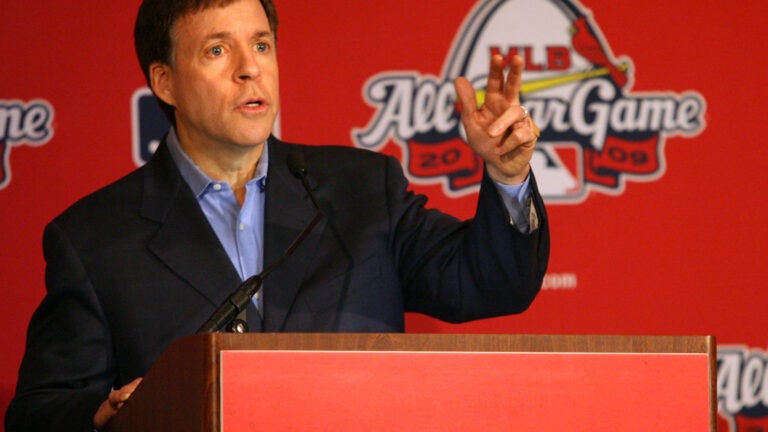
I’ll always think of Bob Costas as a baseball guy first.
Maybe that’s a generational thing. Growing up in the ‘80s, when cable television’s rise as a live sports outlet was still nascent and the internet was decades from not only going mainstream but becoming the mainstream, there was really only one option to watch a national baseball game.
You tuned into NBC on Saturday afternoons. Vin Scully and Joe Garagiola would be at one impossibly appealing locale, probably sunlit Dodger Stadium, or so it always seemed. Costas and Tony Kubek would be at another. And the network would air the one of the two games that was more relevant to your home market.
It was great. Oh, being a baseball fan wasn’t better than it is now, with the ability to watch all 162 Red Sox games on NESN or nationally, or pretty much any out of market game you want where you want on the device of choice. But it was great for the time, in part because all four broadcasters were exceptional. Especially, it seemed to my teenaged self, the congenial Costas whose informed enthusiasm was felt like the way baseball was meant to be called.
Costas isn’t just a baseball guy, of course. I presume the majority of those familiar with his work think of him first in some other role, perhaps foremost as the 11-time primetime host of NBC’s Olympics coverage, but also as a studio host on NFL and NBA coverage. Somewhere down the list is co-starring role in the film “BASEsketball.’’
Costas acknowledges he thinks of himself as a baseball guy first, too. Probably never more so than this Saturday, when he is honored during the Baseball Hall of Fame ceremonies in Cooperstown as this year’s recipient of the Ford C. Frick Award, presented annually for excellence in broadcasting.
“I enjoy broadcasting baseball more than anything I do,’’ said Costas, now 66 years old, who currently calls games for the MLB Network. “I still feel more connected to baseball than any other game.
“I probably have done fewer games than anyone who has ever received this honor,’’ he said. “All of the [previous 41 honorees] were voices of a team, even if they also did national games. I’ve probably done between the two stretches at NBC in the ‘80s and ‘90s and now this stretch at MLB Network, maybe 500 games, right around 500. Which is basically three seasons. But a lot of those were All-Star games and League Championship Series and World Series, games that, if a broadcaster is fortunate, resonate long after they were played.’’
As apparent and authentic as his affection for baseball has always been, Costas has never been reluctant to acknowledge the sport’s problems when they arise. He was skeptical of the swollen biceps, foreheads, and home run totals during what we would come to know as The Steroid Era, and he revealed that skepticism in prominent places.
“Like everything, there are always concerns,’’ he said. “At various times, there have been various concerns about issues in the game, but the game always seems to survive and move past it.’’
Unlike those who caterwaul about baseball’s problems, only to fall silent during the search for solutions, Costas has always quested for ideas to make the game he loves better. His book Fair Ball: A Fan’s Case For Baseball, published in 2001, made a smart and detailed plea for revenue sharing among franchises years before it became a reality.
But there was romanticism to be found, too. He made an impassioned argument for more daytime World Series games, a lovely notion that has about the same likelihood of happening as the Red Sox firing Alex Cora tomorrow and replacing him with Bobby Valentine.
He also outright loathed the implementation of the one-team wild card, which robbed the suspense from pennant races in instances when both teams were going to make the postseason anyway.
“Two wild cards [that play in a one-game playoff, as implemented in 2012] is an improvement over having one wild card, that is for sure,’’ said Costas. “Everything I said about having one wild card I still believe is true. It took the drama away from a close race. Not just in theory, but it happened. It often happened. Contenders could go head-to-head at the end of the season and it scarcely mattered who won.’’
Costas is reminded that this happened with the 2005 Red Sox, who finished tied with the Yankees at 95-67 in the AL East. They played a three-game series at the end of the regular season that was anticlimactic since both teams had already clinched playoff berths.
“Exactly, and in previous years it would have been the height of baseball drama,’’ he said. “So on the one hand, you take the drama away when it’s close. And on the other hand, you take the justice away, when some team finishes 10 games ahead and turns around has to play best-of-five on equal footing, since there was no handicap for being the wild card. By putting the second wild card in, they’ve really put a premium on finishing first.’’
But he sees a way that could even be better.
“Why not make the wild card best two of three,’’ he said. “It wouldn’t take long enough for the team with the best record [the opponent for the wild card winner in the next round] to get rusty. But it would be long enough for it to get rested and ready. That wouldn’t make it impossible for the wild card winner to win in the next round. But it makes it appropriately more difficult.
“The purist in me says that’s the best way to go. But the person who understands the entertainment and the drama and what the fans want understands there’s something to be said for the single-game playoff. All things considered, it’s a giant step forward.’’
One place where Major League Baseball is stuck in its tracks is in marketing its superstars. Commissioner Rob Manfred practically placed full blame on Angels superstar Mike Trout’s relative lack of commercial appeal on the player, even though Trout has a reputation as someone who goes out of his way to be kind and accessible to young fans.
“Baseball has not only a huge number of not just good players, but interesting and diverse and distinctive players,’’ said Costas. “One problem that baseball has is that you can’t assume the best players will get to or close to the biggest stage.
“Ken Griffey Jr. never played in the World Series. Barry Bonds played in one. Mike Trout has played in three playoff games, one series, and goodbye. Forget about LeBron James or Steph Curry-level fame. There are probably players in the NBA who are not All-League who are better known nationally than Mike Trout. That’s not baseball’s fault. That’s the nature of the game.
“There are sensible ideas that you and I have both thought about to perhaps make baseball better, or give it broader appeal. But I don’t want to make it sound like here’s a litany of my complaints about baseball. Every time I walk into a ballpark, I feel happy about it. Every time I turn on the MLB Network and see people talking about baseball, I’m engaged. My love for the game is no less. It doesn’t wane.’’