Checking off milestones helped Eddie Olczyk deal with cancer treatment
Check is a versatile word, one with multiple and distinct definitions.
It can be, among other uses, a hockey term, a form of compensation, an affirmative mark, a reminder to be cautious, especially when it comes to personal health.
Each definition applies in a meaningful way to Eddie Olczyk, a coincidence as remarkable as the man himself.
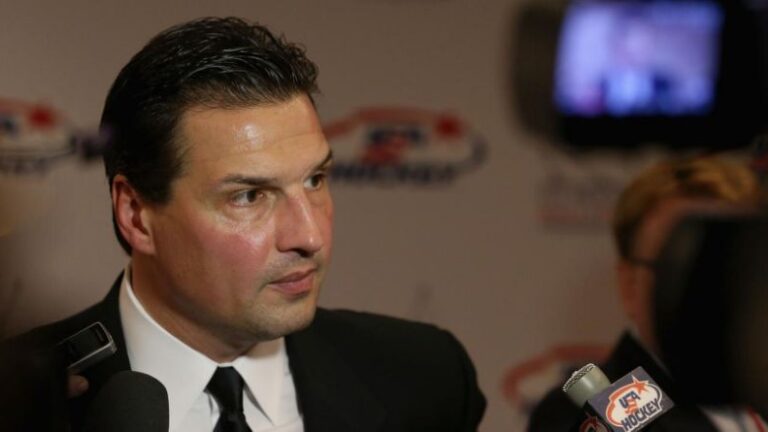
Olczyk, who has a distinctive dual role at NBC Sports of hockey and horse racing analyst, returned to work with great success recently after being diagnosed with colon cancer last September.
After five months of grueling chemotherapy, Olczyk received the news in March that he is cancer-free.
He is now working a full schedule for NBC Sports, the home of the Stanley Cup playoffs and the signature horse racing events, including last Saturday’s Kentucky Derby. Olczyk’s Derby picks are much anticipated by NBC viewers, and with good reason: He hit the trifecta for the second time in four years Saturday, picking Justify to win and the two other top-three finishers in the right order. Viewers who followed his advice came away with a decent stack of cash, though probably not in check form.
“Saturday was good,’’ said Olczyk, “but the vultures were out on Friday [for preliminary races at Churchill Downs]. That comes with the territory.
“Saturday I came back and I think I was 4 for 4 out of the gate. Went a little dry down the stretch, but then in the Derby, I was all over it. Sometimes my picks get to keep running into the next race, which is not a good thing, and sometimes you get to the wire first. It was a good way to end the day.’’
During his cancer battle, Olczyk set goals along the way to make sure the side effects of treatment and the general boredom that accompanies it didn’t distract him from his recovery. Being part of NBC’s Derby coverage was one of his major goals.
“After I was diagnosed, I had to figure out how to deal with the disease and the physical effects, but also the psychology. My first chemo was Sept. 11 last year, and I was wondering how the hell I was going to get to the middle of February [when the chemo was scheduled to end if everything went according to plan].
Olczyk said he had enough quiet time to “last me a lifetime’’ during those first few days. “So maybe 10 days in, I said, ‘I’ve got to set some goals for myself.’’
“I’ve got to put some targets in my calendar.’ ’’
Not the tech-savvy type, nor one to rely on a smartphone for everything, Olcyzk went to Office Max and bought a giant conventional calendar. Upon returning home, he opened it up, picked some significant dates, and set some recovery goals.
Every two weeks, he would take chemo, so of course those days had to be written down. But mostly he wrote down what he was targeting for milestone days that would confirm the progress he was making. He wanted to get back and do some hockey in October, and be part of NBC’s Breeder Cup coverage in November. He marked down the date of his daughter’s graduation from the University of Alabama in December. He wanted to feel good enough to enjoy Christmas. Then there were more hockey games he wanted to call, and horse races, too, and playoff hockey.
“And it went like this,’’ said Olczyk. “Check, check, check, check, check, check. I was able to pass all of those goals.You have a lot of long, boring days when you’re going through what I did, and psychologically, it really helped to look at the calendar and thinking about those milestones ahead.
“The thing I most emphasize to people now is to make sure they stay on top of their health and get checked,’’ he said. “And I recommend for people going through what I did to set those kind of goals. It’s good to have those mile-markers.’’
They helped Olczyk get through the brutality and boredom of chemo, to offer the hope of better times to come. But it wasn’t easy.
“I wanted to get back and do some hockey in early October, and I was able to do that. The Breeders Cup in November, and I was part of the coverage.
Olczyk would get chemo at the hospital every other Monday for two hours. Then he would go home and endure it for another 48 hours. The hospital would send someone to his house to unhook him from the chemo every other Wednesday.
“You really don’t feel better until the following week. And the next thing you know it’s Saturday and it’s like, ‘[Expletive], I’ve got to go back there on Monday.’ It’s the reality of it.’’
Olczyk said he put on 40 pounds during treatment, mostly from the medicine and steroids he was on.
His weight rose to 249 pounds. “I’ve never been 249 in my life,’’ he said. “When I got on the scale during my last visit Feb. 19, all I said was, ‘Don’t be 250, don’t be 250.’ And the nurse said, ‘249.2.’ I turned away, talked into my hands, and said, ‘Attention. Only one person allowed on the scale at a time.’ The nurse looked at me weird, and my wife hit me on the back of my hand, telling me not to worry about it.’’’
He’s down 25 pounds since February.
Olczyk says he feels well, though he’s not quite feeling like he did before the diagnosis. “It takes time,’’ he said. “I’ve got to be patient, but I feel really lucky.’’
That’s just how those who followed his Derby advice felt Saturday.