Any event with Dick Enberg on the call had a big-game feel
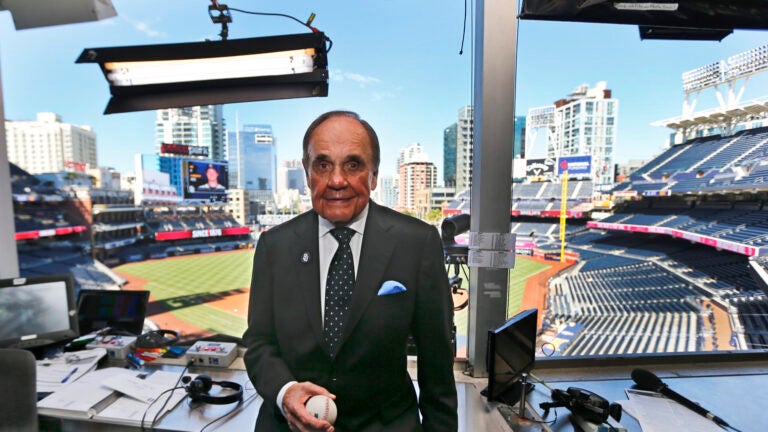
Dick Enberg belonged to Southern California first, as the voice of UCLA basketball during its John Wooden dynasty years. He also built his baseball bona fides as a play by play voice for the California Angels, and as the coda to his career, the San Diego Padres.
Foremost, Enberg, who died Friday at age 82, belonged to a national audience, particularly through his greatest professional heights in ‘70s and ‘80s. For NBC, CBS, and ESPN at various times, he called 28 Wimbledons (often alongside the late, great Bud Collins), nine Rose Bowls, and three Olympics, along with the Breeders Cup, The Masters, and countless MLB and NBA games through the seasons.
Enberg also was the real-time narrator of the two most important college basketball games in television history – UCLA’s winning-streak busting loss to Elvin Hayes and Houston in 1968, and the Magic Johnson/Larry Bird Michigan State/Indiana State showdown in the 1979 NCAA Tournament final, which remains the highest-rated college game of all time.
Other highlights of a career full of them: The 1986 AFC Championship Game, forever known for John Elway’s “The Drive,’’ and the Broncos-Browns conference title game rematch in ’87, forever known for Earnest Byner’s fumble.
That’s not a career. That’s a first-person account of the best of modern sports history. A certain longtime peer said Friday upon learning the news of his death that he “was the greatest broadcaster in modern sports history and will never be emulated.’’
This is not hyperbole. That has never been Vin Scully’s way. It’s the truth.
There were so many reasons to appreciate Enberg, who was apparently as graceful and friendly when the microphone was turned off as he was when he would speak into it and immediately bring an event to life. His knowledge and multi-sport versatility meant that he was capable of expertly voicing virtually any significant sporting event. Because of that, any event he called had a big-game feel.
One of fellow broadcasting legend Jack Buck’s famous lines was, “I don’t believe what I just saw!,’’ after Dodgers pinch-hitter Kirk Gibson’s stunning walk-off home run against the A’s in the 1988 World Series. Enberg, with his gentle catchphrase – “Oh my!’’ – gave the impression that he believed what he just saw, but he was nevertheless marveling at it in genuine unison with his audience.
According to his daughter, who lives in Boston, Enberg was scheduled to fly to the city Friday and his family became concerned when he missed his flight. They believe he suffered a heart attack.
When word of his death was reported, it was logical that his West Coast roots and national admiration were most prominent in his remembrances. His professional ties to New England were comparatively few. But as a sports-crazed child of the late ‘70s and early ‘80s, I can assure you that he mattered here, even in somewhat of ancillary way.
In the early ‘80s, the Patriots had plenty of talent on their roster, but they made the playoffs just once, in the strike-abbreviated ’82 season, in the stretch from 1979 to ’84. The teams were usually competitive, save for the miserable 1980 season when they went 2-14. When games weren’t blacked out in the local television market because tickets had not sold out, it was usually the lower level broadcast teams that were assigned to their games by NBC, which owned the AFC broadcast rights in those days. NBC play-by-play broadcasters Jay Randolph, Phil Stone or Merle Harmon seemed to get more Patriots games in those days than Enberg, Bob Costas, or Marv Albert. (Don Criqui, who was on their No. 2 team, did get his share too.)
Enberg, along with excellent color analyst Merlin Olsen, were NBC’s equivalent to the more celebrated tandem of Pat Summerall and John Madden on CBS. As NBC’s top team, Enberg and Olsen more often than not seemed to get the 4 p.m. West Coast game on the Sundays when NBC had the doubleheader. Watching those broadcasts, often emanating from sunny San Diego or Oakland (Chargers-Raiders was a phenomenal rivalry then), it seemed like they were beaming down to New England from a superior planet, where the football was mesmerizing and the sun shined in the winter. To New Englanders, Enberg and Olsen were warm, welcoming voices in the hopeless frigidity of our winter.
When, deeper into the ‘80s, the Patriots had ascended to real relevance, it was Enberg’s voice that confirmed it. In the 1985 postseason, when the wild-card Patriots beat the Raiders and Dolphins on the road, no dweller of the bottom of NBC’s depth chart called any of those games. Enberg voiced them, as well as the Super Bowl loss to the Bears.
His involvement delivered gravitas and confirmation that the Patriots mattered again. When Dick Enberg called a game, here and everywhere, that’s when you knew it mattered. Better, his friendly and elegant manner always let you know it mattered to him too.
[fragment number=0]