Globetrotter with a penchant for unusual races wins first Fenway Park marathon
"I want to see how fast and how far I can go to really see what my body is capable of."
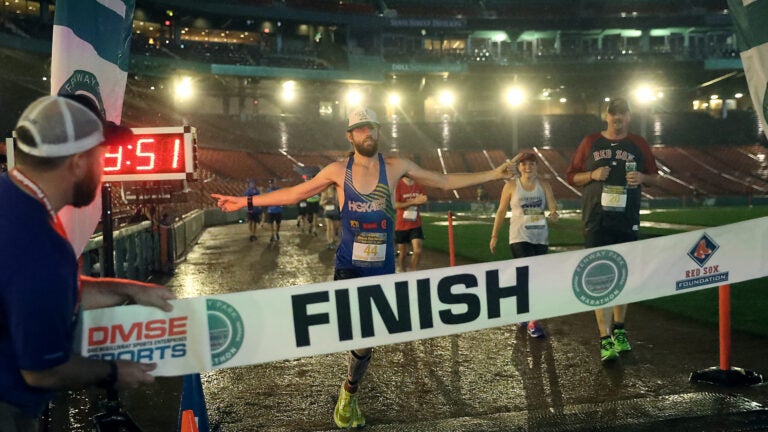
While the Red Sox battled the Tampa Bay Rays in 15 innings, a different type of marathon was happening at Fenway Park on Friday night.
Fifty runners participated in what is considered the first 26.2-mile race to happen inside a ballpark. Consisting of 116 laps around the perimeter of the field, the course passed iconic Red Sox landmarks, like the Green Monster, the Pesky Pole, and the dugout.

Michael Wardian leads the pack at the start.
After nearly three hours and quite a bit of rainfall, American marathoner Michael Wardian was the first to cross the finish line. His official time of 2 hours, 53 minutes, and 54 seconds was roughly 20 minutes faster than that of the second-place runner.
“Tonight was really cool,” Wardian told Boston.com after the race. “Just to be in Fenway and know how much history is there.”
The 43-year-old said he isn’t much a baseball fan but has been to a couple games in the past. Even so, he recognized the fervor of the Boston fanbase and mentioned that he could still feel their energy from simply being inside the park.
“There’s something about the games that are played here,” Wardian said. “I love how stoked everybody is. They’re so into it, like they live and die on every pitch. Even if you don’t love the sport, you got to love going to Fenway, just because of that atmosphere and the uniqueness of the environment.”
 Having competed in 200-plus marathons, the former college lacrosse player is no stranger to seemingly unconventional settings for distance running. In 2011, he ran 135 miles across California’s Death Valley in 120-degree temperatures. And in 2014, he traversed hard snow and frozen ice atop the Arctic Ocean to win the North Pole marathon.
Wardian also finished the Antarctica Ice Marathon in January, as part of the World Marathon Challenge. He completed seven marathons in seven continents in seven days and slept for just 16 hours over the course of the entire week. Averaging a field-best time of 2:45.57, Wardian called the experience “pretty magical.”
“It was incredible to have the opportunity to run in somewhere that’s so dangerous but also unbelievably beautiful and surreal,” he said of the Earth’s southernmost continent. “It doesn’t feel like you should be there.”
Other notable highlights from his extensive archive of races include the Marathon de Sables in the Sahara Desert, where runners have to carry their gear and food for a week as they run 156 miles in six days; the Ultra Trail du Mount Blanc, which circumnavigates 100 miles of the biggest mountains in France, Italy, and Switzerland; Diagonale des Fous on Réunion island, which features 33,000 feet of elevation; and the 100-kilometer Ultra-Trail Australia that takes place atop the Blue Mountains in New South Wales.
When asked about how he decides which races to fill his schedule, he said: “I love to travel, and I love the opportunity to meet different people and have different experiences. I’m always looking for something that’s unique. I love being able to explore the world and have my family be a part of it, too.”
#kwbpride fired up for the first Fenway Park Marathon! For you @KWBjenflores 🏃🏻⚾️ @mikewardian @BAA @bostonmarathon pic.twitter.com/D2xa3mMEef
— Jennifer Wardian (@JenniferWardian) September 15, 2017
Once Wardian started running in 1996, he, quite frankly, hasn’t stopped. As the calendar approaches the 38th week of 2017, the Fenway Marathon marked Wardian’s 40th race on the year. The Virginia native said that he essentially completes a race every week and will sometimes run two during the same weekend.
https://www.instagram.com/p/BTIO4S5D2DG/?hl=en&taken-by=mikewardian
Interestingly enough, the race that sparked Wardian’s interest in running was the Boston Marathon.
“One of my good friend’s mom had done it,” Wardian said. “I went to her house for Easter, and she had the little crinkly blanket and the unicorn medal, and I thought I want that. I had only seen it on TV before, so that was the first time I actually saw a regular person who had done it.”
“I was like, ‘Holy crap!’ If she could do it, I could do it,” he continued. “That gave me the motivation to at least try.”
Wardian’s first race was the Marine Crops Marathon in his hometown of Arlington, Va. He qualified for Boston with a time of 3:06.54 and was off to Boylston Street less than a year later.
“It was so cool to ride the bus out to Hopkinton, start running, see people lining the streets, smell the barbecue,” Wardian recalled. “Since it’s on a Monday, it’s kind of special that basically nobody else in the country is off work that day. Everybody is getting rowdy. As I got closer into town and ran through the scream tunnel at Wellesley, it was just like, ‘What? This is insane.’ And coming down onto Boylston Street, you’re like, ‘I want to do this every weekend.’
“Boston is really special to me because that’s where I got my start and got me into running. I feel so lucky that it worked out.”

While his 21-year career appears to be have the legs to last quite a bit longer, the Fenway Marathon already holds a near-and-dear place in Wardian’s heart due to the city’s significance, the atmosphere, and its design.
“The best parts were the high-fives with my sons,” he said. “We missed a few due to bathroom breaks and a couple rounds of hide-and-seek, but we must have had at least 100.
“Most of the time when you do a marathon, people only see you at the beginning and at the end, so this course was a good chance for spectators to see you the whole time.”
Of course, the peculiar layout of the historic ballpark inevitably created a few challenges. Wardian has completed marathons lap-style, including 211 revolutions around a 200-meter indoor track, but detected a key difference at Fenway.
“When you’re making so many turns on a track, the movement is a little bit more symmetrical,” he said. “This was kind of an irregular outline with odd angles, so you had to figure out how you were going to take the corner before running into the wall. That just made it a little bit slower than i thought it was going to be.”
He said his left leg became a little fatigued toward the end due to all the left turns. The heavy precipitation aso made his footing a little tricky in certain parts, but the added element of rain didn’t faze him.
“The biggest thing is just keeping mental focus,” Wardian said. “Continue to treat it like you’re out on the road. You don’t need to get as much aid as you think you do, like remembering that every time you see water, you don’t have to take it because you’re coming around every minute. Just maintaining what you’ve done in the past.”
Up next for the marathoner is a 250-mile race across the Gobi desert.
“It’s not a stage race, so you can run as far as you want each day until you decide if you’re going to eat or sleep, but there’s no stopping,” he explained. “It’s up to you if you stop or not. I think that’ll be a good challenge.”
As for how his body manages the constant traveling, time changes, and sometimes extreme conditions, Wardian chalked it up to his ample experience with those challenges.
“I love it so much that I just kind of make it work. I don’t have a secret,” he said. “I want to see how fast and how far I can go to really see what my body is capable of.”
Before he leaves for Asia, he will spend another day in Boston with his wife, Jennifer, and sons, Pierce, 11, and Grant, 8. Having visited the Museum of Science on Thursday, they plan to spend Saturday biking in Concord to check out the site of “the shot heard around the world” at the town’s North Bridge.