
Get the latest Boston sports news
Receive updates on your favorite Boston teams, straight from our newsroom to your inbox.
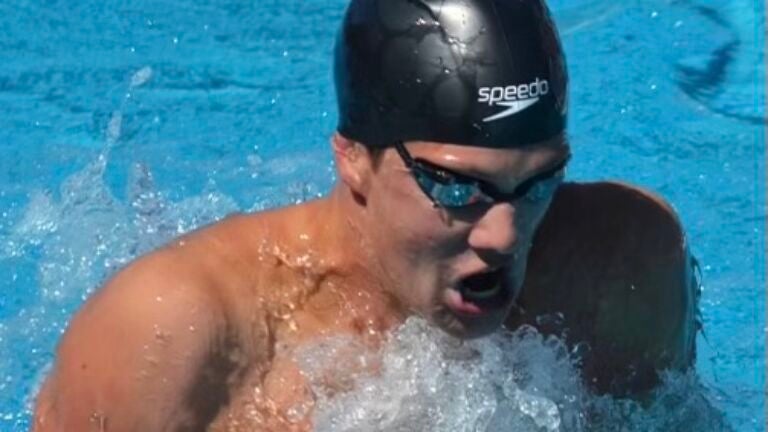
David Abrahams would be impressive enough if all he did was become one of the most decorated swimmers in the world while studying “pure” mathematics— the kind of math that works more with proofs and mathematical concepts than simple numbers — at Harvard University.
He’s doing it all while being legally blind.
That revelation began to dawn on Abrahams, a 20-year-old junior at Harvard, while looking at the chalkboard as a middle-school student in Havertown, Penn., and simply seeing “nothing.” Not long after that, he and his parents learned he has Stargardt disease, which causes progressive vision loss.
“There’s just a big, old blind spot in the center of my eyes,” he told Boston.com. “So wherever I look, it just tracks with it. … You just look at something that’s absent.”
Imagine opening your eyes, knowing something or someone is right in front of your face, and simply not being able to see it. Everyday things we take for granted, like reading or recognizing an animal, are struggles for Abrahams.
But even being legally blind couldn’t stop him from becoming a rising star in the swimming world.
Abrahams said he has been swimming since he was around three years old and was active in the local swimming club scene while coming up through school. By the time his vision started to fade out in middle school, he said he developed enough muscle memory to keep his technique with all of his strokes. But he still had to make some adjustments.
“I had to work through with some of my coaches in high school about learning how to not slow down because like I justifiably had a bit of a fear of crashing into the wall,” Abrahams said. “So I had to work to develop some techniques like counting my strokes to know exactly where I was at any given time, or utilizing my peripheral vision — the outside of the blind spot — to see the markers and the walls next to me to know exactly where I was at.”
Abrahams said he started to sense he could have a longer career in swimming during his junior year of high school — long after he started losing his sight. But he didn’t know he’d be eligible to compete as a para swimmer until about two years ago.
“One of our family friends had swum for a coach at a local college who happened to be one of the coaches on the U.S. Paralympic team,” he recalled. “He reached out to my family and we like, ‘This as an option for you.’
“Within about six months of hearing about it, I was competing at like some of the highest-level meets in the field.”

In the last year alone, Abrahams set six national para-swimming records, and he earned a silver medal in 100-meter breaststroke — his favorite of the four swimming strokes — at the 2021 Tokyo Paralympics.
The Harvard swimmer is also one of the latest wave of college athletes to sign a “name-image-likeness,” or NIL, sponsorship, which allows them to profit off of their careers while still in college. Abrahams announced a partnership with Clearcover, an insurance company that has started to branch out into athletics, in March.
Kyle Nakatsuji, Clearcover’s co-founder and CEO, was a D-I college football player at University of Wisconsin-Madison and said Abraham’s story of resilience spoke to him.
“He’s someone who had two months to sort of deal with a set of circumstances that life handed to him and did so with a positive attitude, who found ways to continue doing what he loved,” Nakatsuji said, calling Clearcover’s decision to sponsor Abraham’s “an obvious choice.”
“The work he put in in the pool and in school, these are all things that we set up this program for: to be able to say, ‘You might not hit the headlines, but you deserve to be recognized, too.'”
For Abrahams, who’s studying mathematics at Harvard, the partnership with Clearcover is “life-changing.”
“It means it means the world to me,” he said. “You look at collegiate athletes who are working hard and then also have to balance very rigorous academic work. A lot of folks are balancing jobs on top of that. So it definitely helps a tremendous amount.”
But his earnings from the NIL agreement are only partial to the message he wants that partnership to send: “My goal is to inspire as many people who are in tough situations, who have been dealt pretty difficult hands, to inspire them to reach the highest level of success they possibly can.”
Receive updates on your favorite Boston teams, straight from our newsroom to your inbox.





To comment, please create a screen name in your profile
To comment, please verify your email address
Conversation
This discussion has ended. Please join elsewhere on Boston.com