
Get the latest Boston sports news
Receive updates on your favorite Boston teams, straight from our newsroom to your inbox.
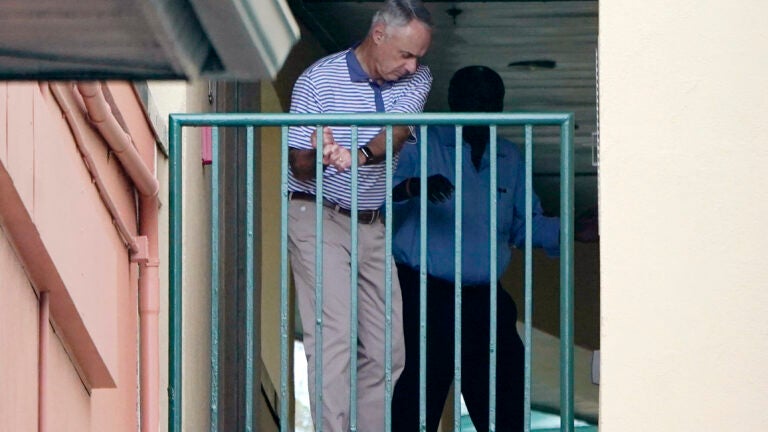
Moments after announcing the first cancellation of Major League Baseball games due to labor strife in 25 years, and the first in any of the major US sports since 2013, Rob Manfred laughed.
After he “officially canceled” the first two series of the regular season via a prepared statement Tuesday, the MLB commissioner took questions. He pointed to Yahoo’s Hannah Keyser, who noted she had two.
Manfred, after a beat, quipped, “Well, you only get one!”
As Keyser kept speaking, Manfred chuckled at his line, looking across the group of reporters (and thus, toward the broadcast camera) with a smile, as though he expected them to join him. Perhaps realizing the optics, perhaps just nervous energy dissipated, he quickly went back to shuffling his papers and furrowing his brow.
Look, I know it’s a stupid takeaway from the sport’s worst day in a generation, especially as someone who thinks the idea of the “bad look” is lazy thinking. It’s just too bizarre, though. I can’t shake it. (Nor could all the players who pinballed screenshots across social media.)
Especially since it was one of two. Manfred ended his presser by cracking more wise, saluting retiring New York Post columnist Ken Davidoff to more chuckles quickly subsiding to Manfred trying to stare a hole through his podium.
“We did take a stab at some early negotiations,” Manfred replied to Davidoff, who essentially asked why the owners — the side who instituted this winter’s lockout to create negotiating urgency — made one formal offer to the players’ union in the first 70 days of it. “Throughout the five-year period, there was a lot of rhetoric about dissatisfaction with the deal that they made. A lot of the rhetoric was negative with respect to the clubs, the commissioner’s office, me. That environment, someone else created.
“And it’s an environment in which it’s tough to build bridges.”
The commissioner regularly comes off as bizarre, but clowning on him is sort of like beating up a manager for losing when he’s got a roster full of scrubs. Manfred serves at the behest of the owners, and while it’s notable he’s abysmal in his role as the public face of the league, that’s not really why there will be no Opening Day on March 31.
It’s that environment he talked about. One that, if he didn’t create it, his bosses certainly continue to nurture.
“A lockout is the ultimate economic weapon,” Tony Clark, executive director of the players’ union, said and repeated in his own Tuesday presser. “In a $10 billion industry, the owners have made a conscious decision to use this weapon against the greatest asset they have: The players.”
The emphasis on the conscious decision was not accidental. Throughout these 92 locked-out days, MLB has had you believe its actions have been forced. Why they had to institute a lockout. Why MLB.com contains no coverage of any active player. Why Monday was a deadline for a new deal (until it wasn’t). Why games were canceled Tuesday as opposed to rescheduled.
It is the latest manifestation of a distrust that dates to the league’s beginnings, and which has bubbled over periodically since Marvin Miller molded the modern MLBPA in the 1970s.
Whether this era of distrust is worse than 1972, or 1981, or 1994, I’m not sure. I just know this one feels it’ll take a lot more to resolve than the frigid first-week homestand the Red Sox just lost.
The union asserts MLB’s moves all winter have been choices designed to break its will. And by and large, they’re correct. What the owners say and what they do have felt like two different things for a long time.
When Manfred described the last five years as “very difficult years from a revenue perspective for the industry given the pandemic,” it was quickly pointed out MLB’s revenues the last five years were $43 billion.
(Revenues, to be clear, are not profits. Atlanta, the only MLB team whose books are reported publicly, declared $104 million in profit in 2021 after having essentially lost in 2020 what it made in 2019.)
When Manfred declared the competitive-balance tax as “the only mechanism in the agreement that’s designed to promote some semblance of competitive balance,” it was quickly pointed out both revenue sharing and TV money guarantee some $150 million every year to the lowest-revenue teams before they lift a finger.
And that MLB revenues, even despite the losses of 2020, have still risen at a comically higher rate than that CBT threshold. Last season’s line of $210 million was nearly $90 million below the $297 million it would have been had it grown since 2011 at the same rate that MLB revenues did. (MLB’s offer, and even the union’s ask, were nowhere near that number.)
The problem is neither side, at least today, appears to truly see the only way forward is with each other. The owners’ refusal to share the sport’s largesse is enraging. The literal structure of what teams value of players has changed considerably just in the past 10 years, and yet, free agency and arbitration have largely gone unchanged for decades.
But just as enraging about anything is the players’ refusal to entertain anything called a salary cap, even while aware they’ve essentially been playing under one for years.
The NFL does it, a salary cap tying player compensation and share to league revenues. The NHL does it. The NBA has a soft cap, in that teams can go over it and pay a tax similar to baseball’s CBT, but they do it too. None pay the majority of players the minimum salary the way baseball does.
I simply don’t see another way forward, short of the union cracking under the weight of another bad deal it’ll regret in five years. Which is a heck of a thing since, when MLB proposed a system with a $100M salary floor and $180 million CBT back in August, it quickly went nowhere.
Details about how it would be calculated and adjusted were never reported, but I’m sure it was light on the owners sharing their books to establish what the revenues are. The Score reported in 2017, MLB instituted a rule barring teams from public offerings that would require public disclosures of financials. (Atlanta and Toronto, owned by Rogers Communications, were grandfathered in.)
It’s not hard to see why. Amid another CBA battle in 1985, the union demanded the owners open their books to prove the significant financial losses they said required a greater cap on player spending.
In a shocking turn, the owners did just that, claiming their figures showed at least 18 of the 26 teams were losing money. The union came to a different conclusion, seeing a nearly $10 million profit leaguewide by simply untwisting some of the number crunching.
That was 35 years ago, when teams were selling for $50 million — not the $2.4 billion Steve Cohen bought the Mets for two years ago — and less part of labyrinthine business interests in which teams can be convenient tax havens.
It is a long, twisted pretzel which concludes at the moment with nothing more than rage and sadness. For the lack of spring optimism. For all those already hurting after two years of pandemic, now further hurt by a $10 billion annual industry keeping its factories shuttered.
For the feeling that those chuckles from Manfred feed the narrative: The owners aren’t worried because April games are a tough sell anyway, and they’ll make a ton more come expanded playoff time.
They best hope so. Because the alternative is worse, and it seems just as plausible in this darkest hour.
Apathy. For the lot of them.

Receive updates on your favorite Boston teams, straight from our newsroom to your inbox.



To comment, please create a screen name in your profile
To comment, please verify your email address
Conversation
This discussion has ended. Please join elsewhere on Boston.com