
Get the latest Boston sports news
Receive updates on your favorite Boston teams, straight from our newsroom to your inbox.
COMMENTARY
On the 71st day, I cracked. I wish Major League Baseball owners would hurry up and do the same.
Not long after MLB locked out its players on Dec. 2, ostensibly to supercharge the negotiations on a new collective bargaining agreement, I made the decision to largely ignore the whole escapade. The reasons are myriad, but best summarized thusly: Why bother? Even baseball’s not stupid enough to kill this golden goose.
Since, the NFL staged a legendarily great playoff slate. Winter seasons rolled along, the NBA authoring a particularly crazy trade deadline even by its standards. We discovered, teemed, and forgot about all new things to be enraged by.
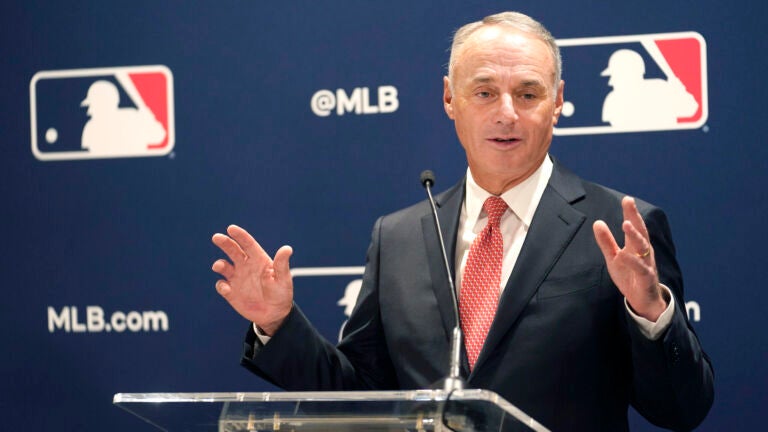
And baseball played its part by spending six weeks not negotiating anything. A silence about which commissioner Rob Manfred, whose side instituted the lockout, noted on Thursday: “Phones work both ways.”
In that lawyer-y way, it holds just enough truth to annoy to the core because it completely misses the genuine point. It’s also the moment my personal embargo crumbled. Thus, a summation of Manfred’s first major comments since sending the sport AWOL:
— He sees missing regular-season games “as a disastrous outcome for this industry.”
— The three-week camps before the shortened 2020 slate led to too many injuries, so a minimum four weeks of spring training will be needed to prepare for the season. With Opening Day scheduled for March 31, time is thus growing short.
— On Saturday, the owners will make their second formal proposal to the players since the lockout began, one Manfred called a “good faith, positive proposal in an effort to move the process forward.” (As opposed to what’s come before now, I guess?)
— While there has been little ground and less trust gained between the sides, “you’re always one breakthrough away from making an agreement.”
It all sounds great until you realize it’s largely the same things Manfred said when he shut things down. Even his optimistic refusal to state the obvious — spring training won’t start on time next week — is tinged bitter.
Not saying it Thursday means if he says it Saturday after the players don’t immediately agree to that next proposal, there’ll be the inference this is just as much the fault of the locked out, as opposed to the owners doing the locking.
The first MLB lockout of the modern social media era is playing out in a predictable “see, it’s their fault” tenor that made it worth ignoring from the jump. Especially when, I suspect, your only concern is the games go on.
While I bristle at the characterizations of this as “millionaires fighting billionaires over a kid’s game” — at the point an industry brings in $11 billion in revenue annually, it ceases to matter whether it’s particle physics or Parcheesi — I can’t deny that. Neither can the owners.
Heck, they’re counting on it. It’s one of the best arrows in their quiver.
Manfred’s side knows you have lived or died with the colors on the uniform since childhood, more than the rolling cadre of players within those uniforms and the core of every happy memory. They know that if you desire, you can know the salary of every player; they see to it, in fact. You can gawk at their generational wealth among the greats, just for playing that kid’s game.
Meanwhile, their finances are a mystery. Which is the most logical cover for Manfred, asked simply Thursday whether baseball teams are good investments, firing off a real gem.
“We actually hired an investment banker, a really good one, actually, to look at that very issue,” he said. “If you look at the purchase price of franchises, the cash that’s put in during the period of ownership, and then what they sold for, historically, the return on those investments is below what you get in the stock market.”
In 1994, when “a minimum of 12 to 14” teams (in Bud Selig’s words) were losing money, a World Series was nuked. In 2001, when he said the league’s operating losses were close to a quarter billion dollars, contracting two teams was on the table.
In 2022, Rob Manfred wants to tell you new Mets owner Steve Cohen could’ve made a couple extra million with dividends and an index fund.
It’s pretty simple. If team ownership was such a terrible deal, the likes of Fenway Sports Group wouldn’t be forming new initiatives to find more to buy, and more than three MLB franchises would’ve changed hands since the end of 2012.
Heck, this is even simpler: If the books showed ownership was a bad deal, the books would be open for you to look at.
Of course, a couple are, not that Manfred et al. are going to wave their arms highlighting it. Liberty Media, the owners of the Atlanta Braves, is a public company and thus must release financials quarterly. The latest showed a $58 million operating profit for the world champs on nearly a quarter billion in revenue. Mind you, that’s for three months.
Toronto owners Rogers Communications also reports publicly. Though they don’t break out team finances as Liberty does, following November reports they were considering selling a share of the Blue Jays, Rogers said last month it has no plans to sell the team. Sounds like things are going OK.
Have I mentioned yet that leaguewide player payroll has dropped for four straight years? That’s what the CBA agreed to in 2016 wrought. As owners got richer, players got poorer. In a strastophere beyond our reach, yes, but starkly — the league’s median salary last year was $1.15 million, down 18 percent from just two years ago and 30 percent from its peak in 2015.
That the aesthetic quality of the game has also withered, and feels almost beside the point in this negotiation, makes my diehard blood boil. But not as much as the clear-as-day knowledge of what’s happening here: The owners know how good they have it, and they’ve spent the last two months trying to pretend entirely otherwise.
“The goal is to get a deal that we’re happy with, that we think both sides are happy with,” ex-Red Sox reliever Andrew Miller, part of the MLBPA’s executive board, told reporters Thursday. “I’d like to get something done. It’s a matter of getting the right thing done.”
The fact is they will. Manfred and his bosses, for all their faults, can’t actually be willing to die on this hill. And when his side finally blinks, we are in for a treat.
A frenzy of preparatory action, months of planning and signing stuffed into days, with the elimination of draft-pick compensation for signing away free agents and the inclusion (at last) of a universal designated hitter exciting things further. The free-for-all will, if history’s taught us anything, wash much of the bad taste of these last few months.
“As angry as your fans can be because your team stinks, or because you have labor disagreements,” former Marlins boss David Samson told the Globe, “all it takes is a competitive September and a playoff run and those fans are right back.”
In New England, it won’t even take that much. We’ll be done rolling our eyes before Jackie Bradley Jr.’s made his first routine circus catch of the spring. We just have to get there.
I suggest tuning out until we do. If only to try and manage it myself again.

Receive updates on your favorite Boston teams, straight from our newsroom to your inbox.




To comment, please create a screen name in your profile
To comment, please verify your email address
Conversation
This discussion has ended. Please join elsewhere on Boston.com