
A freestyle pioneer is an old dog with some new tricks at Nashoba Valley
COMMENTARY
Wayne Wong says I’m doing it wrong, so who am I to argue?
My skis are too close together. I’m not extending my legs enough during each turn. My wrists should be titled backwards, in order to keep my poles from thrusting ahead of me.
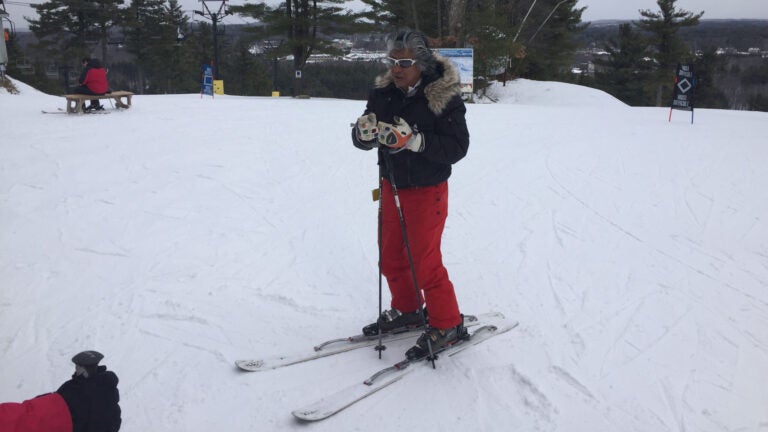
I follow his advice during a run down the Wardance trail at Nashoba Valley under his watchful eye last week, paying attention to the instruction of the freestyle legend and not my instinct to simply rip this dash of the 240-foot vertical at the Westford ski area.
At the base, Wong nods in what I take to be approval of my efforts. Maybe it’s just a courtesy acknowledgement, but it also could mean that Wong feels he’s found the next, great thing in skiing.
Sadly, it’s a little later over lunch that the pioneer hot dogger reveals that he’s been working with what could be the future of skiing for some time now, a technology that he feels should have the same effect on the industry as shaped skis did some two decades ago.
“When I watch the Olympics, and I watch the skis chatter, I go ‘Oh, man, we could kick ass out there’ because our skis want to push down and eliminate that chattering,’’ Wong said about the suspension skis that he’s been promoting for years now. “If the ski is in contact with the snow it’s going to run faster. Coming off the snow you’re going to end up skidding. So we can make a lot of adjustments with this system and really address these issues.’’
Despite his British Columbia upbringing, Wong’s roots in New England run deep. It was at Waterville Valley in 1971 when he participated — and finished third — in the inaugural inaugural National Championships of Exhibition Skiing after seeing an ad for the first-of-its-kind competition in Skiing Magazine. It was at that event that Wong met and struck up a friendship with Nashoba Valley founder Alan Fletcher, Sr., who pleaded with the burgeoning freestyler to visit his hill and ski with locals looking to learn the sport. Wong has returned to Westford every year since, giving tips and instructions over the course of his weekend stay, a genuine promotion of skiing that has served Wong well in the latter stage of the 65-year-old’s life.
Wong’s impact on the sport of skiing includes a long list of accomplishments. He was inducted into the the Canadian Ski Hall Of Fame in 2009, has featured his freestyle moves in countless ski movies, and has been recognized by both Powder and Ski Magazine as one of the top 50 skiers of all time.
(If you’re of a certain age, you at the very least recognize Wong from his appearance in a famous 1974 Pepsi commercial.)
[fragment number=0]
But he’s also onto to what he calls his “third career’’ now, trying to spread the viability of a technology developed by Anton Wilson, who used his engineering background to develop a piece of equipment that looks like a ski with cabinet handles connecting the binding. Wilson, who also helped invent the Anton/Bauer battery found in many TV and movie cameras today, was looking for a way to better develop his stance and balance as a low-level skier, particularly after smashing his knee in a car accident.
“If you go out to the beginner area, watch all these people trying to find their balance,’’ Wong said. “These springs push down, they give you that balance point and allows you to make mistakes without falling because it will support you.’’
Wong was alerted to the technology by a friend at the Yellowstone Club. Wilson ended up sending a pair to Yellowstone for Wong to demo. “They’re very narrow, very carve-y skis with this new technology,’’ Wong said.
“And I got on them and then…one turn, two turns, three turns…and I go, ‘Holy crap, this is the real deal.’ This is the next step from taking the shaped ski — which is able to do this — but what he did with this technology is what skiers have been trying to figure out forever. How to dampen the ski, eliminate chatter, eliminate vibration.
“Now that we have this fundamental system, there are a lot of adjustments that we can build into the system and create a completely custom ski at any level by adjusting the spring length, the tension on it. There’s so many dynamic parts to it that it’s amazing.’’
Wong equates the ski’s viability to that of suspension on a mountain bike, something that was unheard of some years ago. “Now, you can go buy a mountain bike with suspension at Wal-Mart for $80,’’ he said. “It has evolved that way, and that’s what I feel about what we’re dealing with this technology.’’
The ski’s design encourages center balance by concentrating on PSI underfoot to make the skis bite, yet leaves enough pressure for the ski to engage from a pre-load of the spring, thus giving the skier directional control. Wong said that “Anton’s still dinking around with stuff,’’ pointing out that he skied a new prototype a few weeks ago at Yellowstone with an adjustment that creates so mush PSI underfoot that, “it bites like an ice skate — the hard stuff. It won’t slip, and yet it has this suspension that will allow the ski to have directional control.’’
The skis aren’t cheap. The Connecticut-based Anton Active Suspension offers two versions on its web site, ranging from $2,490 to $2,990. But the goal, according to Wong, isn’t to necessarily become a ski company, but to have other ski companies adopt the technology that Wilson developed.
“It addresses a lot of the things the ski engineers have been trying to figure out forever,’’ Wong said. “We really believe that this will address a lot of issues.’’
Alas. There was, unfortunately, no more talk of my own prowess that morning on my aging Volkls. Not with the old dog in town, selling new tricks.
Contact Eric Wilbur at: [email protected]. Follow him on Twitter: @GlobeEricWilbur and Facebook www.facebook.com/GlobeEricWilbur
Photos from Fenway Big Air
[bdc-gallery id=”467334″]





To comment, please create a screen name in your profile
To comment, please verify your email address
Conversation
This discussion has ended. Please join elsewhere on Boston.com