
The ‘challenge trade’ — past, present, and almost — has a notable place in Red Sox history
A challenge trade is when a general manager essentially dares another to do business, betting that his own player evaluation is more accurate.
Baseball has fixed so many of its enduring and self-inflicted problems this season, thanks in large part to repairman extraordinaire Theo Epstein. As if his Hall of Fame case weren’t etched in bronze before he helped save the sport from those running it.
Still, there are further ways for baseball to improve. For instance, you know what baseball needs more of? Since you asked, I for one would like to see …
Wait, what’s that you say?
Daytime World Series games?
Well, yes, of course, and we wish you the greatest of luck convincing owners divvying up that sweet prime-time television revenue of that. There’s a better chance of Rob Manfred setting first pitch for midnight than there is of a Saturday afternoon playoff game again.
Complete games by starting pitchers?
True, true. Baseball needs to let workhorses be workhorses and aces be aces. The Red Sox had five complete games last year, or as many as Roger Clemens had in his first 20 major league starts in 1984. Through 79 games this year, they await their first. The only people who like seeing a parade of relievers in a game are the relievers’ agents.
More A-Rod on national broadcasts?
Ha ha, good one. We know it’s you, Alex. Jeter still looks at you like he wants to trade you back to the Rangers.
No, what I was thinking of, before all you so rudely interrupted with your thoughts, was something more abstract, but something I absolutely wish occurred in baseball more often:
Challenge trades.
A challenge trade, if you’re not familiar with the term, is when a deal is made for one reason: a team likes the player it is getting better than the one it is giving up. It is, in essence, a challenge to the other general manager, a dare to do business, a bet that your evaluation of the players involved is better than that of the person you are trading with.
A challenge trade is ideal when the players play the same position, or at the very least own similar standing within the sport.
Curiously, the most obvious challenge trade in modern Red Sox history — as well as a holy-cow-did-that-really-almost-happen? challenge trade that would have had seismic implications in baseball history — involved the Yankees.
Late in spring training in 1986, the Red Sox and Yankees swapped veteran designated hitters, with the Red Sox sending lefthanded-hitting Mike Easler to the Yankees for righthanded slugger Don Baylor. The Yankees wanted Easler’s lefty bat. Red Sox general manager Lou Gorman said at the time that he wanted Baylor for his clubhouse leadership and righthanded power.
Easler had been productive with the Sox since coming over from the Pirates for lefty John Tudor in December 1983, including hitting .313 with 27 home runs in 1984.
But despite Yankees owner George Steinbrenner’s bluster that Baylor’s bat “would be dead by August,” Gorman and the Red Sox won the deal. Baylor hit 36 homers as the Red Sox won the pennant for the first time since 1975. No word on how they fared in the World Series. We’ll check on that.
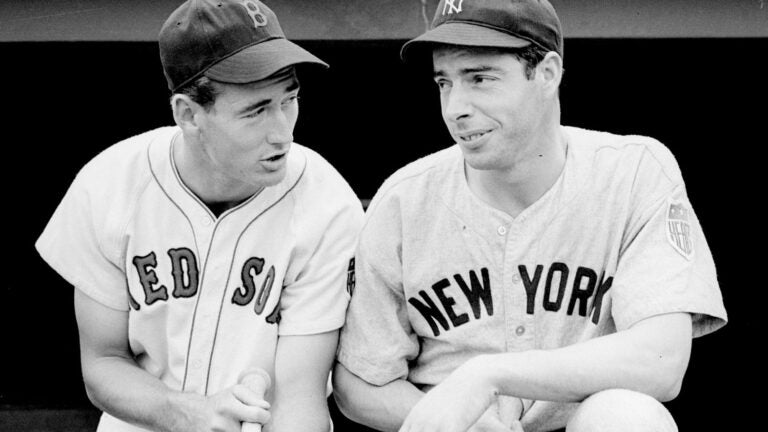
As for that almost challenge trade with the Yankees, it comes with the word “allegedly” attached, but whether or not it is entirely true, partially true, or simply irresistible urban legend, it’s an official part of Red Sox-Yankees lore.
In 1949 — or maybe ‘48, or possibly ‘47, depending on which account you read — Red Sox owner Tom Yawkey and his Yankees counterpart, Dan Topping, had a dinner meeting at the legendary Toots Shor’s restaurant in New York. Some liquid refreshments were believed to be consumed, and then perhaps a few more beyond that, when one man or the other — allegedly — proposed a swap.
Joe DiMaggio to the Red Sox.
Ted Williams to the Yankees.
Who says no?
As it turned out, the clarity of the morning said no, and nothing ever came of it, obviously, which was a blessing for the Red Sox. DiMaggio, impeded by problems with his heels and too proud to stick around to endure a common ballplayer’s decline, retired after the 1951 season.
Williams played nine more seasons after DiMaggio held his head high and walked away. Over that span, Williams, the greatest hitter who ever lived, hit .340 with 198 home runs and a 1.113 OPS. I swear, with only slight facetiousness, that he could have played into the 1970s had he desired and the designated hitter existed.
Yawkey did many ill-considered things. Williams-for-DiMaggio might have been considered, but at least he didn’t act on it.
Challenge trades don’t happen much nowadays. I suspect part of it — a major part — is that there’s not much diversity among general managers and presidents of baseball operations and such, who almost all seem to come from the Ivy League and have some back story about breezing through a copy of Baseball Prospectus in the crib as an infant.
The Red Sox and Dodgers sort of pulled one off this winter, though it wasn’t technically a trade, but rather a point-counterpoint of free agent signings.
On Dec. 29, the Dodgers signed former Red Sox outfielder/DH J.D. Martinez to a one-year, $10 million contract. Eight days later, the Red Sox signed former Dodgers infielder/DH Justin Turner to a one-year, $8.3 million deal with a $13.4 million player option for 2024.
It wasn’t a trade, but in essence, the teams swapped designated hitters.
Martinez, who probably doesn’t get enough credit for his often elite production during his five seasons with the Red Sox, has 16 home runs and an .856 OPS in his first season in Los Angeles.
Turner, a more gregarious sort than Martinez, is a total pro in the clubhouse and on the field, where he’s produced 11 home runs and an .806 OPS while never seeming to waste a plate appearance.
So far, it has worked out well for both sides. It wasn’t a trade. But one could say they’ve both lived up to the challenge.




To comment, please create a screen name in your profile
To comment, please verify your email address
Conversation
This discussion has ended. Please join elsewhere on Boston.com