
Cardinals, Red Sox show different reactions to slow starts
The Cardinals, who visit Fenway Park this weekend, have handled slow starts from some players very differently than the Red Sox.
COMMENTARY
The St. Louis Cardinals — quasi-rivals that they are — arrive at Fenway Park for a three-game series starting Friday on something of a roll. That we can call one series victory that should tell you something.
This weekend’s visitors are bad. At most generous, they’ve been bad, three games adrift in the National League cellar even after winning two of three at Wrigley Field against the rival Cubs. Both 6-8 to begin the year, the Red Sox have won 16 of 24 as the Cardinals have lost 17 of 24.
Bad teams are bad for myriad reasons. The Cardinals rotation (5.40 ERA, 7 quality starts in 38 games) has been roughly akin to that of the Red Sox (6.01 ERA, 8 QS), but without the studly bullpen. The defense has been similarly mediocre, but the offense has been league average as opposed to one of the three best in baseball.
I want to direct your attention to two players: Willson Contreras and Jordan Walker.
You will see Contreras this weekend, but it likely won’t be where you expected to. When St. Louis signed the 30-year-old to a five-year, $87.5 million contract in December, in need of a new backstop with the retirement of Yadier Molina, general manager John Mozeliak declared “the Cardinals have had a lengthy history of standout catchers, and we feel that Willson is someone who is capable of adding his name to that distinguished list in the years to come.”
Last Friday, the Cardinals moved the three-time All-Star out from behind the plate indefinitely. He has DH’d every game since.
“There’s so many different layers and elements to what we’re talking about,” manager Oli Marmol told reporters. When asked to elaborate, Marmol declined.
“I’ll wear it,” he said in part. “At the end of the day, it won’t make sense to anyone else, but we do feel confident in the end product.”
Given that he’s spending his time not on defense working closely with pitchers and coaches, it’s not a real tough riddle to crack. A franchise that didn’t have to think about its catcher for two decades thanks to Molina is suddenly uneasy with the next step.
This despite Contreras largely delivering exactly what’s been expected. His status atop the free-agent catcher pool this winter was almost exclusively based on offense, his game-calling and receiving at best average. The things that seem to be problems on the St. Louis staff — bottom-rung swinging strike rate and batting average on balls in play, plus velocity drops for multiple starters — aren’t typically catcher-driven issues.
Yet St. Louis is willing to further muddle its designated hitter pool — they’ve used six DHs in 38 games — searching for a solution.
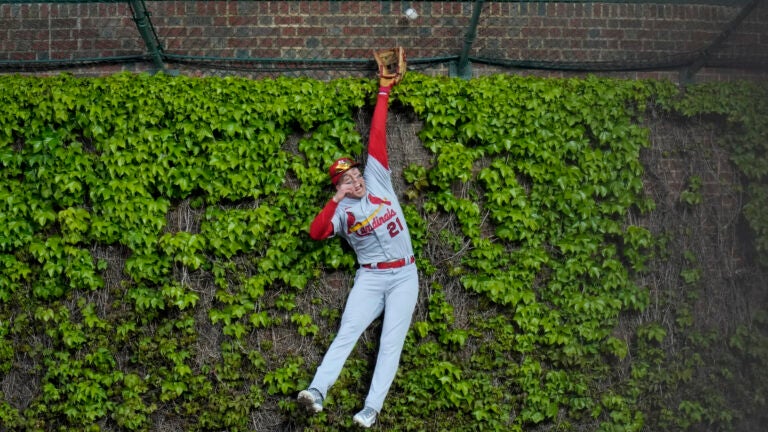
As for Walker, the organization’s top prospect at 20 years old made the most of a spring where multiple players (Nolan Arenado, Paul Goldschmidt, Lars Nootbaar) were away at the World Baseball Classic. He opened eyes to the point he made the Opening Day roster straight from Double A.
Walker started 19 of the year’s first 22 games in right field, with hits in the first 12. A 1-for-17 slump followed, though, and with five players fighting for three outfield spots, Walker was demoted.
“We think this is the best way in a shorter amount of time to get the amount of at-bats needed to make the adjustment,” Marmol told reporters. “You’d be crazy to think the kid is not going to be back up here.”
Reasonable enough. As is Contreras, really . . . six weeks into a five-year commitment (with an option for a sixth) is a sliver of time. Yet each is a window into how two storied organizations, who think an awful lot of their respective Ways of doing business, handled a slow start.
Masataka Yoshida was hitting .167 (8 for 48) when he got April 19 off. The Red Sox trusted what they had, knew what they signed, and he’s hit .384 with 10 extra-base hits in the 18 games since.
Corey Kluber was as bad as could be in his first four starts. They let he (and Chris Sale) work through their issues, and the results have been . . . let’s just say better. Boston’s won Kluber’s last three starts, and three of Sale’s last four.
Kiké Hernández made six errors in his first 11 starts at shortstop. Admittedly, the Red Sox are short enough in the middle infield that they largely had to keep Hernández out there, but he’s been much better since.
It’s not a perfect comparison, but it feels like a bad start sent one team scrambling and left the other to trust in its process.
We’re still talking in small samples, this weekend just getting us to the quarter pole. And I can already hear the argument that the Cardinals’ quick hooks are actually a good thing. The just-roll-’em-out-there attitude from the Red Sox speaks to their current drive to excel.
I’ll always prefer the team that isn’t second-guessing itself before June 1, thanks. And heck knows, given Nate Eovaldi’s scoreless streak in Texas, Xander Bogaerts’ consistent excellence in San Diego, and what will undoubtedly be Jake Diekman’s emergence as a key piece in the Tampa bullpen because Rays, we are never lacking for reasons to second-guess around here.





To comment, please create a screen name in your profile
To comment, please verify your email address
Conversation
This discussion has ended. Please join elsewhere on Boston.com