
Utterly distasteful and somehow compelling, the 2020 Red Sox mirrored their sport
COMMENTARY
What will be your lasting memory of the 2020 Boston Red Sox? It’s easy to say, the final game of a 24-36 slog fresh, that you won’t have one God willing. They are a team, existing in a larger world, begging to be upcycled into scar tissue.
The answer has to do with how you view the world, with who you are, but even more to do with who they are.
“Look, we have a plan,” Red Sox president Sam Kennedy told the Globe on July 23, when asked on the eve of the opener about Mookie Betts signing a 12-year contract with the Dodgers that will all but render Boston a footnote should he become the Hall of Famer he appears. “We are very confident in the direction of our baseball operation.”
I dearly wish I could share Sam’s public optimism. I’m not worried specifically about his baseball operation — I actually agree on that, though that might just be the Stockholm syndrome typing — so much as the baseball operation period, where a jewel franchise can use 30 players to pitch 60 games and we see quality use of a calendar year.
Major League Baseball, at a time where “Does the commissioner actually like baseball?” is an open question, deserves all the credit in the world for pulling it off. Thirty teams played two games shy of the full complement despite a COVID-19 outbreak popping up 96 hours into the regular season, and the 16 playoff games stuffed into Wednesday and Thursday already have mouths watering. Fingers crossed they play them all, and someone’s holding up a trophy in Arlington about a month from now.
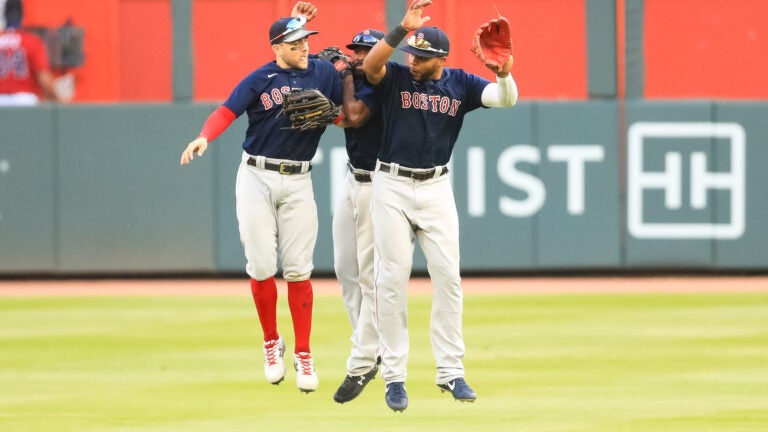
It won’t be the Red Sox, repeat champions only of the Most Spent Per Victory title. Despite Alex Verdugo’s competitive fire and emerging talent. Despite Jackie Bradley Jr.’s final flourish before free agency, amid open pleading akin to that which didn’t keep Brock Holt from Nationals gear and Don Orsillo from becoming San Diego’s treasure.
Covered Jackie for three seasons and never saw him turn down a kid asking for an autograph.
He always made time. https://t.co/BHq5q88IwB
— Chris Mason (@ByChrisMason) September 27, 2020
Despite Tanner Houck and Nick Pivetta popping up in the last two weeks and getting Peter Gammons to vocalize the thoughts of many: The Red Sox “can be, at the least, competitive if the 2021 season is the opener to a new normal.”
“We’re not going to make any excuses. The only thing I’ll say is there were a number of bright spots this year, we’re already attacking the challenges, and we expect to be competitive next year,” Red Sox chairman Tom Werner said on NESN two Fridays ago. “We made a number of trades this year, obviously, that improved our minor-league system. We felt that the cupboard was somewhat bare. Trades with Philadelphia and San Diego will show signs of progress, and if we’re healthy next year, we’ll start hopefully with a starting rotation that may include, among others, [Eduardo] Rodriguez and [Chris] Sale, and [Nate] Eovaldi pitched pretty well this year, and Martin Perez looked sharp on occasion. … We’re not a small-market team and we’re going to be back next year.”
Memories aren’t always chosen, and Werner usually sticks in mine. This year specifically, his appearing to doze off in the latter stages of the Jan. 15 presser to address Alex Cora’s dismissa … er, “collective decision to part ways.” As I wrote after it, the overarching takeaway that day was the hollowness. The steadfast refusal to express anger or sorrow, and the request to “reserve judgment.” (Knowing what we know now, Kennedy’s comments about how “we’re a family, at the Boston Red Sox” also echo loudly.)
Within a month, Betts and David Price were Dodgers. Within two and a half, Chris Sale was out until 2021. By the end of April, the Sox and Cora were largely exonerated. In each case, looking through our 2020 baseball glasses, we could explain it away. Betts wasn’t signing long-term here, so the Red Sox got what they could for him. Even before knowing the season would be shoehorned around a pandemic, Sale’s injury made tanking the smart play. Yes, Cora’s champions broke the rules as written, but they weren’t doing anything more than any number of other annual title contenders.
And that’s the real problem here. Trading a foundational player of Betts’s talent and character shouldn’t be OK. Intentionally forgoing trying to win, just like intentionally keeping MLB-ready talent like Pivetta in the minors for future cost savings and control, shouldn’t be OK. Cheating because a bunch of other people were doing it wouldn’t pass muster with your mom, so why does it in baseball?
Keeping around Bradley Jr., a generational defender and streaky hitter whose best offensive season since 2016 might be a 60-game mirage, has pros and cons. Among them, his teammates love him, the fanbase loves him, he stood tall however you feel about him taking a knee, and … wait, why don’t we want him again?
It’s a business, we rightfully remind ourselves every time our hearts get bruised by it. The Braves team that scrimmaged the Red Sox on its way to the playoffs lost 95 percent of its revenues in the second quarter of the year due to COVID-19 restrictions. The Cubs expect to be down about 75 percent of theirs for the full season, said a report when they laid off about a quarter of their business staff.
Not that such concerns and realities kept the Padres, for example, from bidding $1.4 billion for development rights of four blocks next to Petco Park, down the road creating “non-baseball revenue” they won’t need to share with players, lest you remember what the looming labor war is about. Nor did it keep Turner Sports from reupping its TV contract with MLB for seven years at a 65 percent increase, ultimately meaning the sport might rake in $2 billion annually just from national TV deals.
My math’s not great, but $2 billion divided by 30 teams sure feels like it ought to be enough to keep the Debbie Matsons of the world. Matson being the woman who compiled the Sox alumni newsletter among myriad tasks and, in Peter Abraham’s words, worked “through the death of her parents and her own health issues” until the team laid her off earlier this month.
Our sports, of course, are no more perfect than our world. NESN’s three-man booths from Watertown made this Red Sox season tolerable, the game-is-secondary conversations between Dennis Eckersley, Jerry Remy, and Dave O’Brien genuine and wonderful. (Kudos also to WEEI, where Will Flemming consistently did the same with Joe Castiglione.) Even as Betts did Betts things all summer in Los Angeles, Chaim Bloom’s moves offered reasonable hope that this fourth last-place season in nine years was a last low point, at least until the next high.
It just strikes me, on a foggy almost-October eve, that there’s something deeply wrong when what makes for smart baseball in 2020 runs so concurrent to what makes for enriching, engrossing baseball. The game that pulled us all in was about complete games, not bullpen games. Hits and errors, not strikeouts and homers. The same names every year, rather than a parade of talented newcomers, here until the bill comes due and a hard reset is rewarded with a high draft pick.
The usual idle thoughts of the playoff absent, I suppose. Cured, then and now, by winning.
Whatever the cost.



To comment, please create a screen name in your profile
To comment, please verify your email address
Conversation
This discussion has ended. Please join elsewhere on Boston.com