
5 takeaways from MLB’s findings on the 2018 Red Sox and illegal sign-stealing
Among them, Alex Cora could return, their 2018 behavior likely wasn't unique, and they feel their title isn't tainted
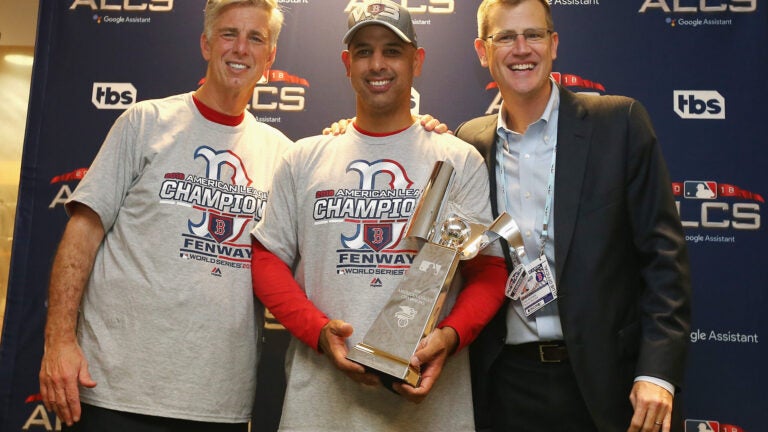
It took a shade more than three months from public accusation to ultimate decision, but the 2018 Red Sox have largely been cleared in an MLB investigation they illegally stole opposing catcher’s signs via their video replay room during their championship season.
While commissioner Rob Manfred made clear Boston’s violations were not on par with those of the 2017 champion Houston Astros, who used a dedicated monitor and a can-banging system to convey pitch signals to hitters, they will still pay a high price for J.T. Watkins, the team’s video replay system operator, who “on at least some occasions during the 2018 regular season, utilized the game feeds in the replay room, in violation of MLB regulations, to revise sign sequence information that he had permissibly provided to players prior to the game.”
Watkins, an Army graduate and former Red Sox minor leaguer, has been suspended for the entirety of the 2020 season, and can’t serve as the replay room operator in 2021. Though no other Red Sox personnel were fined or suspended, the team was docked its second-round selection in this year’s draft — a more severe penalty than normal, given the coronavirus pandemic will limit what’s usually a 40-round affair to as few as five rounds.
“It’s significant,” Sox chief baseball officer Chaim Bloom said on a Wednesday night conference call. “A second-round pick, you typically with that type of pick, you get one of the top two or three dozen players in the country, the way your board lines up in a given year.”
Five other takeaways from a long-awaited, largely painless day for the Red Sox.
Sign stealing, MLB made clear, isn’t illegal.
In a way that wasn’t done when Manfred punished the Astros, the Red Sox report included extensive context to make clear that the mere act of stealing signs doesn’t run afoul of Major League Baseball rules. That echoes much of what 2018 Red Sox players said throughout the wait for Manfred’s report.
“MLB rules in 2018 did not — and still do not — prohibit all methods used by Clubs to decode signs. It always has been permissible for baserunners — particularly runners on second base — to attempt to decode an opposing team’s signs,” Manfred wrote. “It also always has been permissible for Clubs to utilize video before a game or after a game is completed to attempt to decode an opponent’s sign sequences in order to provide the Club with an advantage in future games with that team.”
Additionally, the report made clear that Boston’s 2017 Apple Watch scandal and subsequent fining was less about the use of in-game video to decode signs during a game, but the use of electronics to communicate them to the dugout. Many clubs, Manfred wrote, did not think 2017 rules prohibited “staff and players in the replay room from attempting to decode signs during a game for use when a runner was on second base.”
It wasn’t until March 2018 that MLB clarified explicitly that “electronic equipment, including game feeds in the Club replay room and/or video room, may never be used during a game for the purpose of stealing the opposing team’s signs.” Only from there did the Red Sox again fall afoul of the rules, though perhaps not to the degree many may think.
“Whether it’s just the traditional way it’s been done for 100 years or any other way, legal or illegal within the current rules of the game, you wouldn’t be doing it if you didn’t think it would give you an advantage. I think it would be disingenuous to suggest otherwise,” Sox GM Brian O’Halloran said Wednesday. “I think the report really does a good job of detailing some of the nuances here, of the difference between what was found here in Boston with the findings related to [Watkins] and live decoding and in-game decoding of signs, and relaying to players and ultimately second base and the hitter, the multi-step process, compared to something that was more direct to the hitter. I think it detailed that well.
“And I think the nuances of the fact that, there’s plenty of video work related to decoding of signs that is done around the game, including the Red Sox, that is perfectly legal pregame prep work, advance scouting work.”
Red Sox players wouldn’t be penalized, even without immunity.
Manfred was roundly attacked when it was revealed no Houston players were punished for what he himself described as their “player-driven” scheme because they’d been granted immunity in exchange for their truthful testimony. He defended himself by claiming not only was it the only way he could get the majority of them to testify about Houston’s system, but that any punishment likely never would’ve been actually served.
“We knew if we had disciplined the players, in all likelihood, we were going to have grievances and grievances that we were going to lose on the basis that [management] never properly informed them of the rules,” he told ESPN in February. “I understand the reaction. The players, some of them in a more articulate way than others, have said, admitted they did the wrong thing. And I understand that people want to see them punished for that, and in a perfect world, they would have been punished.”
He will likely suffer far less backlash in regards to the Red Sox. Though he gave players the same immunity, his Department of Investigations interviewing 34 directly — some multiple times — and another 10 short-term Red Sox through an attorney, the report makes clear none of his findings would have merited discipline regardless.
Signs illegally stolen from video were communicated only episodically, the report said, “and [was] isolated to Watkins and a limited number of Red Sox players only.”
Of the 44 players the investigation spoke with, “more than 30” said they didn’t know whether Watkins used in-game video to update sign information he gave as part of advance meetings with the team. Some suspected he did, and one unnamed player went so far as to say he saw Watkins writing down sign sequences while appearing to watch the live feed in the replay room, but few if any had direct evidence.
Many, like Houston’s players, also could and did claim ignorance about the rules against using the replay room — which also included stations where they could review their at-bats during the game — to decode signs.
“The communication of rules to the players, however, was not as consistent” as it was to non-player personnel, Manfred concluded.
The Red Sox’ actions likely aren’t unique.
While Houston and Boston appear they’ll be the only teams penalized for sign stealing in this round, it doesn’t take much Googling to find examples of other teams operating outside the rules through the years. The Yankees, for example, were also reprimanded in 2017 and The Athletic described Boston’s 2018 system “similar to one the Yankees and other teams had employed before MLB started its crackdown.”
Manfred’s report doesn’t offer any claims akin to “everyone was doing it,” but it does offer an interesting nugget about Watkins, who served both as the advance scout responsible for decoding signs between games legally and the replay room operator, responsible for watching the live feeds to determine when the Red Sox should challenge a call.
It’s a situation rife with temptation for someone whose job consists of significant time spent decoding signs from video, and one that wasn’t limited to Fenway Park.
“It was not uncommon for those two roles to be combined in this manner by Clubs in 2018,” the report reads.
Its conclusion further makes clear the difficult situation any staffer in that dual role finds themselves.
“Watkins admitted that because he watched the game feeds during the entire game, he was able to determine during the game when the sign sequences he provided to players prior to the game were wrong. Thus, he was placed in the difficult position of often knowing what the correct sequences were but being prohibited by rule from assisting the players by providing the correct information,” the report said. “While this does not excuse or justify his conduct, I do believe that it created a situation in which he felt pressure as the Club’s primary expert on decoding sign sequences to relay information that was consistent with what he naturally observed on the in-game video.”
Asked whether the league should consider keeping players from communicating with the video room or watching video entirely during games, Bloom said yes.
“I think the report does a good job of highlighting some of the potential issues that have arisen from the perfectly legitimate process of instant replay. I think it’s something that we, as a sport, ought to look at,” he said. “It’s no excuse for a rule violation. We’re all accountable for our behavior, and we’re all responsible for following the rules, whatever they are. But I also think structurally, we ought to do everything we can to make sure … confusion can occur, and that these aspects of our game are beyond reproach.”
Previously, former 2018 Red Sox Ian Kinsler inferred all good teams have similar systems in place.
“They just had a very good system at relaying from second base to home plate, and that was it. Honestly,” he told Dallas radio in February. “In the playoffs, we couldn’t … you’re playing against the best teams. All the best teams know what’s going on.”
The door is open for Alex Cora to return in 2021.
When manager Alex Cora and the Red Sox parted ways on Jan. 14, one day after he was widely implicated in the report against the Astros, the team made clear it was in the best interests of the club Cora depart. However, brass stressed it was solely due to his activities as Houston’s bench coach in 2017 and went out of their way to praise the 44-year-old, who was everybody’s choice to replace John Farrell and whose team won 119 games in his first year.
“He was a tremendous manager for us, on all levels,” principal owner John Henry said. “We’re going to miss him.”
“An incredibly selfless man,” Sox chairman Tom Werner said. “I spoke to him today, and asked him how he was doing and how his family was doing. And he’s just an extraordinary manager and we’ll miss him.”
“I think Alex is an incredibly talented manager. Accomplished great things with us,” Sox CEO Sam Kennedy said. “He expressed remorse. He apologized yesterday to us, for the embarrassment this caused, and I think he’ll go through a process of rehabilitation, and so we’ll see what happens.”
The first step came Wednesday, when Manfred’s Red Sox investigation cleared him. Though the commissioner found Cora hadn’t effectively communicated to his players the sign-stealing rules for 2018, Manfred believes there was no reason Cora or any member of his staff “either knew or should have known that Watkins was utilizing in-game video” illegally. Thus, he received a one-year suspension in line with former Astros GM Jeff Luhnow and manager A.J. Hinch solely for his conduct there. (And which, also like Luhnow’s and Hinch’s, will count as time served regardless of if there’s a 2020 season.)
Boston removed the interim tag from Ron Roenicke after Manfred’s report came out on Wednesday, fully installing the 63-year-old Boston’s 48th manager. Bloom, however, revealed that Roenicke is on a one-year contract, signed through the 2020 season as he was when he was Cora’s bench coach.
“Due to all the unique circumstances obviously of the hiring, we felt that that was an appropriate term for him in this role, and that continues to be the case,” he said, later adding “the fact the contract runs out after 2020 doesn’t mean that he can’t or won’t manage beyond that date. It’s just we thought we were best served, given the uniqueness of the situation, maintaining the length of the situation.”
Roenicke managed four-plus in Milwaukee from 2011–15, making one playoff appearance and going 342-331 in the regular season.
As for Cora, Bloom was asked pointedly about his feelings on Wednesday.
“At the time we parted ways with Alex, we were clear that was a result of his role in what happened with the Astros and everything that the investigation over there revealed, and had nothing to do with what may or may not have occurred in Boston. That’s still the case. All the reasons that we parted ways with him there are still the case,” he said. “My opinion of [Alex] is very high. I also think that people are complicated, and people make mistakes. That doesn’t excuse the conduct in Houston, and that’s certainly something that he is going to have to own, and I’m sure he will.”
Cora issued a statement following the release of Manfred’s report, expressing relief with the conclusion of the investigations and taking “full responsibility for the role I played, along with others, in the Astros’ violations of MLB rules in 2017.”
The team doesn’t believe its 2018 title is tainted.
“No. No. Not at all,” Kennedy said emphatically when asked whether the confirmation the team had broken the rules in any way dims arguably the greatest Red Sox ever. “In no way do I feel it’s appropriate to invalidate the accomplishments of the 2018 team based upon this infraction.”
Asked later whether the team would’ve won the World Series without cheating, Kennedy reiterated his feelings.
“I believe that the 2018 team was one of the most truly talented baseball teams ever constructed. I’ve been around the Red Sox for 19 years now, and it’s by far the most talented team that I’ve ever been a part of or witnessed in person. Just a special, special team,” he said. “I realize that it’s on us that we’re answering a question like this, because we were not, as the report pointed out, 100 percent compliant with the rule. And that’s on us, and we open ourselves up to a question like that when you fall short. So that’s on us.
“We own that. We apologize for that, and we need to commit to doing better as we go forward.”
Overall, Kennedy admitted a feeling of relief, even through an apology to the rest of the league and all Red Sox fans.
“To be clear, we’re not taking any victory laps or anything like that. A violation was uncovered, and that’s wrong and unacceptable,” he said. “I am relieved the report got to the truth and got to the bottom of what actually happened, and people will draw their own conclusions.”





To comment, please create a screen name in your profile
To comment, please verify your email address
Conversation
This discussion has ended. Please join elsewhere on Boston.com