
Red Sox say Chris Sale has a flexor strain, will be shut down for a week
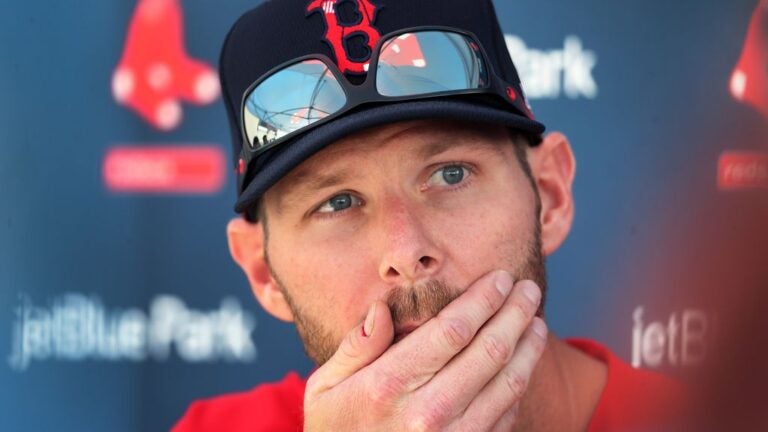
For now, the worst-case scenario with Chris Sale has been avoided — though the Red Sox ace isn’t necessarily out of the woods yet.
A reading of an MRI by Dr. James Andrews, Dr. Neal ElAttrache and Red Sox team doctors revealed that Sale, who experienced soreness on Monday following his live batting practice session on Sunday (his first time throwing to hitters in 200 days), has a flexor tendon strain in his left forearm. Based on the readings from the MRI, his ulnar collateral ligament has not suffered any further damage since last August, when he was shut down for the season with elbow inflammation and received a PRP injection from Andrews.
“The UCL looks the same as the last image,” said Red Sox manager Ron Roenicke. “The doctors have advised him to wait another week before he starts throwing again. He’ll start playing catch again. If everything is good we’ll progress.”
A flexor tendon strain usually results in a prescription of 4-6 weeks of rest and recovery, and there are examples of pitchers with flexor mass and flexor muscle strains returning to the mound without surgery. In 2016, for instance, lefthander Andrew Miller suffered such a strain in June but was back in games after roughly a month, and concluded that season as a dominant postseason force.
At the same time, there are numerous instances of pitchers getting diagnosed with flexor tendon strains but seeing little improvement during the rest period and ultimately undergoing Tommy John surgery. In recent years, Red Sox reliever Carson Smith and prospect Jay Groome both were diagnosed with flexor strains but ultimately required the operation.
Last year, lefthander Rich Hill (then of the Dodgers) was diagnosed with a flexor muscle strain. He returned to the mound after two months for three regular-season appearances and one playoff game, but after the season, he required Tommy John revision surgery. After the surgery was performed, Hill was told that his flexor tendon had been fine, and that the strain (tearing) that had sent him to the injured list had been in his ulnar collateral ligament.
In a best-case scenario, Sale’s diagnosis likely means that he would be able to pitch in games by May — a timetable similar to the one that David Price followed in 2017 when he suffered an early-spring tendon strain after throwing his first live batting practice of the spring. In a worst-case scenario, this diagnosis might merely delay surgery if he does not respond well to rest, an obvious possibility given that his 2019 season ended because of an elbow injury and his first time on the mound against hitters since then — already delayed by pneumonia — resulted in elbow discomfort.



To comment, please create a screen name in your profile
To comment, please verify your email address
Conversation
This discussion has ended. Please join elsewhere on Boston.com