Raging at Dave Dombrowski for Wednesday’s Red Sox inaction ignores a lot
The Red Sox roster architect doesn't set his own budget, nor is it his fault a good roster flopped.
COMMENTARY
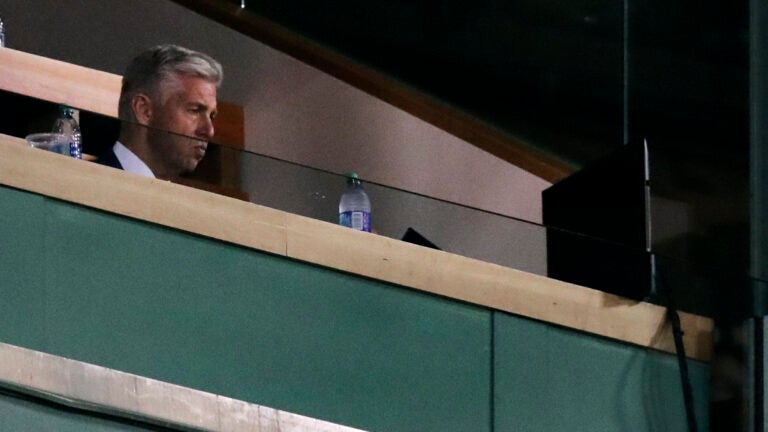
The Great New England Quiet of July 31, 2019, is not a story about Dave Dombrowski, but since there’s a reasonable chance you’re still mad at him this morning, let’s start there.
“We had an opportunity to make a lot of trades, if we wanted to,” the Red Sox roster architect told reporters hours before Boston lost a second straight to Tampa Bay, who’s not much better than the 2019 Red Sox, but is 7-1 at Fenway Park this year. “We just felt that demands for what we were going to receive, we didn’t want to pay.”
That “we” is important. Especially the other half of it.
Given he spoke and fielded questions for 26 minutes, Dombrowski said myriad other things, but I don’t think we need to get terribly deep. Because, as previously noted, this is not a story about Dave Dombrowski, who said nothing to rival two Octobers ago when, in the midst of 34 minutes on why he fired John Farrell, he unabashedly declared “I’m not going to share facts. Those are things I keep to myself.”
How that didn’t break Twitter, I’ll never know.
Farrell was a shocking move in hindsight that was in no way surprising in the moment. Teams just don’t fire back-to-back division winners — there had been four such instances in five decades at that point — but, well, I dare say the majority were calling for it after a pair of meek first-round ousters. Wednesday? Let’s call it the shocking non-move that should in no way have been surprising.
Because for everything Dombrowski said in that presser, Wednesday merely validated what he’s done from the second the ink dried on Nate Eovaldi’s $68-million contract in December: Tell you he wasn’t going to spend big on relief pitching.
The Red Sox inquired about several relievers Wednesday but were told that teams liked prospects from other clubs more than Boston’s. Only way the Red Sox were getting a deal done, a source said, was “to do something stupid.”
— Mark Feinsand (@Feinsand) July 31, 2019
More importantly, it followed what his boss — the guy who, if you’ve got your heart set on needing one, was actually the villain here — made public via WEEI last month in London.
“It’s not a luxury tax issue, it’s a question of how much money do we want to lose,” Red Sox owner John Henry (who owns Boston Globe Media Partners, including Boston.com) said before his team got clobbered by its biggest rival on an international stage. “We’re already over budget and we were substantially over our budget last year and this year. We’re not going to be looking to add a lot of payroll. And it’s hard to imagine fielding a better team. If we play up to our capabilities we’ll be fine.
“It’s a worthy team because we invested. Two years in a row we have the highest payroll. It’s not a matter of investment, it’s a matter of playing well. If we play up to our capabilities we will easily make the playoffs. That’s how I see it.”
You’re certainly welcome to quibble with Henry’s assertion the Red Sox are losing money; old local Evan Drellich reported in February that it’s likely creative accounting. But he’s not wrong on the rest, and calling him cheap would be laughably shortsighted. (And not just because he owns the platform I’m publishing this on.) A top-five payroll 17 of his 18 years, a top-two for 10, a top-one in back-to-back years.
Rick Porcello lasted one out the day Henry said that. Porcello got one out Wednesday before he was trailing and finished July with a 7.94 ERA. Of 75 ERA-qualified starters last month, Porcello was 71st in fWAR and 70th in FIP. For the season, he’s tied for 56th and 60th respectively out of 70, all for a mere $21 million.
For $88 million as a group, there is exactly one member of the Red Sox rotation in the top half of those 70, and it’s Chris Sale, in the midst of perhaps the worst full season of his MLB career. (David Price would be top half, but hasn’t thrown enough innings.) I don’t want to repeat myself, but 2019 has been about the starting pitching, from the blown save count on down. Thus, Andrew Cashner, who still counts even if he came on the 13th instead of the 31st.
Dombrowski’s allowance this winter was spent on Steve Pearce and Eovaldi, via two contracts that were widely beloved when they were signed. Pearce was hurt before the spring ended and has 16 hits in four months. Eovaldi, at least here for four years, is an out shy of 25 innings pitched in Year One.
This title defense has felt, at every turn since that first night in Seattle, not meant to be. The Red Sox acknowledged that on Wednesday. Hardly seems worth getting all that mad about, certainly not when they opted for consistency over panic. Isn’t that all we can ask from a franchise’s brain trust? Using their brains?
The action announced after the 4 p.m. deadline, most notably Zack Greinke to Houston, saved MLB’s first deadline after scrapping the August waiver period for a lot of people. It certainly goosed it, but plenty of teams had already made their intentions clear. The Astros added three pitchers, plus brought back a catcher in Martin Maldonado that most everyone loves throwing to. Now, we just wait to see if they can avoid the fate of Dombrowski’s 2014 Tigers, who rolled out Max Scherzer, Justin Verlander, and David Price as a playoff rotation and … got swept by Baltimore, the thud now in its fifth year of lingering.
Cleveland accepted that it wasn’t resigning Trevor Bauer, and might have made itself better while dealing him. Oakland added pitching, as did Minnesota. Tampa identified its needs and filled both. On the NL side, Atlanta and Washington loaded up their bullpens for October, the Cubs did some supplementing in multiple spots, and the Brewers did whatever you want to call their No. 4 prospect Mauricio Dubon for Drew Pomeranz.
But for all the teams that went after it, some big ones didn’t.
“The best play was we did nothing,” Brian Cashman said in the Bronx, content a healthy Luis Severino and Dellin Betances will be all the pitching help the Yankees need.
“It had to be for the right person, and we never got there,” said an openly frustrated John Mozeliak in St. Louis.
“We feel good about the talent we have in-house,” Andrew Friedman said in Los Angeles, the Dodgers refusing to part with their best prospect to gain lights-out Pittsburgh closer Felipe Vazquez.
None less than the prospect mythmakers at Baseball America pointed out this week that just one in five prospects traded at the deadline from 2003–14 “had MLB careers,” which in their parlance means a positive bWAR. The story highlights some big names who bucked that trend, but it builds on what we know to be true: Getting a hit 30 percent of the time makes you a Hall of Famer, in the batter’s box and the executive suite.
You’d have to be crazy not to think the 2018 title affected the 2019 approach for the Red Sox, especially accounting for what the accounting looks like after this season. Porcello’s $21.125 million goes, as does the nearly $13 million Pearce/Mitch Moreland platoon, more than $13 million in Pablo Sandoval obligations, Eduardo Nunez’s $5 million, potentially the $15 million they paid Dustin Pedroia this year and the $25-odd million they still owe him … $240 million payrolls will be in the rear view just as a natural progression.
Dombrowski will likely get his keys back then, and we’ll all still be able to temper the frustration of whatever this season ends up being with memories of the one that came before it.
At least two of those three teams I just mentioned? New York, St. Louis, and Los Angeles? They’ll truly have nothing.
You’re mad today? Imagine how they’re going to feel.