Taking a look at the Red Sox’ starting pitchers one turn through the rotation
The five starting pitchers have given up 11 home runs after one start each.
COMMENTARY
One full turn through the starting rotation, one victory in five games, and 11 resigned half-turns by those starting pitchers to watch an opposing hitter’s latest home run leave a contrail behind it, and yes, it’s fair to call the start to the Red Sox’ championship defense either a surprising mess or a misguided tribute to John “Way Back’’ Wasdin. Probably both.
The Red Sox are off to a 1-4 start, and they’re fortunate it’s happened on the West Coast while many of us back home were snoozing through these faraway disasters. Their late-night story is a simple one: Their starting pitching has been something worse than abysmal.
In five games, Chris Sale, Nathan Eovaldi, Eduardo Rodriguez, Rick Porcello, and David Price have allowed 26 earned runs in 21 innings. Opposing batters are slashing .351/.420/1.218 against them, for a 1.638 OPS. (For context, Barry Bonds had the highest OPS in baseball history in 2004 — 1.422.) They’ve allowed 11 home runs in those 21 innings. Their ERA as a group is 11.14. I should probably apologize to Mr. Wasdin. He was never like this.
The result of the lousy pitching is a lousy winning percentage. The Red Sox already have lost more games than they did last postseason, when they went 11-3 to win their fourth World Series since 2004. They did not lose their first game during manager Alex Cora’s extraordinary rookie season last year until April 22. That dropped their record to 17-4. Good heavens, they’re already 2½ games behind the Orioles, and the Orioles should be relegated to the International League.
I know, all of this is a small sample size. With Chris Sale making his second start of the season Tuesday in Oakland, it’s possible the Red Sox may even have remedied their issues with what should be an outstanding rotation before they even play a game at Fenway this season.
But there are variables — an extended workload in October, when every starter also came out of the bullpen in a “rover’’ role along the way, then a resulting limited workload this spring — that might make you wonder whether the ugly small sample sizes might become more frequent than we expected.
Let’s take a look at each of the five starters, what happened the first time around, and what should happen going forward:
Chris Sale
First start
— 3 innings, 6 hits, 7 earned runs, 2 walks, 4 strikeouts, 3 home runs.
I’m not especially concerned about Sale’s velocity in his first start, when his four-seam fastball averaged 92.3 miles per hour in the season-opening 12-4 loss to the Mariners. As Christopher Smith of MassLive.com pointed out, Sale’s velocity was in a similar range last April and he gradually ratcheted it up into the summer. I am concerned that we’ve seen Sale throw more than five innings in a game just once since July 27, that coming in his Game 1 victory over the Yankees in the ALDS last October when he recorded 16 outs. I know starters don’t go as deep into games as they used to even a couple of years ago, but Sale seems to have a hard time maintaining his command beyond a couple of innings. That contract extension makes me warier the more I think about it.
Nathan Eovaldi
First start
— 5 innings, 8 hits, 6 earned runs, 2 walks, 3 strikeouts, 3 home runs.
In his eight-year career, Eovaldi has a 4.20 ERA and a 3.86 FIP. If he remains healthy over the full season and finishes with similar numbers in that range, he’s going to easily justify the four-year, $68 million contract extension he received after his October star turn.
Eduardo Rodriguez
First start
— 4⅓ innings, 8 hits, 5 earned runs, 3 walks, 5 strikeouts, 1 home run.
Seems obvious to me that we’re asking too much of him, and have been for a couple of seasons now. His ceiling is as the lefthanded Clay Buchholz, a pitcher talented enough to dominate at times, and sometimes for prolonged stretches, but also a pitcher whose failure to trust his stuff or follow a plan leads to self-inflicted struggles.
Rick Porcello
First start
— 2⅔ innings, 6 hits, 4 earned runs (but 9 total), 4 walks, 3 strikeouts, 1 home run.
I’ll stick to my standard line: He’s a conventional Tim Wakefield, a pitcher who chews up a bunch of slightly above-league-average innings, is an admirable teammate, and exasperatingly, seems to be pitching four of every five games I go to as a fan.
David Price
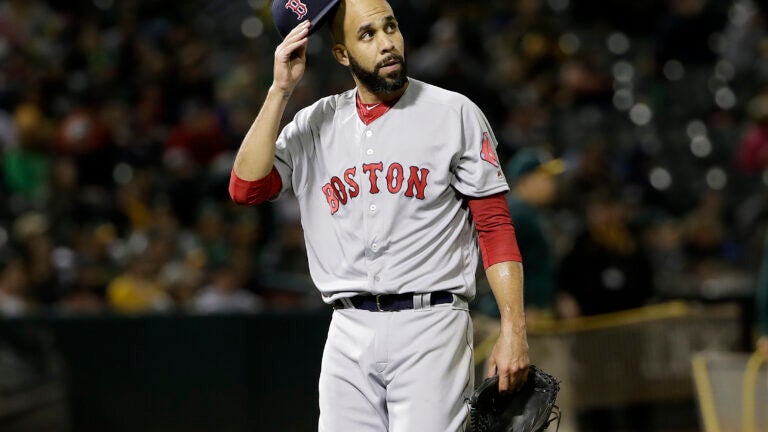
First start — 6 innings, 5 hits, 4 earned runs, 2 walks, 9 strikeouts, 3 home runs.
Ah, no worries here. We all know he’s only good in the postseason anyway.
I suppose in regard to all of this — and probably life in general — we should chill out and welcome the wisdom of Pedro Martinez.
[fragment number=0]
But I’ll tell you, if the Sox rotation takes another collective whupping this time around, it couldn’t hurt to ask Pedro if he might have another spot start or two left in that right shoulder.
Take that facetiously if you will. You probably should. But I betcha he wouldn’t give up 11 homers in 21 innings.