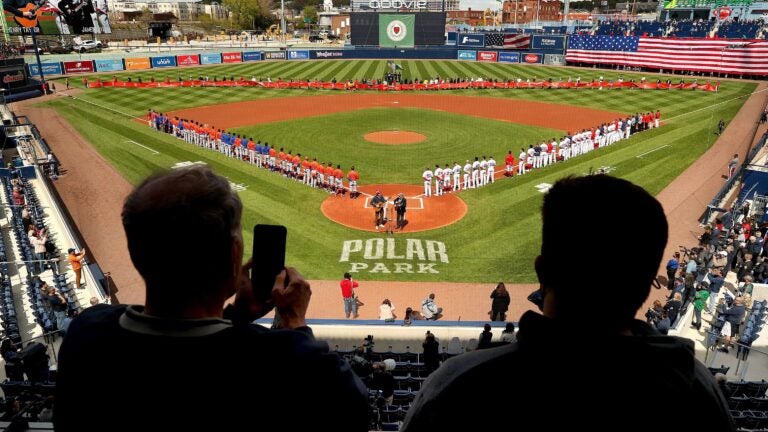
How have teams done in the season following a World Series win?
The Yankees were the last team to successfully defend a World Series title.
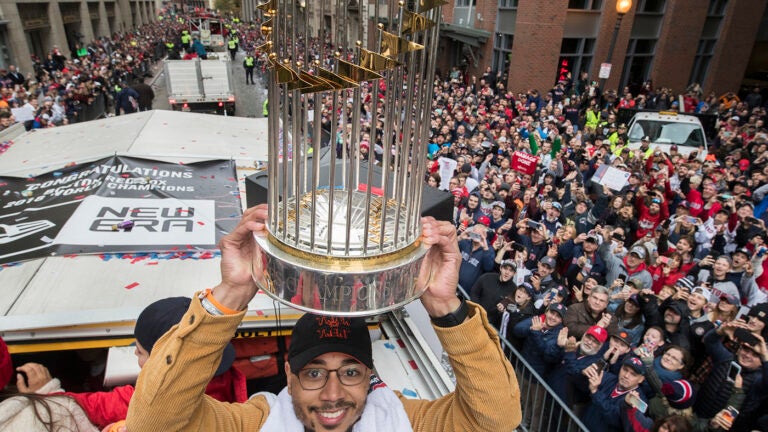
The Red Sox have won four World Series in the last 15 years, more than any other organization. But they have not been able to repeat as champions in that time. In fact, a World Series winner has not been able to successfully defend the title since the New York Yankees won three in a row from 1998 through 2000.
Some teams ran into injuries, while others saw their players unable to perform at the same level. Others lost vital components to free agency, and some found their way back into the postseason, only to be denied by a better team.
Here’s a look at how each team did in the year following its World Series season.
New York Yankees, 2001: The Yankees were this close to winning a fourth-straight title, reaching the World Series and losing to the Arizona Diamondbacks in seven games. They led Game 7, 2-1, heading to the bottom of the ninth at Arizona, but the Diamondbacks were able to score twice off Mariano Rivera for the walkoff win.
Arizona Diamondbacks, 2002: One year after defeating the Yankees, the Diamondbacks went 98-64 and repeated as National League West champs. They looked to be even stronger than the year before, with Randy Johnson going 24-5 to capture the NL Cy Young. Curt Schilling wasn’t a bad No. 2 option, going 23-7. But the team struggled in the postseason, getting swept by the St. Louis Cardinals in the divisional round.
Anaheim Angels, 2003: Poor starting pitching hurt the Angels’ bid to repeat. Jarrod Washburn followed up his 18-6, 3.15 ERA season with a record of 10-15 and 4.43 ERA. Ramon Ortiz was the only member of the rotation to finish above .500 at 16-13, but saw his ERA balloon up to 5.20 ERA as the Angels went 77-85 to finish third in the AL West.
Florida Marlins, 2004: There was no fire sale for the Marlins after they won the 2003 World Series, as the team returned most of its roster for 2004, although Derrek Lee and Hee-Seop Choi were both traded in the 2004 season. The Marlins finished a disappointing 83-79, third in the NL East. The fire sale did not really begin until 2005, when the Red Sox landed Mike Lowell and Josh Beckett.

Boston Red Sox, 2005: After winning their first World Series in 86 years, the Red Sox saw Pedro Martinez and Derek Lowe leave via free agency, and replaced them with David Wells and Matt Clement. They also signed Edgar Renteria after not bringing back shortstop Orlando Cabrera. The Sox finished 95-67 to reach the postseason but were swept by the eventual World Series winners, the Chicago White Sox, in the divisional round.
Chicago White Sox, 2006: After going 99-63 and winning the AL Central in 2005, the White Sox returned most of their roster, but their record dipped to 90-72 to finish in third place behind the improved Minnesota Twins and Detroit Tigers. They did not qualify for the postseason.
St. Louis Cardinals, 2007: Four of the five members of the 2006 World Series-winning St. Louis Cardinals’ rotation became free agents after the season. Jeff Suppan, Jeff Weaver, and Jason Marquis all left after the season. Only Mark Mulder re-signed, and he did not finish the season after having shoulder surgery. The Cardinals finished the year 78-84, third in the NL Central.
Boston Red Sox, 2008: After winning the World Series in 2007, the Red Sox made it back to the postseason dealing trading Manny Ramirez at the trade deadline. They finished second in the AL East to Tampa Bay, and faced the Rays in the American League Championship Series, where they would lose in seven games, with David Price earning the save for Tampa Bay.
Philadelphia Phillies, 2009: The Phillies defeated the Rays in fives games to win the 2008 World Series, and returned to the Fall Classic the next year, going 93-69 to capture the NL East. They would go on to win the NL pennant before losing to the Yankees, who had signed CC Sabathia and Mark Teixeira in the offseason.
New York Yankees, 2010: The Yankees returned to the postseason after finishing second to the Rays in the AL East, going 95-67. After sweeping the Twins in the divisional round, they lost to the Texas Rangers in the ALCS in six games.
San Francisco Giants, 2011: The Giants struggled on offense throughout the season, with Aubrey Huff showing up out of shape and hitting .246 with 12 home runs. All-star catcher Buster Posey was lost for the season when he fractured his lower left leg in a collision at home plate on May 25, leading to the “Buster Posey rule,’’ officially called Rule 7.13, which states a runner “may not deviate from his direct pathway to the plate in order to initiate contact with the catcher.’’ Similarly, catchers are not allowed to block the plate unless they are in possession of the ball.
The Giants finished 86-76, second place in the NL West and out of the playoffs.
St. Louis Cardinals, 2012: Under first-year manager Mike Matheny (Tony La Russa resigned after the team won in 2011), the Cardinals went 88-74, good for a second-place finish in the NL Central and a wild-card spot. Despite losing Albert Pujols to free agency, St. Louis advanced to the NLCS, but did not reach the World Series after the Giants rallied from a 3-1 deficit.
San Francisco Giants, 2013: San Francisco brought back nearly all of its roster from 2012, but the team, outside of Madison Bumgarner (13-9, 2.77 ERA), failed to perform at the same level. No other member of the rotation had a winning record or an ERA below 4.00, and the offense struggled en route to a 76-86 finish.
Boston Red Sox, 2014: The Red Sox went from first to worst, finishing in last place with a 71-91 record. Center fielder Jacoby Ellsbury signed with the New York Yankees in the previous offseason and was replaced by Grady Sizemore. With the team falling out of contention in July, the Red Sox began to unload some of their veterans, particularly those whose contracts were up. Catcher A.J. Pierzynski was released. Pitchers Jon Lester, John Lackey, Jake Peavy, Felix Doubront, and Andrew Miller were traded, as were positional players Stephen Drew and Jonny Gomes.
San Francisco Giants, 2015: The Giants lost third baseman Pablo Sandoval, who signed a five-year deal with the Red Sox after the 2014 season. They failed to successfully defend their World Series title for the third time in five seasons as the offense against struggled. San Francisco finished 84-78 and did not reach the postseason.
Kansas City Royals, 2016: Injuries took their toll on the Royals, who had been remarkably healthy from 2013 through 2015. After consecutive appearances in the World Series, including winning it all in 2015, the Royals went 81-81 and became the fourth consecutive defending World Series champion champ to miss the postseason.
Chicago Cubs, 2017: The Cubs struggled in the first half of the season, but rallied to go 92-70 and win the NL East. After defeating the Washington Nationals in the NLDS, they lost to the Los Angeles Dodgers, 4-1, in the NLCS.
Houston Astros, 2018: After winning the first World Series in franchise history, the Astros rolled to a 103-59 record and swept the Cleveland Indians in the ALDS. After taking Game 1 of the ALCS, they would lose the next four to eventual World Series Champion Red Sox.