5 aspects in which the Red Sox have been perfect
Here's what the Red Sox have done right so far in the World Series.
COMMENTARY
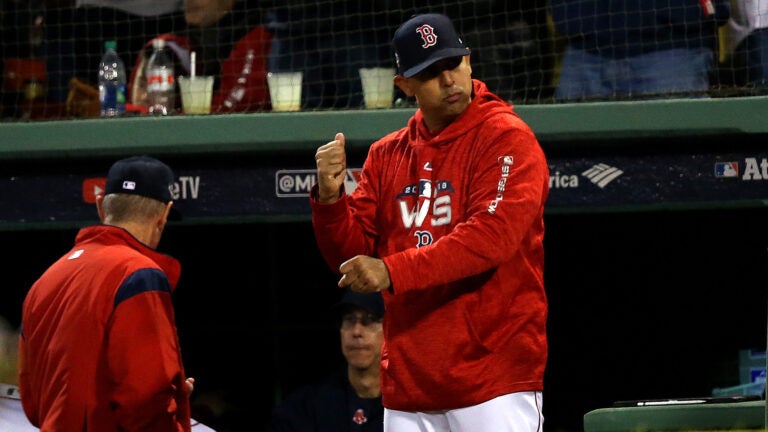
Over the course of the American League portion of the playoffs, questioning Alex Cora came to appear something of a pointless exercise for many among the public and the pundits. As his team forcefully dispatched the Yankees and Astros, and capturing the pennant in far-easier fashion than most expected, everything the Red Sox manager did seemed to work. His perspective and prescience made clear his fingers were on the pulse of his club, and the throat of its opponents. He was darn near perfect.
And through two games of the World Series, his team has taken after its manager in that way.
En route to a 2-0 lead over the Dodgers, mistakes have been difficult to identify from Cora’s Red Sox — on the field, at the plate, in their approach, anywhere. Baseball’s best team from April on has carried that into the last week of October, and even after a 108-win regular season has performed in the first two games of the World Series as though only now has it reached its peak.
So, as the series shifts to Los Angeles, here’s a look at five aspects in which the Sox have essentially been perfect in the process of seizing command:
Preparation
If there was a downside to destroying the AL the way the Red Sox did, it was that it created the potential that Boston might lose its momentum by the time the Fall Classic actually started. The Sox had four off-days following their league championship series, while the Dodgers only had two, and recent history suggests such a gap can have a consequence. The last time the team with the longer wait won the World Series was the 2008 Phillies.
Since then, the second team to qualify has won nine consecutive World Series — and every time the team with less of a break won at least one of the first two tilts.
The Sox have already upset the latter of those trends, and now the task is to do the same with the former. From the first inning of Game 1 the Sox have looked entirely ready for both baseball’s biggest stage and the National League’s best team, never giving even the slightest hint that they’re the team relying almost entirely on players seeking their first title while it’s the Dodgers are back in the Series for the second straight year.
Each of the last two postseasons, the Sox have been outclassed by the Indians, then the Astros, when it came to preparations for the playoffs. Terry Francona toyed with Boston in 2016, and Cora (then the Astros bench coach) has alluded at times to the advantages Houston identified a year ago. This year has been different; whether it’s improved advice from the scouting staff, or just better execution from the roster, the first two games of this series are evidence there’s a well-crafted plan in place, and the players have put it into practice.
Attitude and confidence
With a feeling of preparedness naturally comes confidence. These Red Sox — whether responding to Aaron Judge’s blaring of “New York, New York” or Alex Bregman’s Instagram boasting — have never in 2018 been accused of lacking confidence. But proof of the power of positivity came as soon as Mookie Betts returned to his mates after clinching free tacos for the rest of America in Game 1.
The suspicion here is that somewhere in the lead-up to the series, there was a conversation amid the prep work at Fenway Park that if all went according to plan the series would start as such: Betts would begin things with a single. He’d then quickly assert pressure, and aggressiveness, by stealing second. Soon after that, one of his teammates would knock him home. The Sox would play the series from ahead. The populace would hail their taco hero.
Then that’s exactly how it played out. And as Betts returned to the dugout, joy spread beyond what might be typical for a 1-0 lead in a series opener. As he worked his way through the high-fives he had a huge smile, and when he reached the end of the line he could be seen talking mouthing the word tacos as he looked toward the camera. He looked happy, excited, and like someone who’d made a goal of having that moment over the days leading up to it.
That’s consistent with the way the Sox’ attitude has presented throughout the first two games. In the biggest moments they’ve looked like a team that is experiencing this series just as they’d envisioned it unfolding. Like a team that believes its the better of the two, and is intent on enjoying the experience of proving it.
Resilience at the plate
The Sox’ striking ability to score with two outs has been well-documented. Of their 65 RBIs this postseason, 34 have come with two outs, and with two down and runner(s) in scoring position they are 17-for-41 this October (.415), with a .564 on-base percentage and .756 slugging mark. Among those numbers are seven extra-base hits and 11 walks.
Not to quite this degree, but they’ve been doing it all year, too, so the resilience of the Sox attack is not entirely surprising. But it’s worth pointing out that not only is Boston tough at the plate with two outs, they’re also productive with two strikes, as Christian Vazquez showed in starting the decisive rally that turned Game 2.
Consider the circumstances. Vazquez was a .207 hitter whose .540 OPS ranked 17th of 18 Red Sox hitters with at least 250 plate appearances in the regular season. That night he was the ninth hitter in the Sox lineup, and in his first trip to the plate he struck out on three pitches. By the time he returned to bat in the fifth inning, Dodgers starter Hyun-Jin Riu was rolling, having retired seven straight hitters. In that frame, he’d needed just three pitches to record the first two outs. Then the lefty quickly got ahead 0-and-2 on Vazquez. Ryu was a strike away from getting through the fifth with a 2-1 lead and having thrown just 56 pitches.
Vazquez wouldn’t let him get out that easy, and it quickly snowballed. The catcher fouled off a pitch, took a ball, then lined a single to right — then Betts singled, Benintendi worked an eight-pitch walk, and Ryu was done. By the end of the inning, five straight Red Sox had reached after there were two outs, and the Sox had a lead they wouldn’t relinquish.
Resilience on the mound
Where the Red Sox hitters have been able to outlast Dodgers’ pitching in those big spots, Boston’s hurlers have done almost as effective a job of limiting Los Angeles’ opportunities to seize similar opportunities — starting with Chris Sale and David Price.
Sale seemed to be constantly navigating through traffic in Game 1, his four-plus innings of work featuring five hits and a couple of walks, but the bottom-line damage was minimalized enough that by the time his line was finalized the three runs were enough to keep Boston even. The next night, Price had only one clean inning among his first four. Twice he issued walks a batter before one of LA’s two best hitters was coming to the plate. Another walk loaded the bases with nobody out.
But Price belied his postseason reputation by getting out of those problematic predicaments with only two runs allowed. Then he mowed through the top three in the LA lineup in the fifth, and delivered a shutdown frame in the sixth, after his teammates had staked him to a lead.
The bullpen has been even better. Joe Kelly, Nathan Eovaldi, and Craig Kimbrel have combined to face 18 hitters in this series — and those hitters are 0-for-18 with seven strikeouts. In Game 2, Boston didn’t need Matt Barnes or Ryan Brasier at all, which the troika of Kelly, Eovaldi, and Kimbrel recording the final nine outs in a ridiculously efficient 33 pitches. Those three were so commanding that there wasn’t a three-ball count in those nine batters Wednesday, and only a couple hitters saw two balls. Over the two games, only two of the 18 hitters they’ve faced have even got the ball out of the infield.
Is it sustainable? That remains to be seen. But after an up-and-down regular season, Kelly appears to have saved the best innings of his career for the World Series. Eovaldi’s resilience is reflected by the fact he’s backed up two good starts with three dominating relief appearances. And Kimbrel’s earlier playoff struggles at this point seem to have been fixed by correcting his pitch-tipping tendencies. Add them to Barnes and Brasier, and suddenly the Sox bullpen looks like it has both good stuff and the guts to go with it.
That considered, it shouldn’t be surprising that the group has now stranded 16 of the 17 baserunners it has inherited since Game 2 of the ALDS. Or that opponents are batting just .181 against Boston’s relievers.
The manager
The brilliance of Cora — beyond being the architecture of the culture that has allowed all of the aforementioned to flourish — can’t be overlooked, either. While in the other dugout Dave Roberts has rolled out a couple of right-handed lineups and waited for the Red Sox to dictate when he could use his lefty (and some of his better) bats, has used his bullpen predictably, and has seen his coaching staff’s defensive alignments be taken advantage of.
Cora trusted Rafael Devers at third base, despite the Dodgers starting lefthanded pitchers in each of the first two games, and the decision has paid dividends both at bat and in the field. That said, he made the right call in lifting Devers to insert Eduardo Nunez in Game 1, and was rewarded with a three-run homer. Then in Game 2, Roberts could have forced Cora’s hand by going to a right-handed reliever with Steve Pearce due and the bases loaded — but Cora resisted going to Mitch Moreland, and Pearce brought home a run by working a walk.
The decision to use Kelly in high-leverage spots in each of the first two games was also a testament to Cora’s feel for things. So was his choice to leave in a struggling Brasier to face Manny Machado with the bases loaded in Game 1. LA’s best bat (Machado) was at the plate with the tying run on second, but the manager let him face the righty, then called Eduardo Rodriguez to handle the lefty, and the Sox escaped with their lead intact. The way this postseason has gone, another manager might also have lifted Price after five innings when Boston surged ahead in Game 2.
Meanwhile, the Sox have remained aggressive on the bases, and been properly positioned defensively, and have taken advantage of the Dodgers’ struggles to do the same. Yasiel Puig has been practically playing in Wally’s Clubhouse under the right-field concourse, and the Sox have twice scored on hits to his field on which there should’ve at least been a play. (Puig also set up the Sox’ second run of Game 1 by airmailing the cutoff man.) In left field, the Dodgers allowed a ground-rule double on a ball that should’ve reasonably been caught given the lack of open space, while on the other side Air Benintendi thwarted a rally with a sensational catch that started by being in the right spot.
At this level, it can be the little things. A step here or there. A mindset. An approach. A single decision can make a difference that twists a game, which could redirect a series. So far, Cora has continuously put the Red Sox in position to seize those turning points. The players have then done so. Perfectly.