World Series power rankings: Where all 25 Red Sox place
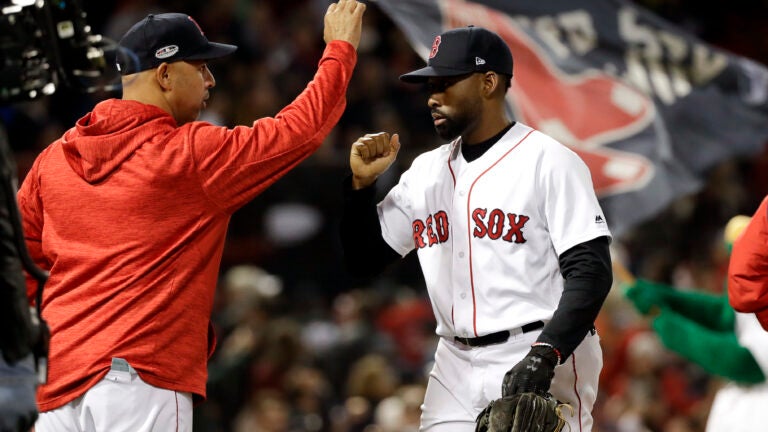
Jackie Bradley Jr. was ALCS MVP, but he hasn't been the most valuable Red Sox.
COMMENTARY
The matchup is now set: The Red Sox’ opponent in their fourth World Series of the past 15 seasons will be the Dodgers, giving baseball an intriguing, bicoastal matchup between two signature franchises with massive payrolls and a multitude of stars — and creating something of a conundrum for the fans in Boston:
If Los Angeles wins, does Dave Roberts have to start buying his own beers in this town again?
Triumphant thief of the most legendary stolen base in Red Sox history, and a conquering hero of those 2004 curse-breakers, Roberts returns to Fenway this week as manager of the Dodgers – looking to reinstate the era of misfortune that reigned when he arrived in New England earlier that summer, but has since been eradicated by three championships and a 12-2 World Series record in the wake of his famous swipe.
His club certainly has the talent to do it, with All-Star-caliber players coming off the bench, a Hall of Fame ace backed up by good young arms, and a quality bullpen. That said, they’ve underachieved for most of this year, and the Red Sox have been the best team in baseball at every turn since April.
Los Angeles beat Atlanta and Milwaukee, and will now come to the other city that has hosted the Braves franchise to find a Boston team that just rolled through two other elite squads in the American League playoffs, and made that path look hardly treacherous, with contributions coming from all over a roster that didn’t rely entirely on its MVP and Cy Young candidates to dominate.
Before delving into the nitty gritty of the World Series, here’s a look at that roster, and how it rolled through the AL, with the Red Sox postseason power rankings:
25. Heath Hembree/Steven Wright: Hembree was added to the roster after Wright’s repaired knee acted up hours before the Yankees series. He made three scoreless appearances – though two were with the Sox trailing by at least four, and the other came with Boston leading by 13. Wright said Saturday that he’s healthy, and if the knuckleballer reclaims his roster rank he figures to be a prominent part of Alex Cora’s bullpen mix.
24. Brandon Workman: While earning his way into the eighth inning of Boston’s title-clinching win in 2013, Workman allowed 10 baserunners over 8.2 postseason frames, and wasn’t charged with an earned run. He’s allowed 10 baserunners this postseason, too – except this time it’s been in one inning, spread over three appearances, and accompanied by five runs. It’s hard to see the manager thrusting him into a high-leverage spot at this point; then again, at this point five years ago it was even harder to envision his manager letting him bat in the late innings of a World Series game, so who knows.
23. Eduardo Rodriguez: Before injuring his ankle in July, he looked like an indispensable part of Boston’s starting rotation. When the team decided in September he’d spend October as a reliever, he projected as a lefty weapon. As the World Series begins, however, Rodriguez has become an unreliable nonfactor. He let Game 2 against the Yankees get away from the Sox, then didn’t see more than mop-up duty again until Game 4 against the Astros, when he summoned with Boston leading by a run and walked the only batter he faced.
22. Blake Swihart: Personally, his only at-bat, and appearance, came with the Sox comfortably leading a game they’d win by 15 runs. But that doesn’t surmise Swihart’s value on the roster. Because they have a third option at the position, Boston has had the liberty to pinch-hit for its catcher. Those pinch-hitters have reached base in three of six chances, with a hit, a walk, and two RBIs – one of which came via a hit by pitch ahead of Jackie Bradley Jr.’s grand slam in Game 3. According to Baseball-Reference, only three plays in that game had a great impact on Boston’s victory than Moreland getting plunked. Swihart has been an indirect factor, but a factor, thus far.
21. Ian Kinsler: He was the AL’s sixth-toughest man to strike out this season, but has whiffed 11 times in 24 at-bats this postseason. To get back to his career rate of 7.2 at-bats per strikeout, Kinsler would need to hit 55 times without a strikeout in the World Series. It’s an indicator of just how lost he’s looked of late, despite delivering three playoff doubles.
20. Eduardo Nunez: The signature play of his postseason was the charge-and-throw that eliminated the Yankees, and it will be replayed forever in these parts (especially if the Sox go on to win it all). Otherwise, though, Nunez has been a defensive liability at third base, and hadn’t been hitting enough to hold his place in the lineup before coming up lame with a leg injury in the ALCS. Even if he’s cleared to go, the hot corner belongs to Rafael Devers from here forward.
19. Mitch Moreland: Moreland incurred a leg injury of his own, limiting his availability until he returned to the starting lineup for Game 5 in Houston. The veteran has still found a way to contribute, however, going 4-for-9 and reaching base in six of his 11 trips to the plate during the AL playoffs. Given the lefthandedness of the Dodgers’ rotation, Moreland figures to spend more time on the bench this coming series, but his proficiency as a pinch-hitter could yet make him a key contributor.
18. Sandy Leon: Lauded for his defensive skills after the opener of the Yankees series, his offensive limitations caught up to him, and so he’s ceded the starting role behind the plate. Nevertheless, he could be the receiver trying to help the Sox navigate the late innings against Los Angeles, and Boston is in the fortunate position to fully trust its backup with such big responsibility.
17. Joe Kelly: The righty has been solid in four postseason appearances, which have included earning the victory in Game 4 – despite entering in a tie and leaving with the Sox down a run. He hasn’t issued a walk while pitching with a fearlessness, and that combination would seem to be a recipe for Cora calling on Kelly in a big spot at some critical juncture if this series goes deep.
16. Christian Vazquez: Give him credit. After signing a three-year extension over the offseason, Vazquez had a disappointing year. Then he broke a finger, and returned with Leon having seemed to take over the starting role and Vazquez’s place on the roster in some doubt. This October, though, he’s been steady behind the plate and also picked good times to deliver offensively, his bat helping win a game in the Bronx and then setting up one of Bradley’s big moments in Houston.
15. Brock Holt: Outside of hitting for the cycle, Holt is 1-for-9 this postseason with a single, a run, an RBI, and a walk. No matter. He demonstrated his value as a pinch-hitter on several occasions during the regular season, and his positional versatility could put him in a spot to make a significant impact when the World Series moves to the National League park. Especially if Nunez is a health question.
14. Chris Sale: The power rankings that appeared in this space during the regular season consistently had Sale ranked somewhere in the top three, a tribute to his performance and to the idea that the Sox needed him to compete in the top-heavy AL tournament. Well, then Boston proceeded to eliminate a pair of 100-win teams in convincing fashion with Sale delivering one decent start, losing his second, and then missing a third start because of a (less-than-believable) belly-button injury. So after two series, he now ranks 14th – and it’s only that close to the top because of the inning he pitched out of the bullpen in New York.
13. Andrew Benintendi: Game 4 of the Houston series was a vision of what Boston hopes Benintendi will be for the next decade. He delivered two doubles, scored twice, helped set the tone, then made an all-time defensive play to seal a victory (and in some ways the series). Unfortunately, that’s not the player he’s been for most of these playoffs, hitting .237 with a .310 OBP overall. Hoping he can build on a pair of two-hit performances in Houston, the Sox need more from their No. 2 hitter in the next series.
12. Steve Pearce: He’s a free agent at the end of the year, and that’s great timing for a 35-year-old journeyman who has further validated his usefulness on a good team this postseason. With a knack for the lunging stretch he’s made several pretty defensive plays, he’s reached base at a .387 clip, he’s slugged a timely homer, and to cement his favoritism with the fans he fearlessly flung his body headfirst into a dugout in pursuit of a foul ball. Credit to Dave Dombrowski for finding a glue guy for little cost.
11. Xander Bogaerts: It’s been a solid, steady postseason for the shortstop, who had a hit in each of Boston’s first eight games, and who had a couple of RBI in the Game 4 victory. He’s hit cleanup seven times this postseason, so the Sox could use a bit more of the pop and presence that produced the seventh-highest slugging percentage in the AL in the regular season, but Bogaerts has been good anyway.
10. Craig Kimbrel: The righty has been tasked with getting 19 outs these playoffs, and locking down five save opportunities. He has recorded all 19 of those outs. And all five of those saves. Of course, in the process he’s allowed six hits, six walks, a homer, and five earned runs, on top of hitting two guys, yielding a few hold-your-breath shots to the warning track, and sprouting a variety of gray hairs in heads across New England. It may not feel that way, but the bottom line is that the closer has yet to blow a game. And if his troubles were really the result of him tipping pitches, perhaps the heart attacks are behind him along with those issues.
9. Rafael Devers: Going into the night the Red Sox clinched the AL East, Devers’s place on Boston’s postseason roster looked in doubt. He’d struggled to stay healthy, to play defense, and to hit consistently. But Devers got hot at the right time – collecting a couple of hits in the clincher, then slugging four homers with 10 RBIs over the next six days. It was a reminder of the impact his bat could have, and previewed the punch he’d provide against Houston. If not for Bradley he might’ve been the ALCS MVP, capping a .385/.467/.615 effort with the game-winning, three-run, opposite-field shot into the Crawford boxes above left field. His glove can’t be trusted. But his bat belongs in the lineup.
8. Ryan Brasier: If Kimbrel had allowed the tying run to get to the plate in Game 5, the guess here is that Brasier – who was closing games in Pawtucket in April, and effectively out of baseball in January – would’ve been called upon to finish the clinching contest of the league championship series. It’s a call that would’ve been made confidently, too, considering what Brasier has done since a tough postseason debut. Through seven appearances his playoff ERA is perfect, he’s allowed only four hits in seven innings, and he has shown an ability to handle himself in high-pressure spots.
7. Mookie Betts: The presumptive AL MVP is hitting just .205 this postseason, but in Game 4 he directly saved two runs with his defense (hat tip, Joe West), and may well have saved a third with his Tom Emanski-approved turn-and-throw to cut down Tony Kemp trying to get to second after a hit off Kimbrel in the eighth. Those plays led to an enormous win, and while the hits have been sparse, Betts still set the tone atop the lineup by reaching to lead off the game four times in the Houston series. There’s been no evidence of the 30/30-level homer and steal threat he is, but the Sox have overcome it in part because of the other ways Betts can help a team win — which may in the next week also include playing second base.
6. David Price: Among teammates, only Kimbrel, Rodriguez, and Workman have a worse postseason ERA than Price’s 5.11 through two playoff rounds. But the much-maligned southpaw delivered a competitive outing that put the Sox in position to win Game 2, then came back on short rest to fill Sale’s spot with a masterful outing in Game 5. With nine strikeouts, no walks, and three hits, those six scoreless innings comprised a game score of 75, which was Price’s career playoff best – and only one other was higher than 50. That’s in line with the best postseason starts Jon Lester made for the Red Sox, and better than anything turned in for Boston by Curt Schilling.
5. Rick Porcello: The numbers look Porcello-like, with a couple of home runs pulling the ERA to 4.22. But Porcello has been an absolute linchpin this postseason. He likely had another inning in him during his start at Yankee Stadium, he battled through some traffic to keep the Red Sox close in Game 4 at Houston, and on top of that he handled the eighth inning masterfully in Boston’s first win of both series. He’s steady, reliable, tough, and motivated to erase his own spotty postseason track record – all of which makes him a huge cog in the Red Sox’ engine.
4. Matt Barnes: The homer he surrendered in Game 5 against the Astros was the first hit Barnes allowed this postseason, elevating opponents’ collective average to .050, and the righty’s ERA to 1.42. Those might not even be the most impressive numbers, either, as Barnes has been invaluable in helping the Sox get out of trouble. He entered three of his five games against the Astros with two men on base – and stranded all six of those inherited runners, duties that brought him to the mound in the fifth, sixth, seventh (twice), and eighth innings. He’s been ready every time, and been the arm that has allowed Cora to set up the rest of the relief staff as planned.
3. J.D. Martinez: There was a mighty drought in between the homers that started the Yankees series and helped finish the Astros affair, but including those two clouts Martinez has by and large been good this October. Through nine games he shares at least the team lead in hits (10), homers (two), RBIs (nine), walks (seven), and he’s hitting .313 with a .415 on-base percentage and a .946 OPS. As a team, the Sox hit just .233 against the Astros, in spite of winning four of five games. Outside of the 16-run, 18-hit outburst against the Yankees, they hit .218 in that series. The offense has dipped, predictably, compared to the regular season – yet Martinez remains the steady force.
2. Jackie Bradley Jr.: Martinez being tied for the team lead in homers, walks, and RBIs is predictable. That he’d be tied with Bradley would’ve been thought as unlikely as, well, as unlikely as JBJ being named most valuable player of the ALCS. Those nine RBI came on the strength of his only three hits in the series – a grand slam, a two-run homer, and a three-run double – but despite a .200 average Bradley posted a 1.082 OPS buoyed by those big knocks and diligent plate discipline. They were just three moments, but those moments are exactly the type that will be remembered as part of Red Sox lore forever if this team wins four more games.
1. Nathan Eovaldi: In the games he’s started, the Sox have outscored their opponents 24-3. His relief appearance never saw the tying run get further than the on-deck circle. Yet the significance of Eovaldi’s excellence this postseason cannot be overstated. He took the mound for Game 3 at Yankee Stadium with the series tied and with the Sox offense really struggling to find itself after two earlier years of postseason flops. He breezed through the first three innings, giving his own bats a chance to settle in, and eventually went seven full. He next took the mound in Houston, again with the series tied, and this time he authored six strong innings, the last being a shutdown frame after his teammates staked him to a one-run lead. Then there was Game 5, when on one day’s rest he came out of the bullpen to retire four of the five men he faced, ramped his heater up to 102 mph, and handed the ball to Kimbrel with a three-run lead. At the start of the playoffs it was unclear whether he would even earn a start. Since then he’s earned a start, a place in Red Sox history, and probably a bunch of money as a free-agent-to-be.