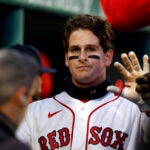
The Red Sox lost this one because their bats were not weapons, but props
In the end, there was little excitement and no satisfaction to be found for the Red Sox.
Turns out the unusual does not equal entertaining.
In the Astros’ 7-2 victory over the Red Sox Saturday night in Game 1 of the American League Championship Series, the teams combined for 14 walks and three hit batters, but just eight total hits.
An umpire was drilled by a catcher’s throw, and Red Sox manager Alex Cora was ejected for arguing with another umpire.
It made for colorful moments, but in the end, there was little excitement and no satisfaction to be found for the Red Sox, who went down, 1-0, in the best-of-seven series in large part because their bats were not weapons, but props.
The reasons the Red Sox offense snored through the opener were understandable. That did not make them any less aggravating.
The fundamental reason was the quality of the opponent standing 60 feet 6 inches away. Astros starter Justin Verlander, still excellent at age 35, brought a repertoire to the mound Friday night that was at times reminiscent of his stuff from 2011, when he beat out the Red Sox’ Jacoby Ellsbury for the American League Most Valuable Player award. Yes, he’s been doing this awhile.
Save for an unexpected and ultimately unimportant spree of walks in the fifth inning, Verlander was superb, allowing two hits and two runs through six innings, with four walks and six strikeouts to earn the win.
[fragment number=0]
His most impressive pitch might have been a called strike to Andrew Benintendi with two outs and two on in the bottom of the fifth inning. Benintendi took a 98-mile-per-hour fastball just off the black for strike three.
It was also his most controversial. Should it have been strike three? Well, the pitch was not on the black. It was just off. The same could be said of home plate umpire James Hoye, who was just off all night.
Hoye’s strike zone was not just inconsistent. It could have been a guessing game called Ball or Strike: You Have No Idea What I’m Going To Call On This One. It was almost enough — almost — to make you wish the rightfully maligned Angel Hernandez was umpiring in this series. Did I say almost?
(It was Joe West, not Hoye, who was nailed by a Christian Vazquez throw in the eighth inning. West did not look amused. No truth to the rumor Hoye called Vazquez’s throw a strike.)
It’s tough to hit under any circumstances against a pitcher with the savvy and skill of Verlander, not to mention the assorted power arms that followed him (former Red Sox farmhand Ryan Pressly, Lance McCullers Jr., and Collin McHugh combined to allow one hit in three innings).
It’s virtually impossible when the strike zone varies from pitch to pitch, something the Red Sox manager addressed when he confronted Hoye after Benintendi’s strikeout, a conversation that resulted in his ejection.
“I guess Verlander executed his pitch and he called it a strike,’’ said Cora. “Andrew didn’t agree. I didn’t agree. It’s a big pitch right there. It’s ball four, bases loaded. . . . Most likely Verlander comes out of the game.
“You can’t argue balls and strikes and I did. It’s kind of embarrassing that it happens in the playoffs. That wasn’t cool watching the game in the clubhouse. . . . But sometimes you’ve gotta do what you’ve gotta do, and you’ve got to defend your players.’’
The Red Sox did a lousy job adjusting to the circumstances. The Red Sox led the majors in runs during the regular season (876), and entered Game 1 leading all teams in the postseason (27) despite having played just four games. They managed just threehits against Astros pitching — a leadoff single by Mookie Betts on the first pitch of the game, Steve Pearce’s single to lead off the bottom of the fifth, and Xander Bogaerts’s single to start the bottom of the ninth. The Red Sox managed a pair of runs off Verlander in the fifth to tie the game at 2-2, but neither was the result of a hit.
Verlander walked three straight Red Sox — Eduardo Nunez, Jackie Bradley Jr., and pinch hitter Mitch Moreland, none of whom had an on-base percentage higher than .325 this season. Moreland’s walk plated Pearce. The second run came on a Verlander wild pitch. The Red Sox seemed poised for more, but Betts hit into a fielder’s choice, and Benintendi whiffed on the impossible-to-hit pitch that preceded Cora’s ejection.
The Red Sox have not scored a run on a base hit since the fourth inning of Game 4 of the American League Division Series against the Yankees, a span of 14 innings. Betts’s leadoff single in the first was the only hit among the top four in the batting order. Betts, Benintendi, J.D. Martinez, and Xander Bogaerts went a combined 2-for-15 with a walk. Betts is now hitting .212 in his postseason career.
The Red Sox most compelling connection of the night was not with a bat, but when reliever Joe Kelly, who took over for Chris Sale to start the fifth, buried a 100-m.p.h. fastball into budding nemesis Alex Bregman’s left arm in the sixth. When Bregman crossed the plate four batters later courtesy of Carlos Correa’s single, he appeared to glance out at Kelly, and then into the Red Sox dugout.
[fragment number=1]
The Astros got justice — a victory that offered no suspense at the end once Yuli Gurriel turned a 4-2 game into a 7-2 Houston advantage with a three-run homer in the top of the ninth.
Offense was not the Red Sox’ only issue. Chris Sale was wild East-West all night, and that is not the Sale we were accustomed to seeing in the spring and early summer, when he pitched like the Cy Young Award was destined for his mantle. He gave up just one hit in four innings Saturday night, but he walked four — his most as a member of the Red Sox, one below his career high of five — and struck out just five. He looked OK, and OK for Sale is ominous.
David Price gets the ball in Game 2. It’s to be determined which Red Sox will use their bats.