What’s it like for a Red Sox player under the media microscope in Boston?
"Playing in Boston was the five best years of my career."
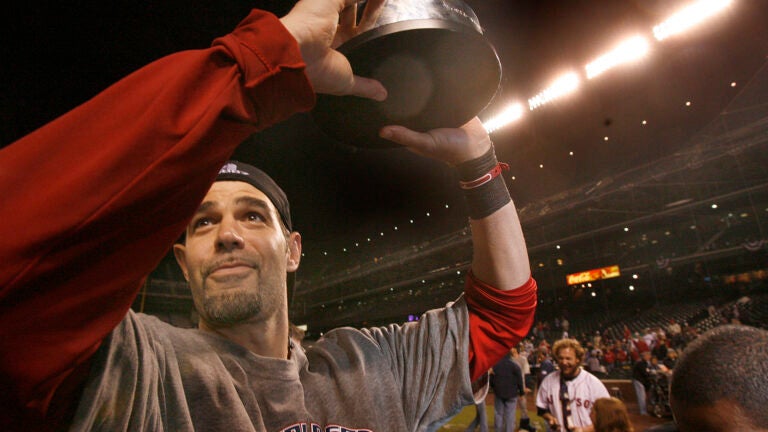
Fun fact: Kevin Millar, Mike Lowell, and Ryan Dempster were teammates on the Florida Marlins for four seasons (1998-2002). None of those teams had a winning record.
Fun fact that is actually relevant to Boston fans: The trio of Marlins refugees, all of whom now work for MLB Network, each won a World Series as a member of the Red Sox, but on different teams.
Millar was one of the chief self-proclaimed “idiots’’ on the iconic 2004 champions, who delivered joy and catharsis to New England with the franchise’s first World Series win since 1918. Lowell was the steady and often superb third baseman (and World Series MVP) of the ’07 champs. Dempster was one of the group of veterans who brought camaraderie and unity to the ’13 winners and to the city itself, in the wake of the Boston Marathon bombings.
I caught up with the three of them at once to reflect on their time in Boston and how they handled the intense media scene.
Was there a culture shock coming from a market in Miami that was often indifferent about the Marlins to Boston, where it can feel like a playoff atmosphere every day?
Millar: The difference in New York and Boston is all the media outlets. You get asked the same question 14 different times after a baseball game, win or lose. The fan bases, the stadiums, the passion of the East Coast for baseball, it’s all awesome.
But when you have 42 media members in the clubhouse after a game every single night, compared to playing for the Florida Marlins where you know the three or four reporters on a first-name basis, it can be a huge adjustment, and you find out who can handle it and who can’t pretty darn fast.
Lowell: Ryan went to the Cubs before he came to Boston, but for Kevin and I, our first taste of playing somewhere else after Florida was Boston. That made it magnified even more so.
We had a couple of good years in Florida where we hoped to play in front of big crowds, but it didn’t often happen. You come to Boston and the streets are closed and it’s sold out every night, it’s a new world.
There is that dynamic where if you did well, it’s great to stand in front of your locker, but if you didn’t, you know those questions will be coming at you.
Dempster: Chicago did prepare me for Boston a little bit, but Chicago hadn’t won yet, and going to Wrigley was still like going to a giant beer garden.
I found in Boston that the fans hang on every pitch. But not in a negative, fatalistic way, which was their old reputation. I think the expectation changed when Kevin’s team won in ’04, and then Mike’s in ’07. They expect the good to happen. That’s how it felt to us.
But I would echo what Kevin said about the media. I came here in in ’13, after the whole chicken-and-beer thing and then the Bobby Valentine year; there was just a lot of negativity media-wise then.
We turned that around real quickly, but there would still be a tiny bit of focusing on the negative rather than the positives there. You could pitch a shutout and give up just one hit, and the first question from Jonny [Miller, WBZ Radio’s veteran reporter] would be, “What happened on the one hit you gave up?’’ [Laughs.]
Does it take a certain mind-set to play here? It seems that it must be a requirement to be able to shake off criticism, but there’s also that adulation that might feed the ego a little bit.
Millar: Absolutely, it takes a certain kind of makeup to play there, and the Red Sox generally have done a good job identifying who can handle it. I played for the Marlins, and then you get to the Red Sox and suddenly even at spring training it’s like you’re Aerosmith or something, recognized wherever you go.
It’s like you’re a rock star when you’re playing for the Red Sox, and then you go home and you’re supposed to be a normal guy. You can’t understand that until you experience it.
Lowell: Kevin says Aerosmith, but when you’re going good, the fans would shove Aerosmith out of the way to get the ball boys’ signatures. They make you feel like you’re superhuman.
I remember when we played them in an interleague series in 2003 and fans were chanting Manny [Ramirez’s] name while he was in the on-deck circle. He wasn’t even at the plate yet. I thought, “Wow, this is nuts,’’ and that was just a taste of it.
That’s when I realized that there’s a playoff-type atmosphere at Fenway, you know, on May 10 against a last-place team. From a personal standpoint, I loved it. Playing in Boston was the five best years of my career.
Dempster: Listen, we appreciated this, because we knew what it was like to play in front of 300 people in South Florida. That’s no lie.
Lowell: Yeah, and it you take away my Cuban extended family, it was like 50.
Dempster: And in Boston, it’s a big deal every day. I played there one year, but I have so many memories it might as well have been 10. I lived on Comm. Ave. and just to walk to the ballpark every day, it was an incredible experience. I’ll never have a bad word to say about it.
What was distinctive about the individual teams that you won with here?
Millar: Well, when you’re going to spring training, everyone is happy and gets along. But that can change for a lot of reasons once the season gets going. With 25 guys, it’s a great situation if you have 15 that are the boys’ club, that like hanging out together.
There’s a selfishness to all of us. We all want hits, Ryan wants wins, and if you do your job, you can be happy even if the team loses. That’s just how it is. Everybody is trying to make money and take care of generations, got it.
But, when you have a group that almost to a man gets along, like we had in ’04, that makes it that much more special, and it makes it easier to get through the tough times. We were a .500 team through July, but we stuck together, and the guys who came in like Orlando Cabrera bought in.
When you’ve got talent and you’ve got guys who are pulling for each other and care about their teammates, that’s special. We were a team, man.
Lowell: I don’t think our story can match up with the other two championships, but we had a really well-rounded team. Our lineup still had Manny and David [Ortiz] from ’04, plus we had developed several homegrown guys: [Dustin] Pedroia, [Jacoby] Ellsbury came up, [Jon] Lester, [Jonathan] Papelbon. Josh [Beckett] was a monster that year, and J.D. [Drew], Daisuke [Matsuzaka], and Hideki [Okajima] were brought in and really gave us quality everywhere.
“And we had that great chemistry as well. We’d lose 6 of 10 or whatever, and Schill [Curt Schilling] would get everyone to go together to a steakhouse to keep the camaraderie going. We’d have 15-18 guys there. Even Manny would join us. He wouldn’t bring his wallet, but he’d join us.
Dempster: Maybe our teams have more in common than it appears, because there was that closeness with our group right away too.
We obviously had some unique circumstances that brought us together even more with the Marathon bombing, and it all fit together with chemistry that’s hard to find. We had a greater purpose.
I think fans appreciated not only that we won, but how we went about it, just grinding out victories and never giving up. And Kevin is right — when it goes well, there’s no place else you want to be.
I played one year in Boston, and I still don’t pay for beers when I go back there. I’d like to keep it that way, too.