How past seasons have gone when the Red Sox and Yankees topped the American League
Since 1904, the two rivals have led the American League in wins nine times. It's led to a few memorable showdowns.
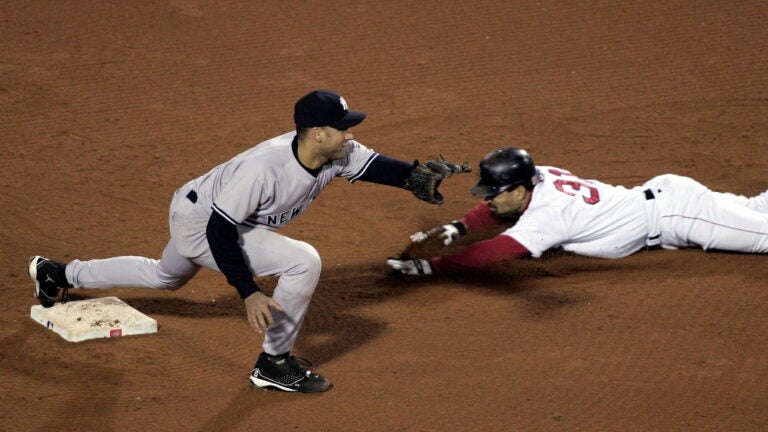
For the Red Sox and Yankees, order has been reestablished in the baseball universe so far this season. A joint return to the top of the standings has seen a promising reboot of the rivalry.
Pushing each other in a back-and-forth A.L. East race, Boston and New York currently have the two best records in baseball. It’s a restoration of traditional battle lines, with the free spending clubs once again outpacing the rest of the league.
Since the wild card playoff format was adopted in 1995, the two rivals have both made the postseason nine times in 23 seasons.
Stretching even farther back in history, it’s been a relatively rare occurrence when both teams have jointly topped the American League in wins. In fact, it’s only happened nine times.
Here’s a look back at each of those examples:
1904: What fans know today as the Red Sox were then the Boston Americans, while the Yankees were the Highlanders. Each team was in the fourth year of its existence, yet Boston had already been champions.
In the prior season, the Americans defeated the Pittsburgh Pirates in the first ever World Series. And thanks to wins in three of the last four against New York in a dramatic season series finale, the Americans looked set to challenge for a repeat of the fledgling World Series title. Ultimately it was not to be, as the National League champion New York Giants boycotted the World Series. It was the only cancelled Fall Classic for the next 90 years.
1938: The Red Sox rose from the depths of the American League to finish second in 1938, their highest finish since the 1918 World Series victory. Of course, it was a distance away from the dominant Yankees, who won the pennant by 9.5 games.
Though the Red Sox challenged the Yankees as late as July, New York sprinted through the second half of the season. By Sept. 10, the lead had stretched to 16 games before settling back at 9.5 as the Yankees went on to win the World Series.
1939: The following season proved a distorted version of 1938. Once again, the Red Sox finished second, but far in the rearview mirror of the first placed Yankees. New York again thundered down the stretch, winning 106 games and clinching the pennant by 17 games.
The year was notable for the debut of Ted Williams and the retirement of Lou Gehrig.
1941: Another year in which the Yankees won the pennant at a trot (by 17 games) was defined more for the individual performances of Williams and Joe DiMaggio.
The Yankee outfielder strung together his record setting 56-game hitting streak, during which time he held an average of .408. A day after the streak finally ended, DiMaggio began another 16-game streak, meaning that he hit safely in 72 of 73 games.
Williams, not to be outdone, joined the exclusive list of players to record a batting average over .400 for the season. After a brief “slump” in mid-July, Williams’ average didn’t fall below .400 for the rest of the year. He remains the last player to achieve the feat.
1942: Despite winning 93 games – the most by a Red Sox team since 1915 – it was another second place finish for Boston. The Yankees won 103 games to win another pennant comfortably, though they would lose to the Cardinals in the World Series.
The issue looming over the season was American entry into World War II. In June, Williams announced his enlistment as a Naval aviator (though he was allowed to play out the remainder of the season). President Franklin Roosevelt’s “Green Light Letter” formally gave baseball the go-ahead to keep playing despite wartime constraints.
1949: For the first time (though certainly not the last), the Red Sox and Yankees met in pivotal showdown to decide a trip to the World Series. The Red Sox, who trailed the Yankees by 12 games on July 4, made a late push to close the gap on New York. Heading into the final two games, Boston led the race by a single game.
Needing only one win at Yankee Stadium, it appeared that Boston would complete the epic season-long comeback. Yet New York prevailed in both games to clinch still another pennant. Red Sox manager Joe McCarthy (who had previously managed the Yankees to seven World Series wins between 1932-1943) made several controversial bullpen decisions late in the second game, which was partly blamed for the defeat.
1978: After finishing first and second five times from 1938-1949, the Red Sox and Yankees wouldn’t top the American League again until 1978. As had been the case in 1949, it proved a dramatic finish. Boston surged 14 games ahead of New York in July, but a 3-13 start to September saw the lead completely evaporate.
The Yankees came to Fenway Park for a one-game playoff after both teams finished with the same regular season record. And in a moment that would go down in Red Sox infamy, light-hitting Yankees shortstop Bucky Dent clubbed a three-run home run to give New York a 3-2 lead. The Yankees never looked back, winning 5-4 and taking the pennant with them.
1998: Two decades after the crushing loss in the playoff, the Red Sox once again crested the 90-win plateau but finished second to the Yankees. The difference in 1998 was instead of trailing by a single game, Boston ended up a whopping 22 games behind the 114-win Yankees.
New York went on to capture another World Series, while the Red Sox lost in the first round of the playoffs to the Indians. Dennis Eckersley, who retired after the season at age 43, remarkably played on both the ’78 and ’98 Red Sox teams.
2004: A century after the Red Sox and Yankees first topped the American League in wins, it happened for the ninth time in 2004. After a reheated rivalry culminated with a back-and-forth ALCS in 2003 – ending with another crushing Boston loss, the stage was set for a rematch. The Yankees won the division, though the Red Sox closed a 10-game gap down to three games before the postseason.
In what remains a defining playoff series, the Red Sox rallied from a 3-0 ALCS deficit to eliminate the Yankees in a one-sided Game 7. It was a startling reversal of a decades-long trend where Boston finished behind New York. The Red Sox went on to end their 86-year drought, winning the World Series in a sweep over the Cardinals.
https://www.youtube.com/watch?v=6tz1az1W_ME