Jackie Robinson Foundation weighs in on petition to rename Yawkey Way
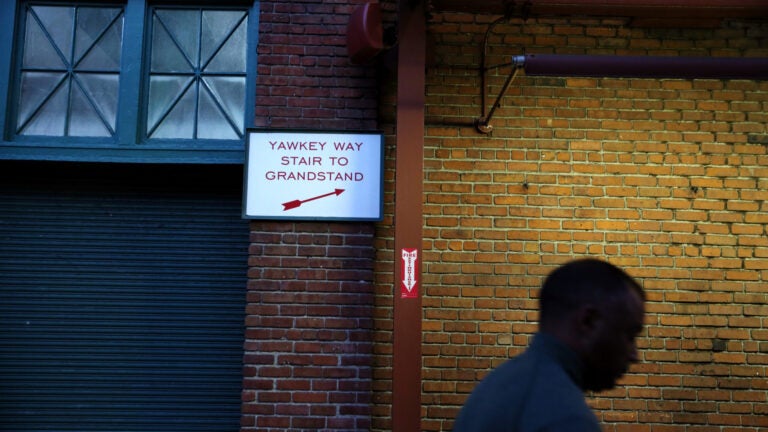
On the eve of a decisive vote set for Thursday, a new voice has weighed in on the yearslong, controversial question of whether to rename historic Yawkey Way — that of the Jackie Robinson Foundation, set up in honor of the man whose legacy is very much at the center of the debate.
The foundation’s president and CEO, Della Britton Baeza, sent a letter to the Boston Public Improvement Commission highlighting the work of the Yawkey Foundations, the charitable foundations that were set up by Tom Yawkey and his wife, Jean, and which have donated hundreds of millions of dollars to area programs.
“It is associated with good will, generosity and a desire to proactively confront the institutionalized discrimination that continues to cripple our society,’’ Baeza said in the letter, pointing out that Jean Yawkey sponsored the Boston tour of a traveling exhibit of Jackie Robinson and the Jackie Robinson Foundation three decades ago.
The letter stops short of calling on the Public Improvement Commission to reject the request to change the name of Yawkey Way, a request that was based on allegations that Yawkey and the Red Sox have a history of discrimination against blacks.
But the letter suggests what others who have opposed the name change have argued: that the name Yawkey Way is inseparable from the work of the Yawkey Foundations, and so changing the name of the street by Fenway Park would taint the legacy of the foundations and their charitable work.
“The Yawkey name resonates loudly at [the Jackie Robinson Foundation],’’ the letter states, pointing to the charitable contributions, “and it has profoundly helped pave the way for the completion of the Jackie Robinson Museum, which will tackle the same complex racial dynamics that are swirling around the Yawkey Way naming controversy.’’
The letter adds that, “We remain hopeful that our efforts will continue to contribute to leveling the playing field for all to pursue the promise our country offers, in keeping with the aspirations of our beloved namesake . . . We give credit to the Yawkey name for making that possible.’’
The letter comes as the Public Improvement Commission is expected to vote on the request to return the two-block strip to its original name, Jersey Street, a request that has divided Boston’s business and civic leaders. Boston community leaders such as Partners HealthCare chairman Jack Connors and Cardinal Sean O’Malley, of the Roman Catholic Archdiocese of Boston, opposed the name change, saying it would taint the work of the charitable foundations.
The Red Sox, led by principal owner John Henry, requested the name change in February, citing Yawkey’s reputation as a racist and a willingness to distance Fenway Park from that history. Henry also owns The Globe.
The letter does not specifically state whether the foundation supports or opposes the name change, and calls to the foundation were not immediately returned.
Yawkey, for whom the street was named in 1977, owned the team from 1933 until his death in 1976. During his tenure, the Red Sox were the last Major League Baseball club to integrate, finally calling up their first black player, infielder Pumpsie Green, in 1959. That was 12 years after Jackie Robinson broke baseball’s color barrier with the Brooklyn Dodgers.
Yawkey is also believed to have screamed a racial slur from the grandstand at Robinson and two other black players during a team tryout in 1945, though the person who yelled the slur has never been confirmed.
The Public Improvement Commission, an independent body that controls and permits the use of public space, has the final say of whether to rename the street. The members represent departments within the administration of Mayor Martin J. Walsh, who has not publicly taken a position on the proposal. His office said he would defer to the commission’s process, “which is still ongoing.’’