The extraordinary and exasperating Xander Bogaerts is in need of a bounceback season
Let’s admit it. When we’re talking about potential bounce-back candidates in the Red Sox lineup, there’s one player who comes to mind before all others:
That player, I imagine you will agree, is the sometimes extraordinary, recently exasperating 25-year-old shortstop, Xander Jan Bogaerts.
Sure, the Red Sox could use more out of Hanley Ramirez, who drove in 49 fewer runs in 53 fewer at-bats in 2017 than in ’16. Jackie Bradley Jr., the Marcus Smart of the Red Sox (brilliant defense, maddening offense) could stand to be less enigmatic. And it’s hard to believe Mookie Betts’s batting average will collapse to the sunken place of .264 over a full season again.
But Bogaerts is the one to watch this year, in part because he was such a disappointment compared to expectations last year. In his fourth full major league season — none of which have been similar — he slashed .273/.343/.403. That’s not terrible — the American League averages were .253 (batting), .324 (on-base percentage), and .429 (slugging).
The league-average OPS was .753. Bogaerts’s was .748. He was . . . well, average, or slightly below. Theoretically, that’s tolerable considering he plays a premium defensive position, shortstop, with competence if not much more than that.
But it really wasn’t tolerable, given the player Bogaerts has been before and is expected to be. When he came up as a 20-year-old late in the 2013 season, he was regarded as one of the top few prospects in baseball. His sensational performance that postseason — he was essentially the Red Sox’ second-most dangerous hitter to David Ortiz in the World Series while capably playing an unfamiliar position, third base — suggested that promise would be fulfilled and then some.
In many ways, it has been fulfilled, though Betts has become the MVP-caliber player Bogaerts was supposed to be. The disappointment in recent unmet expectations clouds the recognition and remembrance of all that he has already accomplished.
In 2015, at 22, he finished second to the Tigers’ Miguel Cabrera in the AL batting race (.320), while rapping 196 hits and driving in 81 runs. The next season, he slashed .294/.356/.446 with 21 homers, 89 RBIs, 115 runs scored, and 192 hits. In both seasons, he won the AL Silver Slugger award for his position.
He was especially exceptional from the middle of the ’15 season (when he slashed .337/.372/.431 with 100 hits in 71 games in the second half) through midseason ’16 (when he slashed .329/.388/.475 with 115 hits in 88 games).
There is some mystery as to why Bogaerts hasn’t been consistently at that level since. But perhaps the mystery is easily solved. Last year, he was off to a fine start, hitting .308 with an .818 OPS when, on July 6, he was hit on the hand by a Jacob Faria fastball in a game with the Rays.
He missed just one game, but it clearly affected him for the rest of the season: he hit .232 with a .661 OPS the rest of the way, the league quickly figuring out that he couldn’t turn on inside fastballs with the injury. Players who battle through injuries are often praised for their grit. Bogaerts proved his toughness and should be acclaimed for that, but in retrospect it would have been best for all involved if he went on the disabled list for a while.
The other reason that Bogaerts has struggled? He became less aggressive, and seemed to consciously sacrifice power for the sake of contact. Bogaerts has genuine power. This was obvious when he first arrived in the majors in ‘13, his first homer coming on a bomb to left field at Yankee Stadium. His memorable opposite-field double off the great Max Scherzer in the ALCS that same season was further confirmation.
But over the last year or so, Bogaerts became the anti-Nomar, constantly taking the first pitch and rarely trying to use his quick wrists to annihilate the ball when he got the pitch he was looking for. There’s a fine line between patient and passive. Bogaerts crossed over to the latter.
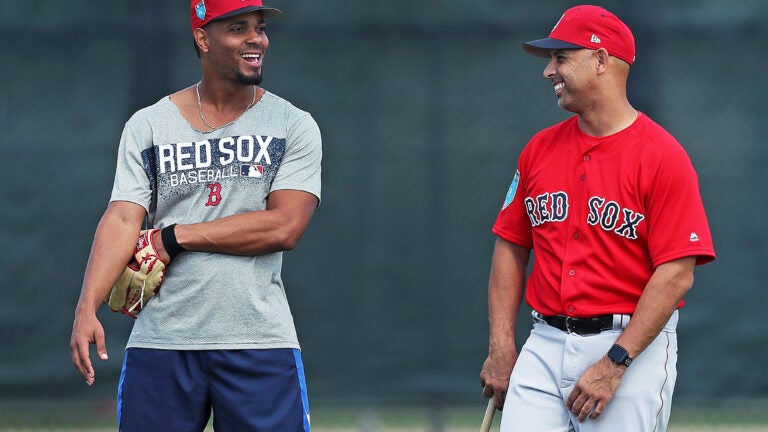
This is where playing for new manager Alex Cora should benefit him.
Cora has been preaching aggressiveness since the day he was hired. That is a savvy, modern approach. The patient approach that served the Red Sox so well a decade ago has become obsolete, with so many bullpens deep in power arms now. You can’t wait out the starter anymore. You’ve got to hit him when you have the chance.
No other player in the Red Sox lineup should benefit more from this philosophical shift than Bogaerts, who has the talent to be a force and has been one for long stretches, just not recently enough.
He’s been too patient at the plate, and that at times has tested fans’ patience with him. Here’s to mastering that newfound aggressiveness that, with good health and a little luck, should once and for all unleash all of his offensive talent.
Believe it along with me: Bogaerts’s bounceback is going to be something to behold.