Why are so many Red Sox fans eager to trade Jackie Bradley Jr.?
Top five defensive center fielders for the Red Sox in my 40 years of following them:
5. Otis Nixon: An all-timer at turning potential home runs into outs, he’d be higher if my man played in Boston more than one year (1994). Honorable mention: The Noodle-Arm Triplets, in order of capability. Coco Crisp, Jacoby Ellsbury, Johnny Damon.
4. Darren Lewis: Steady rather than spectacular for Jimy Williams’s late-‘90s squads, he and backup Damon Buford were a constant friend to Red Sox pitchers.
3. Ellis Burks: A Gold Glove winner in 1990, he gets bonus credits for having to dodge guided missile left fielder Mike Greenwell any time a ball was hit to left-center.
2. Fred Lynn: As graceful as an outfielder can be. Anyone who called him Fragile Freddy conveniently forgot how often he careened off the wall with no regard for his body after making another crazy catch.
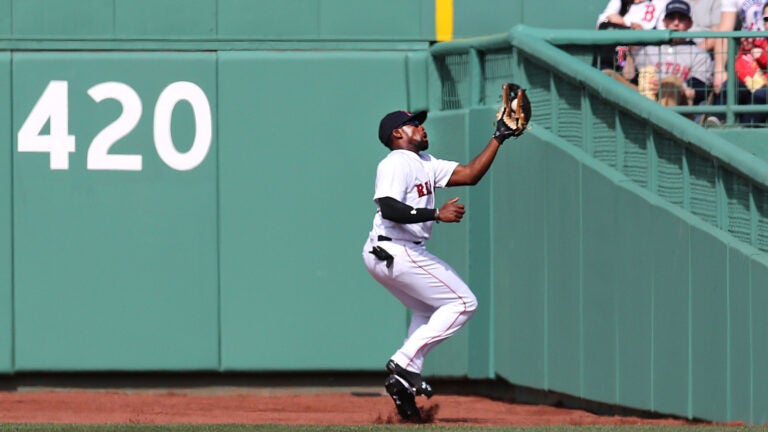
1. Jackie Bradley Jr.: OK, so this is the purpose of this exercise today: To discuss JBJ and try to comprehend why Red Sox fans don’t seem to properly appreciate how he helps them win even when his bat has gone cold.
Let’s start with this truth: Bradley is the best Red Sox center fielder I’ve ever seen, and as much as I appreciate Lynn and Burks in particular as favorites of my distant youth, it’s not close. It’s only slightly hyperbolic to say the gap between JBJ and everyone else on this list is as wide as the gap between Lynn and the 40th-best center fielder in this span, which is probably Wrong-Way Dwayne Hosey if you needed a name there.
I’m more bewildered than John Farrell during an interleague game that so many Red Sox fans seem eager to move on from Bradley this offseason for some undefined “power-hitting first baseman’’ or another. Sure, Bradley can be an exasperating hitter because he is so prone to streaks, with the valleys being especially deep. Check out his month-by-month OPS since the beginning of the ’15 season:
2016
March/April: .808; May: 1.175; June: .805; July: .839; August: .651; September/October: .731.
2017
March/April: .576; May: .808; June: 1.009; July: .576; August: .770; September/October: .517.
Bradley has had his moments as a hitter, some of them prolonged. Over the past two seasons he’s averaged 22 homers and 75 RBIs, with a .257 average and 105 adjusted OPS, which means he’s five percent better than a league-average batter.
But because he is so inconsistent from one month to the next, if not one game to the next, it’s easy to overlook his overall contributions from the bottom of the lineup. The lows play a trick. They make it seem like the highs never happen.
What should not be overlooked by those who pay attention to the team on a daily basis is the value of his defense. Aesthetically, Bradley is as good as it gets defensively. His range allows him to make tough catches look routine and seemingly impossible catches possible.
Jackie Bradley Jr. made a catch on the warning track on a long fly ball on Opening Day, 2017.His defense is one of the daily joys of following this team over the long season, right up there with Chris Sale when he has the whole repertoire working or when Mookie Betts is putting on a spectacular one-man show with his bat and his glove. (This happens often in Baltimore.)
A reminder should be required that the two-out catch charging full speed toward the triangle with runners on second and third has the same value as hitting a two-run triple himself. It’s a zero-sum game. Two runs saved is equal to two runs driven in.
Bradley provided 10 defensive runs saved this season per Fangraphs, third among all American League center fielders and seventh among all AL players overall. Angels shortstop and defensive marvel Andrelton Simmons was first (32), while some dude named Mookie was second (31).
You could turn those 10 runs saved into five two-run homers and Bradley’s statistics would look better. His performance might be perceived as better. But the value? That’s the same. To look at it another way, Bradley was worth 1.3 Wins Above Replacement solely on defense in 2017. That’s more value strictly for his glove than Christian Vazquez provided overall, and nearly as much as Dustin Pedroia and Mitch Moreland.
This is not to suggest Bradley is untradeable. He’s a little older than many fans realize (28), and he’s going to start getting paid soon. But the notion to trade him in a package for a very good hitter who is not quite an elite player at his position, such as the White Sox’ Jose Abreu, seems to be one that would get consensus approval from the Fenway faithful.
That surprises me. I like to believe Red Sox fans are generally informed and nuanced in their opinions. They like to believe it too. To fail to recognize Bradley’s contributions suggests that perception may require some reevaluation. After all, they’re the ones who have the good fortune of watching Bradley, the best center field glove the Red Sox have had in at least four decades, work his magic every day. And yet it seems too many haven’t opened their eyes enough to see it.