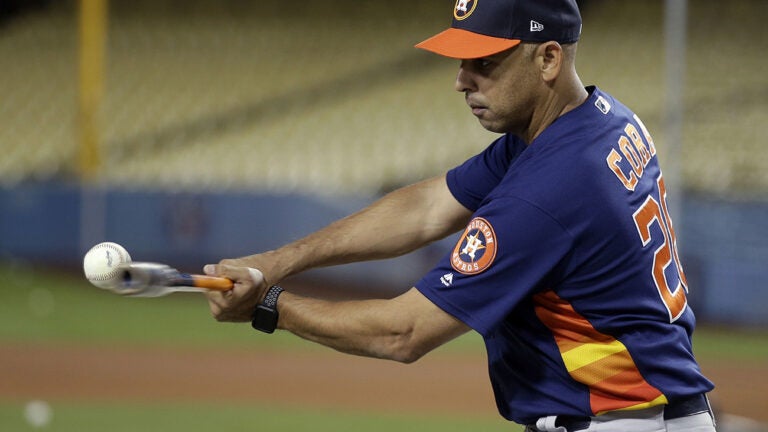
Alex Cora’s varied roles in the game will serve him well here
COMMENTARY
So here’s what we know about Alex Cora as a major league manager: Nothing. His slate is as blank as the Red Sox’ won-lost record will be come the morning of March 29, when they open the season at Tampa Bay.
He has spent one season as bench coach with the Houston Astros, managed the mighty Criollos de Caguas in the Puerto Rican Winter League from 2014-16 . . . and that is about it for his dugout experience, unless you think he gained some knowledge through osmosis by sitting next to so many managers during a 14-year playing career spent mostly as a utility player.
Cora is a relative novice, the most inexperienced Red Sox manager since Butch Hobson replaced Joe Morgan in 1992. Let’s hope this is the only time we draw a parallel to Hobson, a beloved player in the late 1970s who burned most of his stockpile of goodwill during his hapless three-year stint managing a Red Sox team that never finished higher than fourth.
Perhaps Cora’s lack of seasoning as a manager is a concern in some outposts of Red Sox Nation. I can understand that. After all, you don’t really know what you have in a manager until a dossier of evidence is built up over time on his approach and tactics.
Even Hobson was celebrated when he was hired, with general manager Lou Gorman saying they promoted him from Pawtucket to Boston because other organizations coveted him. And experienced managers can disprove a preconceived perception when circumstances change.
Remember when Terry Francona was just a Phillies retread who arrived in Boston with a career record that was 78 games below .500? He’s 214 games above .500 now.
Right now, we have no guarantees where Cora will fall on the Francona-Hobson Scale of Managerial Competence. But we can make educated assumptions based on who we know him to be from his four-year playing career (2005-08) with the Red Sox and what those who have worked with him say about the man.
And those educated assumptions lead to confidence that in Cora, the Red Sox have hired the right manager at the right time.
Honestly, I couldn’t even feign concern about this decision if I drew the “pretend you’re worried’’ straw on some generic hot-take sports debate show. Why? Let me ask you this: What do we know about him?
Answer: He’s an expert communicator who understands the Boston market and mind-set. More important, we know he has a knack for helping younger players thrive; we saw this first-hand when he was a player and Dustin Pedroia was breaking through. It’s something Astros manager A.J. Hinch talked about during the Red Sox-Astros Division Series.
“His first year of coaching has gone well given his ability to connect with players and given his baseball intellect,’’ Hinch said. “He’s very sharp, sees the game in an extraordinarily deep way, has really connected well with players in our clubhouse, and spent a lot of time developing relationships and being the bench coach liaison to the clubhouse that I asked him to be.’’
We also know Cora is arriving from the most analytically advanced organization in baseball in the Astros, so he’s going to desire and know how to utilize reams of data. Yet he’s also an ex-player who has seen the game from various perspectives — a college star at Miami, a touted prospect, a regular (he played at least 134 games three times for the Dodgers from 2001-04), a utility player, and a journeyman.
I always thought the I’ve-been-through-it-myself relatability to virtually any experience in baseball is what made Francona so adept at handling diverse personalities. Cora seems to be the same way. He may never have been a superstar, but he knew how to connect with one; he was one of the few Red Sox players to get through to Manny Ramirez when the worst of his personality would come out.
Part of the reason I believe Cora is going to be a great success is because of whom he is following. Farrell is the most maligned successful manager the Red Sox have had in my lifetime, though I’ll hear arguments on miserable John McNamara and Don Zimmer, who was so helplessly old-school he probably wrote out the lineup card on slate.
Even if Cora has tactical hiccups on occasion, well, so did his predecessor. Early on, he’s going to get leeway from the fans because of who he is not.
And chances are certain aspects of the ball club will improve, based in part on Cora’s personality, but also because it’s tough for some of them to get worse. The Red Sox ran the bases last year as if they were trying to create bloopers for their own YouTube channel.
It’s highly unlikely that their collection of established young players will uniformly regress again under the optimistic and youthful 42-year-old Cora as they did under the distant Farrell.
I do wonder how he will handle the pitching staff. Farrell and pitching coach Carl Willis got the best out a bullpen that was presumed to be a weakness but turned out to be a strength. Hiring an experienced pitching coach — former Red Sox pitcher Mike Maddux is an intriguing name — would seem to serve Cora well.
But before he even begins, it’s easy to foresee how Cora will serve the Red Sox well. He’s not experienced as a manager, but he’s had an array of experiences that have led to him becoming a manager. He’s going to be good at this. And even if he isn’t right away, chances are he’ll still be better than the last guy.