Nine Innings: For Red Sox, it was lose-trounced-repeat in Houston
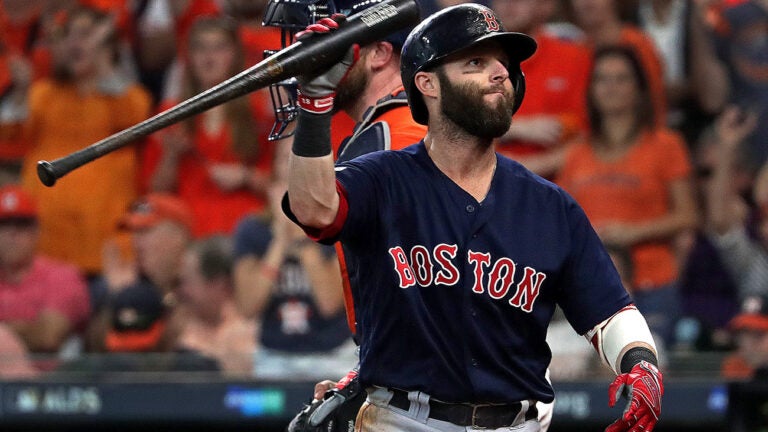
Playing nine innings (Game 2 edition) while wondering if we’ll ever see the Win-Dance-Repeat celebration by the Red Sox outfielders in the postseason . . .
1. Well, isn’t this bleak? The Astros were the superior team entering the Division Series matchup with the Red Sox, and through the first two games, they’ve done nothing but prove it again and again. The Astros outscored the Red Sox, 16-4, in the two games in Houston, capped with Friday afternoon’s 8-2 throttling of Drew Pomeranz. Viscerally, it feels more like it has been a collective 80-4 score. The Astros have been a juggernaut. The Red Sox have been a hapless pack of can-nots. Houston had two home runs in the first inning of Game 1. The Red Sox haven’t hit one in the series yet. Watching this series unfold reminds me of the A’s sweeps of the Red Sox in ’88 and ’90, or the Indians’ throttling them in different decades (1995, 2016), when the Red Sox were outclassed on paper and on the field. The Astros are better. We knew that. And they’ve been awfully vicious in proving it.
2. The Red Sox bats have been silent. Manager John Farrell has put together his usual what-is-he-doing potpourri of curious decisions. But the most frustrating development during this series is the underperformance of the starting pitching. This actually is a recurrence of the rotation’s collectively lousy performance against the Indians last year. The Red Sox have lost all five of their games over the two postseasons. In both series, their Games 1 and 2 starters bombed, allowing a total of nine homers and 21 runs in 14⅔ innings over four starts. Pomeranz bumbled to a 2-inning, 5-hit, 4-run stinker Friday, meaning the best start the Red Sox have received in the playoffs over the past two years was Chris Sale’s 5-inning, 9-hit, 7-run gem in the opener. The Red Sox have had their share of big-game pitchers in the last 20 years: Pedro Martinez, Curt Schilling, Derek Lowe, Josh Beckett, and Jon Lester. I’m not sure there are any in their rotation right now.
3. David Price was superb in relief of Carson Smith directly and Pomeranz indirectly, throwing 38 pitches in 2⅔ innings of scoreless pitching. In the third, like an old-school stopper, he pitched out of a one-out, bases-loaded jam of Smith’s doing, getting a pair of popups. Of course, appropriate to how this series is going, there’s a downside to even the positive developments. Price’s workload in Friday’s losing cause may affect his availability Sunday, when the season hangs in the balance. The idea was for Price to be the guy who came in to get some key outs ahead of Craig Kimbrel, much the way Andrew Miller did the dirty work for Cody Allen with the Indians last year. But instead of using him to help save victories, they’ve needed him just to save face.
4. I’m still a Xander Bogaerts believer. He’s been a productive player at a premium position, and he just turned 25 on the first of the month. I hope he doesn’t get traded in a package for a slugger such as Giancarlo Stanton in the offseason. But watching Correa rule in this series while Bogaerts (still hitless) falters is a stark reminder of his slippage to the second tier of excellent young shortstops in the American League. He’s been surpassed — and by a wide margin, frankly — by Correa, who set the game’s tone with a homer in the first inning, and Francisco Lindor, the heart of a championship-caliber Indians team. He’s not even in the class of Astros third baseman Alex Bregman, a natural shortstop who moved to his right because of Correa.
5. This series is confirming and emphasizing flaws with the Red Sox that have plagued them all year. They have to scramble for every hard-earned run, as you would expect from a lineup that was last in the AL in home runs. Conversely and enviably, the Astros seem to hit a home run every other inning in which Correa, Jose Altuve, or George Springer comes to the plate. The Houston lineup is reminiscent of the run-scoring machines the Red Sox used to feature in the David Ortiz/Manny Ramirez heyday. The Red Sox must get a power bat in the offseason, and Astros discard J.D. Martinez, who had a monster free-agent year with the Tigers and Diamondbacks, should be the first consideration.
6. It’s a drag to see Mookie Betts, one of the most appealing players in the AL, struggle so much. Perhaps he has been affected adversely by injury; he exited Game 2 late with a wrist problem. But the reality is that ineffective postseason performances are becoming habit. He has three hits in eight at-bats in this series, but they’re all meaningless singles. He hit .200 in the ALDS against the Indians last season, and he does not have an RBI — let alone a home run — in his postseason career. In Game 2, he made a rare miscue in the outfield, the ball slipping from his hand as he tried to throw it after recording the second out of the sixth inning. The blunder cost the Red Sox a run when Marwin Gonzalez scored from third. I haven’t seen that kind of mistake from a Red Sox outfielder since Mike Greenwell was a one-man blooper reel in the early ’90s. The defensive mistake was so uncharacteristic of Betts. But the underwhelming performance at the plate in October is, sadly, starting to become too familiar.
7. Any positive takeaways? The Geico commercial with Skeletor was pretty good. Hadn’t seen that one before. He outwitted He-Man! Anything else? Hmm, I was pleasantly surprised by FS1’s broadcast team of Joe Davis, David Cone, and A.J. Pierzynski, meaning I thought they’d be a mish-mash of mediocrity and they were actually a good listen. Davis was Vin Scully’s successor on Dodgers television broadcasts this year, and you can understand how he got the gig. He sounds the part of big-game baseball play-by-play voice. Pierzynski was one of the most annoying Red Sox players of this generation, but he’s an engaging analyst who had a good rapport with Cone about approaches to pitching in particular.
8. If you told me Angel Hernandez decides whether a pitch is a ball or a strike before it leaves the pitcher’s hand, I’d say, “Ah, now his strike zone make sense.’’ Not that his abstract approach to umpiring had anything to do with the loss. Dallas Keuchel did get a couple of calls on pitches clearly off the plate — maybe he reminded Hernandez of Tom Glavine — but let’s admit it: He would have kept this flailing, powerless Red Sox lineup at bay even if Hernandez told him he had to throw four strikes per batter rather than three.
9. And so all that stands between the Red Sox and the offseason is Doug Fister, a journeyman righthander who is 17-22 with a 4.72 ERA over the past two seasons with the Astros and Red Sox, and who ended up here only because he was waived by the Angels, and after a pleasantly effective stretch in August, he had a 9.18 ERA over his last four starts. Maybe he’ll be Pete Schourek ’98, a marginal pitcher who pitches well in a crucial game, but it certainly looks like the sun sets on the Red Sox season Sunday. And then it will be time to talk about John Farrell.